The World Holds Its Breath
It began in the predawn hours of February 28, 2026. American B-2 stealth bombers and Israeli F-35s tore through the skies above Tehran, and within hours, one of the most consequential military operations of the 21st century was underway. The target was not just a nuclear facility or a missile depot — it was the Iranian regime itself. Supreme Leader Ali Khamenei was killed. Senior commanders were assassinated. The Islamic Republic, one of the most enduring authoritarian regimes of the modern era, was decapitated in a single night.
The world woke up to a new and deeply uncertain reality. Oil prices spiked past $100 a barrel within 24 hours. Airports across the Middle East went dark. Thousands of missiles and drones streaked across the sky toward Israel, US military bases, and the Gulf Arab states that had quietly allowed American forces to stage operations from their soil. In a matter of days, Kuwait, Bahrain, Qatar, Saudi Arabia, the UAE, Jordan, and Iraq were all hit by Iranian counterstrikes.
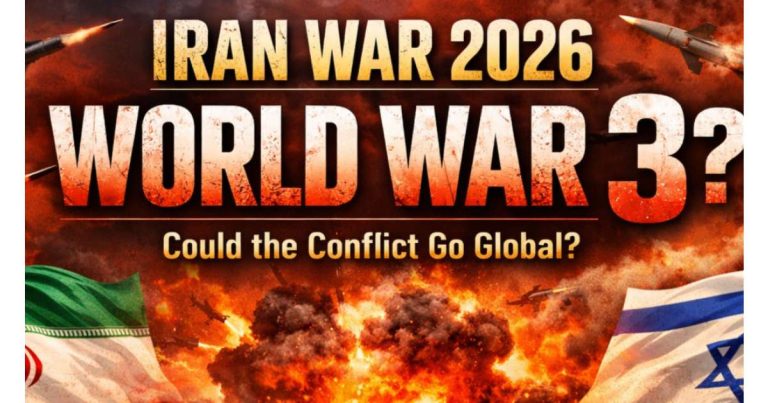
Now, ten days into what the Pentagon has codenamed “Operation Epic Fury,” the world faces a question that haunts every living generation but has never felt quite this close: Are we watching the opening salvos of World War 3?
The answer, like all things in geopolitics, is not simple. But it demands to be examined — honestly, soberly, and without flinching.
How Did We Get Here? The Road to February 28
To understand this war, you have to understand the years of tension that built toward it. Iran’s nuclear program had been a festering wound in international relations for decades. The Joint Comprehensive Plan of Action — the landmark 2015 nuclear deal — fell apart. Subsequent rounds of negotiations in 2025 and early 2026 came agonizingly close to a new agreement, only to collapse.
Iran had been weakened on multiple fronts. A 12-day war with Israel in June 2025 degraded its air defenses and set back its nuclear infrastructure. Its regional proxy network — Hezbollah, Hamas, and other armed factions — had been battered by years of Israeli military campaigns. Internally, the country was convulsing. Beginning in late December 2025, the largest protests since the 1979 Islamic Revolution erupted across Iranian cities, driven by a collapsing currency, crippling inflation, and a population that had simply had enough.
The Iranian regime responded to the protests with brutal force, killing thousands. The images of dead protesters flooded social media. US President Donald Trump urged Iranians to keep demonstrating, hinting that “help is on its way.”
By February 2026, the United States had amassed its largest military buildup in the Middle East since the 2003 Iraq War. Carrier groups, submarines, and long-range bombers were in position. Trump, at the State of the Union, accused Iran of secretly restarting its nuclear weapons program. Days later, on February 28 — just days after Iran’s foreign minister called a diplomatic agreement “within reach” — the bombs fell.
The Opening Shockwave: What Has Happened So Far
The scope of the conflict has already exceeded most worst-case projections. Iran, despite years of sanctions and the losses it sustained in previous conflicts, unleashed a ferocious missile and drone response across the entire region. Dubai International Airport — one of the world’s busiest — was damaged by drone strikes and temporarily shut down. Shipping through the Strait of Hormuz, through which roughly 20% of the world’s oil passes, came to a near standstill.
Iran has named a new supreme leader: Mojtaba Khamenei, the son of the assassinated leader. His appointment has been met with pledges of allegiance from Iran’s military and political establishment, signaling that the regime has no intention of surrendering.
The human cost is already devastating. Over a thousand people have been killed. Eight American service members have lost their lives. An Iranian attack on a US warship off the coast of Sri Lanka killed over 100 Iranian sailors. Tens of thousands of foreign nationals have fled the region. The US State Department ordered all non-emergency government personnel and their families out of Saudi Arabia. By March 8, more than 32,000 Americans had been evacuated from the wider Middle East.
“This is not your war,” Oman’s foreign minister told Washington — hours after he had expressed optimism that diplomacy was within reach.
The World War 3 Question: Real Risk or Overblown Fear?
Every major regional conflict of the past century has prompted the same terrifying question. But the 2026 Iran war carries several distinct features that make it genuinely different — and genuinely more dangerous.
First, for the first time since the Cold War, we have a hot war directly involving a nation that sits at the center of a competing great-power axis. Iran is not just a regional power fighting a regional fight. It is deeply embedded in a strategic partnership with both Russia and China. In late 2025, Iran finalized a 20-year comprehensive strategic partnership with Russia and accelerated its 25-year cooperation program with China. Both countries have provided Iran with advanced military technology, including S-400 air defense systems and satellite navigation tools.
Second, this conflict has already brushed against NATO’s borders. Iranian missiles were intercepted heading toward Turkey — a NATO member. Debris fell in Turkish territory. Turkey has deployed F-16 fighters to Northern Cyprus. A British RAF base in Cyprus was struck by an Iranian drone. The United Kingdom is now legally and militarily involved, having allowed the US to use bases at Diego Garcia and RAF Fairford for strikes on Iran.
Third, oil — the lifeblood of the global economy — is already being weaponized. With prices surging past $100 a barrel and briefly touching $120, the G7 has held emergency meetings. The Strait of Hormuz, which Iran controls on its northern shore, has been threatened with closure. If that waterway shuts completely, the global economy faces consequences that would make 2008 look mild.
Russia and China: Watching, Waiting — and Calculating
Russia condemned the strikes as a “preplanned and unprovoked act of armed aggression.” China’s foreign minister said the war “should never have happened.” But strong words at the United Nations are a long way from military action.
The consensus among analysts is that neither Russia nor China will intervene militarily — at least not yet. Russia is still deeply entangled in Ukraine, its military stretched and its economy battered by sanctions. China has far more to lose from a direct confrontation with the United States than it stands to gain from defending Iran. Beijing has quietly evacuated its citizens from Iran while urging de-escalation. As one analyst put it bluntly: “China is a fair-weather friend — long on words, short on risk.”
And yet, the calculus is shifting. Russia and China have transitioned from being Iran’s diplomatic allies to its “technological anchors.” They have supplied advanced weapons systems, satellite technology, and the financial architecture Iran needs to survive under sanctions. An Iranian collapse would hand the United States and Israel effective dominance over the Middle East — a strategic nightmare for Moscow and Beijing. As one geopolitical assessment put it, “neither can afford to let Tehran fall.”
The real danger is not a sudden Russian nuclear strike or a Chinese invasion. It is a slow, grinding escalation in which Moscow and Beijing are forced — by reputation, by economic interest, by alliance commitment — to bridge the gap between enabling Iranian resistance and actively safeguarding it. That bridge, once crossed, leads somewhere no one should want to go.
Former NATO Deputy Supreme Allied Commander Richard Shirreff has warned that future historians may look back at this conflict as “the final catalyst for a third world war,” saying he “cannot remember a more perilous moment in geopolitics” in his lifetime.
The Taiwan Wildcard: A Two-Front Nightmare
Perhaps the most alarming scenario being discussed in defense and intelligence circles is not what happens in the Middle East — but what happens in the Pacific if the United States becomes consumed by a ground war in Iran.
If American military resources, attention, and political will are locked in the Persian Gulf for months or years, China may calculate that the window for a decisive move on Taiwan is narrowing. An administration focused on regime change in Tehran, managing a restive domestic public, and keeping oil prices from destroying the economy may simply be too distracted to react in time if Beijing chose to make its move.
This nightmare scenario — a two-front war stretching the United States from the Persian Gulf to the Taiwan Strait — is not being dismissed by serious military planners. The US and South Korean militaries are already in discussions about redeploying Patriot missile batteries from South Korea to the Iranian theater, a move that would thin American defenses precisely where they may be needed most.
Voices From the Ground: This Is Not an Abstract Debate
It is easy, sitting far from the explosions, to treat this as an intellectual exercise. It is not. In Dubai, families who came for a holiday found themselves sheltering from drone strikes. In Bahrain, sirens woke residents at 3am. In Saudi Arabia, a Bangladeshi worker was killed by shrapnel in a city he had traveled to for a better life. In Tehran, civilians are dying in strikes intended for military targets. In Israel, survivors of Iranian missile hits are trying to explain to their children why the sky sometimes falls.
Across the Middle East, the ordinary rhythms of life — work, school, trade, worship — have been shattered. Flight cancellations have stranded hundreds of thousands of people. Shipping disruptions are causing supply shortages across a region that imports much of its food. The Houthis in Yemen, sensing an opportunity, are signaling they may re-enter the fray, threatening to open yet another front in an already multi-theater conflict.
This is what war actually looks like. Not the clean graphics of military briefings. Real people. Real fear. Real loss.
So — Is World War 3 Actually Coming?
The honest answer is: not yet. But the conditions for catastrophic escalation have rarely been so present, so combustible, so difficult to contain.
World War 3, if it comes, will not look like World War 1 or 2. It will not be declared. It will not start on a single day. It will be a process — a series of miscalculations, provocations, and retaliations that gradually pull in powers that each, individually, believed they could stay out. It will be fought with drones and missiles and cyberattacks and economic warfare and proxy armies, and perhaps — at some terrible, final moment — with something much worse.
The factors pushing toward wider conflict include: Iran’s determination to fight rather than surrender; Russia and China’s inability to simply abandon a strategic partner without losing credibility; the Houthis and Hezbollah waiting for a moment to act; NATO’s entanglement through Turkey and UK bases; and an oil market on the edge of panic.
The factors pushing against it include: China’s enormous economic stake in a stable global trading system; Russia’s military overextension in Ukraine; Iran’s weakened conventional capabilities after years of conflict; and a US administration that, for all its aggressive posture, has expressed a desire to see the conflict end “very soon.”
The margin between those two sets of forces is thin. Dangerously thin.
A Moment That Demands Honesty
There is a temptation, in moments of great danger, to either catastrophize or to minimize. To either scream that the apocalypse is here, or to dismiss the alarmists and say everything will be fine. Neither is honest.
What is honest is this: the 2026 Iran War is the most serious geopolitical crisis of this century so far. It has already killed thousands of people, disrupted the global economy, and drawn in powers from three continents. It sits at the intersection of nuclear anxiety, great-power competition, energy security, and generational grievances that run impossibly deep.
It is not inevitable that this becomes World War 3. History is not predetermined. Diplomacy, restraint, and the basic human instinct for self-preservation have pulled the world back from the brink before. They may do so again.
But they will only work if the people with their hands on the levers of power — and the people who elected them, or who live under them — understand what is genuinely at stake. Not as a political game. Not as a chance to score points or prove strength. But as a shared human reckoning with what war, in the modern age, actually means.
The world is not yet at war with itself. But it is closer than it has been in a very long time. And every decision made in the days and weeks ahead will either widen the distance from that edge.
Sources: Wikipedia, Britannica, Al Jazeera, CNBC, CNN, Axios, Chatham House, UK House of Commons Library, The Week, Special Eurasia

Your comment will appear immediately after submission.