Think of putting up a blog post which you have researched thoroughly and written. You click the publish button, put it out once on social media, and wait. One day goes by. Then another. The post gains very few views.
This happens to many bloggers and website owners. The problem often is not the content itself but the lack of visitors.
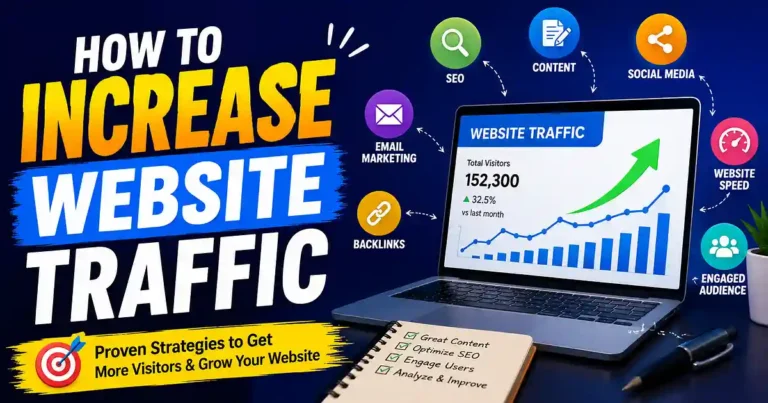
It is not about taking shortcuts or hoping for a stroke of luck when trying to increase website traffic. It is about creating a system which consistently brings visitors using search engines, social media, email marketing, and valuable content.
The good news is that traffic generation can be done gradually. No matter if you own a blog, an online shop, or a corporate website, this guide will help you develop a traffic-generating strategy without using paid marketing only.
Table of Contents
- Why Website Traffic Matters
- Understand Your Target Audience
- Focus on SEO Before Anything Else
- Create Content People Actually Search For
- Publish High-Quality Content Consistently
- Optimize Every Page for Search Engines
- Build Topic Clusters Instead of Random Articles
- Use Social Media Effectively
- Build an Email List
- Improve Website Speed
- Earn Quality Backlinks
- Refresh Old Content
- Track Performance with Analytics
- Practical Examples
- Common Mistakes to Avoid
- FAQs
- Conclusion
Why Website Traffic Matters
The number of people visiting your website is not only a metric recorded on Google Analytics. Every one of them is a prospective reader, subscriber, buyer, or client.
Higher quality traffic may assist you with:
• Generating income through advertising;
• Earning affiliate commissions;
• Promoting your goods and/or services;
• Creating authority;
• Expanding your email subscriber base;
• Getting better search engine rankings over time.
Nevertheless, not all types of traffic are equally useful. A thousand visitors that leave your website instantly is much less useful than a hundred people that stay for a while and read your content.
This is why your aim is always to get qualified traffic.
Focus on Understanding Your Audience
Before attempting to generate traffic, start with a single question:
Who is your audience?
The majority of websites face issues because they write content not on what their visitors need but on what they would like to write.
Examples:
A finance blog intended for newcomers requires content about budgeting, saving and investments written in easy-to-understand language.
While a highly skilled investing audience might require comparisons, analysis and market-related information.
Determining your audience makes it possible to select:
• Keywords
• Topics
• Writing Style
• Examples
• Calls to Action
Every good traffic strategy begins with knowing the search intent.
Focus on SEO Before Anything Else
If you were to ask for ways to drive more website traffic, then SEO would be the most efficient answer in the long run.
As opposed to paid marketing, SEO can keep working for months or even years after your post goes live.
Effective SEO entails the following elements:
• Keyword research
• Utility of the content
• Internal links
• Page loading speed
• Responsive design
• SEO technicalities
Instead of trying to “beat Google’s algorithm,” you should aim to provide better answers than others through your pages.
Start with Keyword Research
Keyword research helps to learn the exact search terms that people use.
Instead of guessing on your own about the content of your articles, you can conduct keyword research to learn:
• Search volume
• Competitive value
• Related search terms
• Long-tail keywords
For example, instead of using general keywords like:
SEO
You can use:
• Drive traffic to your website as a beginner
• Drive traffic for free
• SEO for small business
• Get more visitors to your blog
Long-tail keywords are easy to rank and have a good chance of bringing visitors.
Create Content People Actually Want
One of the biggest reasons websites struggle is publishing content that nobody searches for.
Every article should solve a real problem.
Instead of writing:
- Company updates
- Generic opinion pieces
- Rewritten news
Focus on:
- Tutorials
- Step-by-step guides
- Product comparisons
- Case studies
- Frequently asked questions
- Beginner-friendly explanations
Think of every article as answering one important question completely.
If readers leave your page feeling that they don’t need another article, you’ve done your job well.
Publish High-Quality Content Consistently
Of course, one good article per week will always be much better than average articles every day.
The advantages of regularity are:
• Trust from your reader
• Good SEO score
• Relevance
• The larger number of indexed pages
The possible schedule will be as follows:
• One good article per week
• One updating article per month
• One support article posted after two days if possible
Keep in mind that quality always goes before quantity.
Optimize Every Page for Search Engines
Learning how to increase website traffic also means making it easy for search engines to understand your pages.
Basic on-page SEO includes:
Write Better Titles
Your title should:
- Include your primary keyword
- Create curiosity
- Promise clear value
Example:
How to Increase Website Traffic: 15 Proven Strategies That Actually Work.
Use Proper Heading Structure
Use proper headings by using:
• H1
• H2
• H3
Proper headings make things easier for readers and search engines to understand.
Create a Great Meta Description
Good meta description increases the click-through rate.
Instead of keyword stuffing, give a reason to click your link.
Include Internal Linking
Each article must include internal linking to other pages on your website.
For instance, this page can link to:
• SEO For Beginners
• Best Keyword Research Tools
• How To Start Blogging
• Content Marketing Guide
Build Topic Clusters Instead of Random Articles
Bloggers tend to have separate posts without any links among them. The best method would be making content clusters.
For instance, if your primary topic is Website Traffic, then the supporting posts can be:
• Keyword Research Guide
• On-Page SEO Checklist
• Free SEO Tools to Use
• Technical SEO Guide
• Content Marketing Tactics
• Basic Link Building Techniques
• How to Make Your Website Faster
The common thread that ties all these articles together will be the main post titled “How to Boost Website Traffic”.
Use Social Media Strategically
A common practice by many website owners is posting an article to social media once and hoping that it catches on. The truth is that it is unlikely for many people to see it.
Instead of posting only one, create various formats of the same piece of content for various platforms.
For instance, if you have created a guide on budgeting, you can post:
• Tip on X (Twitter)
• Carousel on LinkedIn
• Infographic on Pinterest
• Videos on Instagram Reels
• Question on Facebook
This way, each platform reaches a unique audience while directing people to your website.
Tip: Avoid only posting links. Offer some value first before sending your readers to your website.
Build an Email List
It is true that the rankings of the search engines can be influenced, but there is instability in the algorithms used in social media. However, once you have an email list, you can be assured of reaching out to your audience whenever you produce content.
Offer something of value for the email addresses such as:
• A free checklist
• An eBook
• Budgeting Template
• Printer Friendly Planner
• SEO Checklist
Keep updating them via newsletters with your latest works. You will find that your email list comprises your most loyal readers.
Improve Website Speed
Rapid loading is a requirement for all websites. Slower loading sites will most likely result in people leaving before they view your pages.
The procedures that will ensure your pages load faster include the following:
• Image compression
• Browser caching
• CSS and JavaScript minification
• Use of a good host
• Removal of unwanted plugins
• Use of CDN if necessary
The more rapidly your pages load, the better their experience.
Earn High-Quality Backlinks
Links that come to your website from other sites are still an important ranking signal, but quality trumps quantity in this case.
Below are some white hat ways of getting your backlinks:
• Creating your own research and datasets.
• Producing guides.
• Participating in guest blogging on legitimate websites and blogs.
• Creating useful infographics.
• Developing helpful tools and calculators.
Do not practice any black hat methods like buying links. Immediate gains often lead to heavy consequences.
Refresh Older Content Regularly
Updating old articles may be an easier task than creating entirely new ones.
Some ideas for updating old articles include:
• Supplying new statistics
• Supplanting old screen shots
• Enhancing readability
• Fluffing up thin sections
• Employing new FAQs
• Correcting broken links
• Upgrading SEO titles and meta descriptions
New and correct information makes sure that you are still up-to-date.
Monitor Your Performance
It is a never-ending process when it comes to traffic creation on websites; hence it becomes important for you to monitor the factors which work well for your website.
The following are some of the most important things that you need to monitor:
• Organic Traffic
• Click Through Rate (CTR)
• Bounce Rate
• Time on Site
• High Performers
• Keyword Performance
• Conversion Rate
This will help you understand where there is scope for improvement.
Practical Example
Let us now assume that you write a blog about personal finance, and you write a particular article called “How to Save Money Every Month.”
For making your article more visible, you can think of:
1. Optimizing your article with respect to a specific keyword.
2. Creating links to some other budgeting articles within your blog.
3. Posting the same on various social networking sites.
4. Including this article in your weekly newsletter.
5. Updating the article every six months.
These are some techniques that can increase visibility for your article.
Common Mistakes to Avoid
However, even seasoned website owners are vulnerable to certain behaviors that work against them when growing their websites. Here are some of the mistakes that website owners usually neglect:
• Posting content without checking keywords.
• Emphasis on quantity over quality.
• Ignores mobile traffic.
• Creates deceptive and sensational titles.
• Ignores the importance of internal linking.
• Does not update old posts.
• Keyword stuffing.
• Page loading time and technical aspects.
• No marketing for posted content.
Frequently Asked Questions
1. What is the fastest way to increase website traffic?
Paid advertising can deliver immediate visitors, but for long-term, sustainable growth, focus on SEO, valuable content, and consistent promotion.
2. How long does SEO take to boost traffic for a website?
SEO is a process that requires time. Most websites start noticing results between three to six months.
3. How frequently should I publish posts?
It is better to be consistent than posting too many. One post a week will be much more effective than posting several bad-quality posts a day.
4. Do I really need social networks for my site to gain popularity?
Though SEO will be enough to get you many visitors, the use of social media is necessary to extend your audience.
5. Is there any way to increase traffic for free?
Yes, of course. There are lots of methods to increase your traffic which won’t cost you anything.
Conclusion
Knowing how to generate website traffic isn’t just about learning one trick or technique that gets results right away. It is more about integrating various techniques, all of which will give you great results when combined together.
Start with making content answering questions that people have, optimizing this content for search engines, improving the website itself to make it more user-friendly, promoting your content consistently, and adding new valuable content on a regular basis. You may not get overnight results from these efforts, but it will be a good start towards growing your traffic.
Keep in mind that any successful website had its first visitors once.

Your comment will appear immediately after submission.