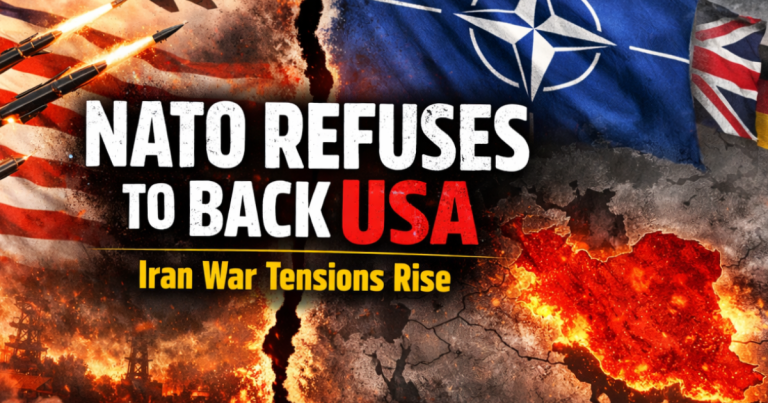
The US-Israel war on Iran has entered its third week with Washington struggling to build a coalition. Major NATO allies including the UK, Germany, France, and Italy have all turned down Trump’s requests for military support. The refusal marks the deepest crack in Western alliances in decades.
What Happened
President Trump publicly demanded NATO allies send warships to the Strait of Hormuz to support the ongoing war effort against Iran. Every major European ally rejected the call, refusing to commit troops or naval vessels to the conflict. Trump responded with fury, calling the alliance’s refusal a “very foolish mistake” and threatening its future.
Key Details
Iran’s attacks on Gulf vessels have effectively shut down the Strait of Hormuz, a chokepoint carrying one-fifth of the world’s oil supply. Since the war began on February 28, Iran has fired over 500 ballistic missiles and nearly 2,000 drones across the region. The United Nations has warned the conflict could push 45 million people into acute hunger if it continues.
Reactions
British Prime Minister Keir Starmer stated clearly that this was never envisioned as a NATO mission and that Britain would not be drawn into a wider war. Germany’s Defense Minister went further, saying bluntly that this was not Europe’s war and that they did not start it. Trump fired back on social media, declaring that the US no longer needs or desires NATO’s help — and never did.
Background
NATO is a defensive alliance whose charter only obligates members to act when one of them is attacked by an outside force. The sole time that clause was ever triggered was after the September 11, 2001 attacks on the United States. This time, it was the US and Israel that launched the strikes on Iran, giving other members no legal or political basis to intervene.
What Next / Impact
Oil prices have already risen sharply as doubts grow over whether the Strait of Hormuz will reopen anytime soon. Trump warned that NATO’s refusal will have very serious consequences for the future of the alliance going forward. With trust between Washington and its European partners badly damaged, the long-term unity of NATO now hangs in a deeply uncertain balance.
FAQ
Why did NATO countries refuse to join the US in the Iran War?
NATO allies refused because the US and Israel launched strikes on Iran without consulting them first. European nations saw no legal obligation under NATO’s charter to join a war they did not start. Many also feared being pulled into a wider regional conflict with severe economic consequences.
Is the Iran War an official NATO mission?
No. NATO is a defensive alliance that only acts when a member country is attacked. Since it was the US and Israel that launched strikes on Iran, other NATO members have no obligation to participate. British PM Keir Starmer confirmed it was never envisioned as a NATO mission.
When did the US-Iran War begin?
The war began on February 28, 2026, when the US and Israel launched coordinated military strikes across Iran. Since then, Iran has retaliated with over 500 ballistic missiles and nearly 2,000 drones fired across the wider Middle East region.
What is the Strait of Hormuz and why does it matter?
The Strait of Hormuz is a narrow but critical waterway in the Persian Gulf. Roughly one-fifth of the world’s oil supply passes through it daily. Iran’s attacks have effectively shut it down, causing global oil prices to spike sharply.
How did Trump react to NATO’s refusal?
Trump called the refusal a “very foolish mistake” and warned it would be very bad for NATO’s future. He posted on social media that the US no longer needs NATO’s help and never did. He also hinted at reconsidering America’s commitment to the alliance going forward.
Which countries are supporting the US in this conflict?
Unlike NATO allies, several Middle Eastern nations have expressed support for the US effort. Trump praised Qatar, the UAE, Saudi Arabia, and Bahrain for their backing. However, no major Western ally has committed military forces to the operation so far.
What are the humanitarian consequences of this war?
The United Nations has warned that the ongoing conflict could push 45 million people into acute hunger. The closure of the Strait of Hormuz has disrupted global oil supplies and driven up energy prices worldwide. The broader economic fallout is expected to worsen significantly if the war continues.
What happens to NATO if this rift continues?
Trump has openly threatened that NATO’s refusal will have serious long-term consequences for the alliance. The lack of consultation before the war began has severely damaged trust between Washington and European partners. Many analysts now consider the future unity and relevance of NATO deeply uncertain.
Sources
**Reuters** — *Trump slams NATO allies for refusing to join Iran war coalition* — March 20262. **BBC News** — *Starmer: Iran conflict is not a NATO mission* — March 20263. **The Guardian** — *Germany’s Pistorius: This is not our war* — March 20264. **Al Jazeera** — *Iran fires 500+ missiles since war began February 28* — March 20265. **CNN** — *Trump threatens NATO future over Strait of Hormuz refusal* — March 20266. **Associated Press (AP)** — *Oil prices surge as Strait of Hormuz remains closed* — March 20267. **United Nations** — *UN warns 45 million could face acute hunger due to Iran conflict* — March 20268. **Politico Europe** — *EU foreign ministers reject US naval coalition request* — March 20269. **The New York Times** — *NATO allies blindsided by US-Israel strikes on Iran* — March 202610. **Trump / Truth Social** — *Official statement: “We never needed NATO”* — March 2026
Your comment will appear immediately after submission.