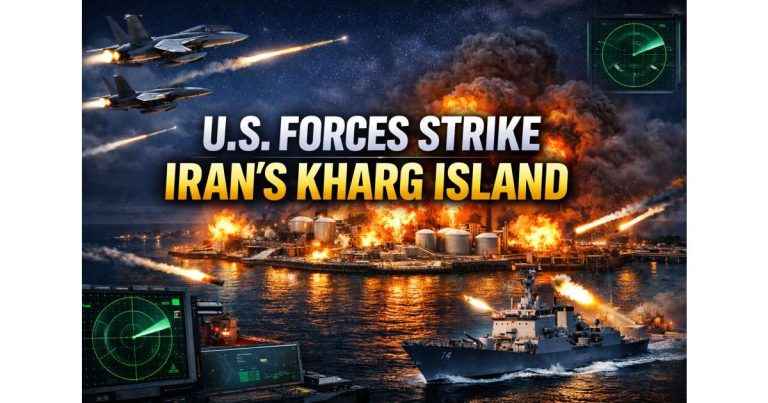
The United States military launched one of the most powerful bombing raids in modern Middle East history on Friday night, striking Iran’s Kharg Island in the Persian Gulf. President Donald Trump announced the attack on Truth Social, declaring that U.S. forces had completely destroyed every military target on the island. The strike marks a dangerous new escalation in the three-week-old war between the United States, Israel, and Iran.
What Happened
U.S. Central Command carried out a large-scale precision strike on Kharg Island, destroying over 90 Iranian military targets in a single night. The targets included naval mine storage facilities, missile storage bunkers, air defense systems, a naval base, and airport facilities. More than 15 explosions were heard on the island, with thick black smoke rising high into the sky and visible from miles away.
Oil Infrastructure Spared — For Now
Despite the scale of the attack, Iran’s oil export infrastructure on the island was deliberately left untouched by U.S. forces. Trump stated on Truth Social that he chose not to destroy the oil facilities out of decency, but issued a sharp warning to Iran. He said he would immediately reconsider that decision if Iran or anyone else continued to interfere with the free and safe passage of ships through the Strait of Hormuz.
Why Kharg Island Matters
Kharg Island is a small coral island located about 15 miles off Iran’s southern coast in the Persian Gulf. It serves as Iran’s main oil export terminal, responsible for roughly 90 percent of all Iranian crude oil exports. About 20 percent of the world’s total oil supply passes through the nearby Strait of Hormuz, making this island one of the most economically sensitive targets on earth.
Iran’s Defiant Response
Iran struck back with fierce warnings, with Foreign Minister Abbas Araghchi threatening to reduce U.S.-linked oil and energy facilities across the region to a pile of ashes. Iran also issued evacuation warnings for three major UAE ports, claiming U.S. forces had used them to launch the Kharg strikes — a claim the UAE strongly denied. Hours later, debris from an intercepted Iranian drone struck an oil facility at Fujairah port in the UAE, causing a fire.
The Human Cost
The war, which began on February 28 with a joint U.S.-Israeli assault on Iran, has taken a devastating toll on civilian life. Iran’s Ministry of Health reported that at least 1,444 people have been killed and over 18,000 injured since the conflict began. Millions of civilians have been displaced across Iran and Lebanon, while the U.S. Embassy in Baghdad urged all Americans in Iraq to leave the country immediately after a missile struck the embassy compound.
What Happens Next
The conflict is now entering its third week with no clear sign of de-escalation on either side. The U.S. is sending 2,500 additional Marines and an amphibious assault ship to the Middle East, adding to the largest American military buildup in the region in decades. With global oil prices surging past $100 a barrel and the Strait of Hormuz still partially blocked, the world watches closely to see whether diplomacy or further military strikes will define the next chapter of this war.
Your comment will appear immediately after submission.