Zainul Abedin Biography: Famous Painter of Bangladesh and His Contribution
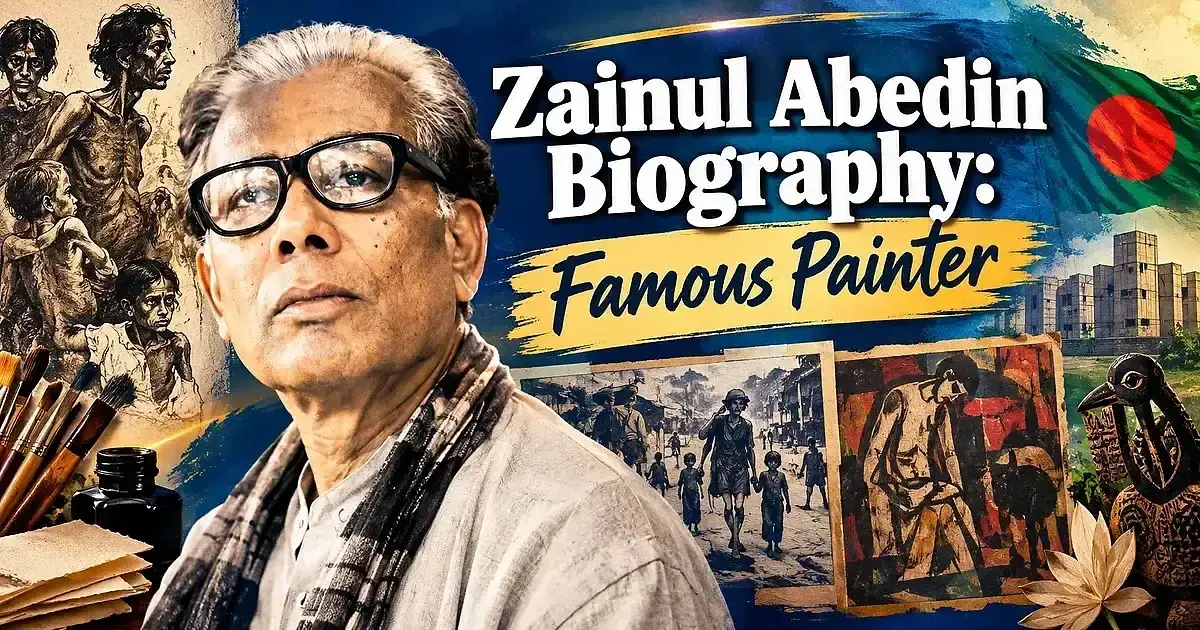
Cheap packing paper from the bazaar. Ink made by burning wood into charcoal. With those humble materials, a young artist walked the streets of Calcutta in 1943 and sketched what he saw: starving families, abandoned children, bodies on the pavement. The Great Bengal Famine was killing millions, and Zainul Abedin refused to look away. The drawings he made became some of the most powerful works of art in South Asian history. Abedin later founded Dhaka’s first art institution, trained a generation of artists, and collected folk art to save it from disappearing. Bangladesh calls him Shilpacharya, “Master Teacher of Art.” This biography follows his life, his art and his lasting legacy.
Zainul Abedin at a Glance
| Detail | Information |
|---|---|
| Full name | Zainul Abedin |
| Honorific | Shilpacharya (“Master Teacher of Art”) |
| Born | December 29, 1914 |
| Birthplace | Kendua, Kishoreganj subdivision, Mymensingh district, Bengal (now in Netrokona district, Bangladesh) |
| Died | May 28, 1976, Dhaka (aged 61) |
| Education | Government School of Art, Calcutta; later art training in London |
| Best-known works | 1943 Famine Sketches, Santal series, Naboanna (scroll painting), Sangram |
| Institutions founded | Government Institute of Arts and Crafts, Dhaka (1948); Folk Art Museum, Sonargaon (1975); Zainul Abedin Collection, Mymensingh (1975) |
| Spouse | Jahanara Abedin |
| Resting place | Beside the Dhaka University Central Mosque |
Early Life: A Boyhood on the Brahmaputra
Born in Kendua
Zainul Abedin was born on December 29, 1914, in the village of Kendua in the Kishoreganj subdivision of undivided Mymensingh district in British India. The area now lies in Netrokona district. His childhood unfolded in quiet rural Bengal.
The River That Taught Him to See
He grew up near the Brahmaputra, where boats, boatmen, farmers and village paths filled his days. These scenes became his earliest visual education, and the river kept reappearing in his paintings throughout his life.
Art Education: From Calcutta to London
Government School of Art, Calcutta
In 1933, Abedin enrolled at the Government School of Art in Calcutta, where he trained in the European academic tradition. After completing his studies, he joined the school’s faculty in 1938. During these years he sketched constantly, drawing the people of Calcutta and the Bengali countryside.
Finding His Own Voice
Although he mastered European technique, Abedin did not simply copy it. He wanted Bengal’s own landscapes, folk traditions and people at the center of his work. He later studied art in London, and he returned with a sharper commitment to forging a distinct Bengali visual language.
The 1943 Famine Sketches: Art as Witness
A Man-Made Catastrophe
In 1943, a devastating famine struck Bengal. Estimates of the death toll commonly run into the millions. Abedin walked through the streets and villages sketching starving, helpless people. The resulting series is known as the Famine Sketches.
Charcoal Ink and Packing Paper
The materials were strikingly simple. He made ink from burnt charcoal and drew on cheap packing paper. The humble tools did nothing to weaken the impact: skeletal figures, dead children and abandoned mothers appear in bold, anguished lines.
Recognition
The sketches were first exhibited in 1944 and drew strong praise from critics. They remain among the most influential works in South Asian art history, and they established Abedin as a master of social realism, an artist whose work bears witness to human suffering.
Founding Dhaka’s Art Institute
A New Country, an Empty Field
After the Partition of 1947, Abedin moved to East Bengal. At that time, Dhaka had no institution for art education. With the help of a few colleagues, he set out to change that.
The Government Institute of Arts and Crafts
In 1948, the Government Institute of Arts and Crafts was established in Dhaka, with Abedin as its first principal. It became a hub for modern art in the region and later evolved into the Faculty of Fine Arts at the University of Dhaka. He led the institution until his retirement in 1967.
Teaching a Generation
Abedin built more than a school. He trained a generation of artists who went on to anchor Bangladesh’s art scene. That is why he is called Shilpacharya, and the title was formally given to him by the institution at the time of his retirement.
The Art of Zainul Abedin
A Focus on the Common Person
Farmers, fishermen, boatmen, mothers, hungry children: Abedin’s art centers on ordinary people and their struggles. He painted hardship honestly, without sentimentality.
Folk Art Influences
Bengal’s folk art, scroll paintings and rural designs shaped his color and line. His fusion of European technique with Bengali folk tradition gave his work its distinctive character.
Bold Line and Movement
The most striking quality of his work is the power of his line. Quick, confident brushwork gives his figures, animals and boats a sense of motion.
Notable Works
The Famine Sketches (1943)
His best-known and internationally recognized work, a record of hunger, death and helplessness.
The Santal Series
This group of paintings portrays the lives and beauty of the Santal community and displays his vibrant use of color and line.
Naboanna (1969)
During the mass uprising of 1969, Abedin used Chinese ink, watercolor and wax to create Naboanna, a monumental scroll painting. It joins the harvest festival of Bengal with the spirit of the movement.
Sangram (1976)
Sangram (“Struggle”), painted in oils, is among the notable works of his final years and captures the strength of people’s resistance.
Two Faces
Two Faces is regarded as his last painting, completed shortly before his death.
Preserving Folk Heritage: Sonargaon and Mymensingh
The Folk Art Museum, Sonargaon
Abedin was a passionate collector of Bengali folk art, including crafts, pottery and embroidered quilts. In 1975, he founded the Folk Art Museum at Sonargaon in Narayanganj to preserve these traditions. It remains one of Bangladesh’s leading centers for folk heritage.
The Zainul Abedin Collection, Mymensingh
In the same year he established a gallery in Mymensingh to house his own works, known as the Zainul Abedin Collection (Zainul Abedin Sangrahashala).
Honors and Recognition
- An honorary Doctor of Letters from the University of Delhi (1974)
- Appointment as National Professor after independence and honorary presidency of the Bangla Academy
- The Independence Day Award, posthumously, in 1977
- A special award from the Bangladesh Shilpakala Academy in 1998, marking fifty years of the fine arts movement
- A crater on Mercury named “Abedin” (2009)
- A Google Doodle in 2019 on his 105th birth anniversary
Personal Life and Final Days
Abedin’s wife was Jahanara Abedin. In his last years he suffered from lung cancer. He died in Dhaka on May 28, 1976, at the age of 61, and was buried beside the Dhaka University Central Mosque.
Legacy: The Master Who Still Teaches
A Foundation for Art Education
The Faculty of Fine Arts at the University of Dhaka, which began under Abedin, remains the nation’s main center of art education. Generation after generation of artists has emerged from it.
Collections Around the World
Abedin’s works are held in the National Museum of Bangladesh, the Bangladesh Shilpakala Academy’s National Art Gallery, the Zainul Abedin Collection in Mymensingh and the Folk Art Museum in Sonargaon. Works are also found in collections elsewhere in the region, such as in Kolkata and Lahore.
Remembering Him Every Year
His birth anniversary on December 29 is observed annually. The Faculty of Fine Arts and the Bangladesh Folk and Crafts Foundation have organized a multi-day “Zainul Utsab” in his memory.
Conclusion
Zainul Abedin showed that art can be an act of witness and of courage. His charcoal-and-packing-paper sketches of the 1943 famine remain among the most honest records of human suffering ever drawn in South Asia. He also built an institution, trained a generation and rescued folk heritage from neglect. For all of this, he remains the master teacher of Bengali art, a title he earned by example.
Frequently Asked Questions
Who was Zainul Abedin?
Zainul Abedin was a leading painter of Bangladesh, regarded as the founder of modern Bangladeshi art. He is internationally known for his 1943 Famine Sketches. He founded the Government Institute of Arts and Crafts in Dhaka and is honored with the title Shilpacharya.
When and where was Zainul Abedin born?
He was born on December 29, 1914, in the village of Kendua in the Kishoreganj subdivision of undivided Mymensingh district, British India. The area is now part of Netrokona district in Bangladesh. He grew up on the banks of the Brahmaputra.
Why is Zainul Abedin called Shilpacharya?
Shilpacharya means Master Teacher of Art. He earned the title by founding Dhaka’s art institute and training a generation of Bangladeshi artists. The institution conferred this honorific on him when he retired in 1967.
Where did Zainul Abedin study art?
He enrolled at the Government School of Art in Calcutta in 1933 and trained in the European academic tradition. He joined its faculty in 1938. According to several sources, he later received art training in London as well.
Did Zainul Abedin study at the Dhaka Art College?
No. He studied in Calcutta, not Dhaka. In 1948 he played the leading role in founding the Government Institute of Arts and Crafts in Dhaka, where he served as its first principal and as a teacher.
What are Zainul Abedin's most famous paintings?
His most celebrated work is the 1943 Famine Sketches. Other notable works include the Santal series, the 1969 scroll painting Naboanna, the oil painting Sangram (Struggle) and his final work, Two Faces. Together they show his focus on ordinary people and their struggles.
What are the 1943 Famine Sketches?
They are a series of drawings Abedin made during the Great Bengal Famine of 1943, showing starving people, dead children and abandoned mothers. First exhibited in 1944, they were highly praised by critics. They are considered among the most influential works in South Asian art history.
What materials did Zainul Abedin use for the Famine Sketches?
He used no expensive materials. He made ink from burnt charcoal and drew on cheap packing paper. Despite the simple tools, the drawings have a deeply moving impact.
What was the Bengal Famine of 1943?
It was a man-made catastrophe in which an estimated millions of people died of hunger and related causes in Bengal. Abedin documented its human cost in his sketches, which became a lasting visual record of the tragedy.
What is Naboanna?
Naboanna is a large scroll painting that Abedin created in 1969 during the mass uprising of that year. He used Chinese ink, watercolor and wax. It merges the harvest festival of Bengal with the spirit of the movement.
What is the Santal series?
The Santal series is a group of paintings that portray the life and beauty of the Santal community. It shows his vibrant use of color and line and is among his best-known works alongside the Famine Sketches.
What was Zainul Abedin's last painting?
Two Faces is regarded as his final painting, completed shortly before his death. The oil painting Sangram, from 1976, is also among the notable works of his last period.
What are the main features of Zainul Abedin's art?
His art centers on ordinary people and their struggles, drawn with bold lines and a strong sense of movement. It draws on Bengal’s folk traditions, scroll painting and rural designs. He blended European technique with a distinctly Bengali visual language.
What style of art is Zainul Abedin known for?
He is best known as a social realist, whose work records human hardship honestly. At the same time, he drew inspiration from Bengali folk art, so his paintings carry a strongly local character.
When was the Government Institute of Arts and Crafts founded?
It was founded in Dhaka in 1948 by Zainul Abedin and a few colleagues. It later became the Faculty of Fine Arts at the University of Dhaka. At that time, Dhaka had no other institution for art education.
How long was Zainul Abedin principal of the art institute?
He was the founding principal and led the institution until he retired in 1967. When he retired, he was given the honorific Shilpacharya.
Who founded the Folk Art Museum in Sonargaon?
Zainul Abedin founded it in 1975 in Sonargaon, Narayanganj. He had been collecting crafts, pottery and embroidered quilts for years, and the museum preserves these traditions. It is one of Bangladesh’s main centers for folk heritage.
Where is the Zainul Abedin Collection located?
It is located in Mymensingh. Abedin established this gallery in 1975 to house and display his own works.
What awards and honors did Zainul Abedin receive?
He received an honorary Doctor of Letters from the University of Delhi in 1974 and was appointed National Professor after independence. He was honorary president of the Bangla Academy, and in 1977 he was posthumously given the Independence Day Award. The Bangladesh Shilpakala Academy gave him a special award in 1998.
Was Zainul Abedin a National Professor of Bangladesh?
Yes, after independence he was appointed National Professor. He also served as honorary president of the Bangla Academy.
Is there a crater on Mercury named after Zainul Abedin?
A crater on Mercury has been named Abedin, approved internationally in 2009, as a mark of international respect for his work.
Did Google make a doodle for Zainul Abedin?
Yes, Google published a doodle on his 105th birth anniversary in 2019. It was another sign of the international recognition of his work.
Who was Zainul Abedin's wife?
His wife was Jahanara Abedin. Sources report that they had three children.
When and how did Zainul Abedin die?
He died in Dhaka on May 28, 1976, at the age of 61. He had been suffering from lung cancer in his final years.
Where is Zainul Abedin buried?
He was buried beside the Dhaka University Central Mosque. The site is close to the university campus and the Faculty of Fine Arts that grew from his institute.
Where can Zainul Abedin's works be seen?
His works are held in the National Museum of Bangladesh, the National Art Gallery of the Bangladesh Shilpakala Academy, the Zainul Abedin Collection in Mymensingh and the Folk Art Museum in Sonargaon. Works are also found in collections elsewhere in the region, including Kolkata and Lahore.
How is Zainul Abedin's birth anniversary observed?
His birth anniversary, December 29, is observed every year. The Faculty of Fine Arts at the University of Dhaka and the Bangladesh Folk and Crafts Foundation organize a multi-day event called Zainul Utsab in his memory.

Recommended for You
-
ARTICLE

The Life Story of Virat Kohli: A Unique Journey from Childhood to Legendary Success
Cricket Arif
-
ARTICLE

Mayank Yadav Biography: Age, Career, Speed Records, Personal Details, Stats in IPL, Domestic & International
Cricket Arif -
ARTICLE

The Echoes of Andara/ Chapter -5
kishore karunik
-
ARTICLE

Harshit Rana Biography: Personal Information and Statistics
Cricket Arif -
ARTICLE
Dr. Sarvepalli Radhakrishnan Biography: A Renowned Educator and Statesman
Shamima Begum
-
ARTICLE
Subhas Chandra Bose Biography: The Brave Freedom Fighter of India
Shamima Begum
Your comment will appear immediately after submission.