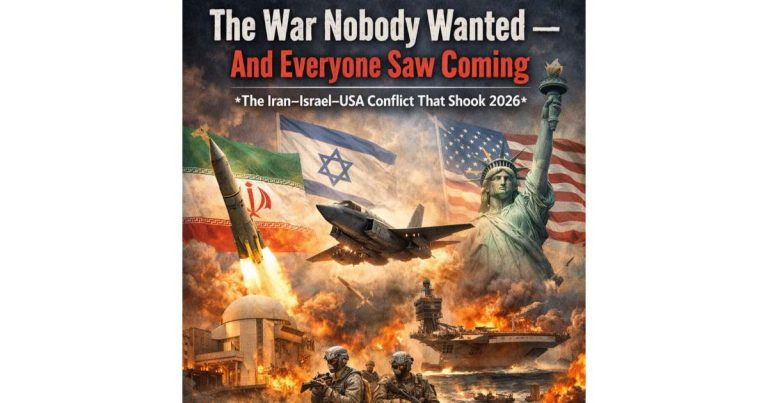
Introduction
I remember the exact moment I saw the notification on my phone. February 28, 2026. It was early morning, the kind of quiet hour when the world feels still. The headline read: “US and Israel Strike Iran. Khamenei Dead.” I sat with my coffee going cold, reading it three times, because part of me still couldn’t believe we’d actually arrived here.
And yet — if I’m honest — I wasn’t surprised. Not really. I think most of us, somewhere deep down, had been watching this slow-motion collision for years.
This Didn’t Happen Overnight
Let me take you back a bit, because this story doesn’t start on February 28th. It started decades ago — in 1979, when Iran’s revolution turned a U.S. ally into a fierce adversary. It deepened when Iran began quietly building a nuclear program the world couldn’t ignore. And it accelerated brutally on October 7, 2023, when Hamas’s attack on Israel unleashed a chain of events that nobody has been able to stop since.
After Gaza, Israel didn’t just fight Hamas. It went after the entire architecture of Iran’s influence in the region — what strategists call the Axis of Resistance. Hezbollah’s leader, Hassan Nasrallah, was killed in a dramatic Israeli strike in late 2024. Syria’s Assad fell from power in December 2024, cutting Iran’s land bridge to Lebanon. One by one, Tehran watched its regional allies crumble.
By early 2026, Iran was in a genuinely desperate position. The economy was in freefall. The rial had collapsed. And in December 2025, something the Iranian government had always feared finally happened: the people took to the streets — in numbers the country hadn’t seen since the revolution itself.
When a Nation Turns on Its Own People
I want to pause here, because this part of the story gets lost in all the talk of missiles and airstrikes.
What happened inside Iran in January 2026 was catastrophic. Protests that began over economic despair turned into something much larger — a full-throated demand for the end of the Islamic Republic. The government’s response was savage. Security forces opened fire on crowds. Human rights organizations reported thousands killed. Families were torn apart. Young Iranians, people who just wanted a livable future, were dying in the streets.
And the world watched. Some governments issued statements. Some imposed more sanctions. None of it stopped the massacre.
It was against this backdrop — a regime fighting for its survival on two fronts, at home and abroad — that the United States and Israel made their decision.
February 28: The Night Everything Changed
The strikes began before dawn. By the time most people woke up and checked their phones, Iran’s supreme leader was dead.
Ayatollah Ali Khamenei, who had ruled Iran since 1989 — who had outlasted multiple American presidents, multiple Israeli prime ministers, multiple rounds of sanctions and sabotage and cyber attacks — was gone. Along with him, dozens of his top military commanders and officials. The head of the Iranian state, decapitated in a single night.
The scale of what followed was unlike anything the region had seen in years. Nearly 2,000 targets struck across Iran in the opening days. Iran’s air force, navy, air defense systems — systematically dismantled. Israel called it an operation to remove an existential threat. The United States called it necessary. Critics around the world called it a war of choice.
Both things can be true.
Iran Hits Back — And It’s Not Just Israel That Bleeds
Here’s what I think people outside the region don’t fully grasp: when Iran retaliates, it doesn’t just fire at Israel. It fires everywhere.
Bahrain, Kuwait, Saudi Arabia, Qatar, the UAE, Jordan, Iraq — all of them took Iranian strikes. The U.S. Navy’s Fifth Fleet headquarters in Bahrain was hit multiple times. Riyadh was struck. An airport in the UAE was targeted. Three foreign workers in the Emirates were killed; over a hundred wounded. Seven American soldiers died.
Lebanon reignited. Hezbollah — battered but not broken — resumed rocket fire on northern Israel in revenge for Khamenei. Israel struck Beirut’s southern suburbs. Tens of thousands fled. More than a hundred people were killed in a matter of days.
Jordan intercepted nearly 50 drones and missiles in its own airspace. Turkey had a missile aimed at it. This wasn’t a surgical strike between two countries. This was a region catching fire.
The Human Cost We Tend to Skip Past
Numbers become abstract very quickly in war coverage. So let me just say it plainly:
More than 1,300 Iranians were killed in the first week of fighting alone. Thousands more wounded. In a country already reeling from economic collapse and the massacre of its own protesters.
In Israel, dozens of buildings in Tel Aviv were damaged. Families sheltering in basements. Children in bomb shelters. A population that has known this fear before, but never quite like this.
Across the Gulf, migrant workers — people who came to these countries just to earn a living and send money home — found themselves caught in someone else’s war.
These are real people. That’s worth saying out loud.
What the World Said — And What It Did
The international response followed a painfully familiar script. Russia and China condemned the strikes. Switzerland called them a violation of international law. The European Council on Foreign Relations called it an illegal war of choice.
The United States, Germany, and a handful of others called it justified. Necessary. Long overdue.
Oil prices spiked to their highest level in years. Global markets shuddered. The Pope called for peace.
And the fighting continued.
There’s something deeply disheartening about watching the international community respond to a major war with statements. Not because statements are worthless — they matter, they shape history, they hold nations accountable. But when the missiles are already in the air, words feel very thin.
The Question Nobody Has Answered Yet
Here’s where I think the story gets genuinely complicated — and genuinely important.
Iran’s military has been severely degraded. Its supreme leader is dead. Its economy is in ruins. Its people are exhausted and grieving. By almost any conventional measure, the country has lost this opening phase of the war catastrophically.
But the Islamic Republic has not collapsed. The regime has not surrendered. And history tells us — from Iraq, from Afghanistan, from Libya — that destroying a government is not the same as building something better in its place.
What comes next for Iran? Who leads it? Will the protest movement, so brutally crushed just weeks ago, find new life in the chaos of war? Or will Iranians, as they have before, rally around national identity against a foreign attack — even a government they despise?
These are not rhetorical questions. They are the questions on which the next decade of Middle Eastern history depends.
Why This Matters to You, Wherever You Are
If you’re reading this and you’re not from the Middle East, you might be wondering what any of this has to do with your life.
The honest answer: more than you might think.
Energy prices are already rising. The global economy is rattled. The rules that govern when countries can legally attack each other are being tested in real time. And perhaps most importantly — the precedent being set right now, about whether military force is an acceptable answer to nuclear proliferation fears, will shape how the world handles the next nuclear standoff. And there will be a next one.
We are watching history happen. That’s not a phrase I use lightly.
A Final Thought
I’ve been thinking a lot, since that February morning, about what it means to watch a war unfold in real time — in push notifications and Twitter threads and breaking news tickers. There’s a strange numbness that sets in. Event after event, strike after strike, until it starts to feel almost normal.
It isn’t normal. None of this is normal.
Somewhere in Tehran right now, someone is grieving. Somewhere in Tel Aviv, someone is afraid. Somewhere in Beirut, someone is trying to figure out where to go. Somewhere in the Gulf, a migrant worker is calling home to say they’re okay.
These are the stories that get buried under geopolitical analysis. I think we owe it to ourselves — and to them — to keep that human reality in view.
Because wars are started by governments. But they are lived by people.
If this piece resonated with you, feel free to share it. And as always — I’d love to hear your thoughts in the comments.
*This article is based on reporting from Al Jazeera, NPR, CBS News, and international news agencies covering the Iran–Israel conflict in early 2026. All views expressed are my own.

Your comment will appear immediately after submission.