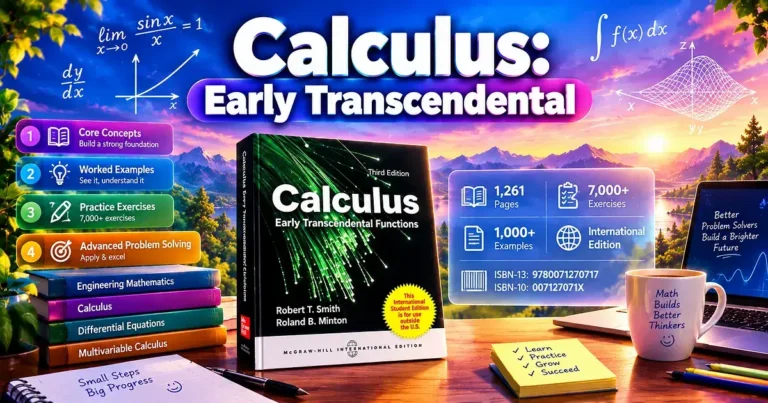
Some Calculus textbooks do more than explain formulas and definitions. They take a learner from foundational concepts to increasingly challenging applications, examples, and problem-solving practice. Calculus: Early Transcendental Functions 3rd Edition by Robert T. Smith and Roland B. Minton is a substantial textbook designed around that broader learning journey.
Physical Dimensions of the 3rd International Edition
| label | value |
|---|---|
| Height | 25.5 |
| Width | 22.8 |
| Thickness | 4.7 |
Published by McGraw-Hill, this International Edition carries ISBN-13 9780071270717 and ISBN-10 007127071X. Bibliographic records identify it as the 3rd Edition, International Edition, with the main text extending to 1,261 pages.
What makes this edition particularly notable is its practice-oriented scale. The book is associated with approximately 7,000 exercises and 1,000 examples, giving students a large collection of opportunities to move from understanding a mathematical idea to applying it independently.
Calculus: Early Transcendental Functions 3rd Edition at a Glance
| Feature | Details |
|---|---|
| Book Title | Calculus: Early Transcendental Functions |
| Edition | 3rd Edition |
| Authors | Robert T. Smith and Roland B. Minton |
| Publisher | McGraw-Hill |
| Edition Type | International Edition |
| ISBN-13 | 9780071270717 |
| ISBN-10 | 007127071X |
| Amazon ASIN | B01N4SPZ1T |
| Subject | Calculus / Mathematics |
| Language | English |
| Main Page Count | 1,261 pages |
| Exercises | Approximately 7,000 |
| Examples | Approximately 1,000 |
The combination of extensive topic coverage, a large number of worked examples, and thousands of exercises makes this edition more than a quick-reference formula book. It is structured as a substantial academic resource for studying, practicing, and revisiting Calculus concepts.
Why Calculus 3rd Edition Stands Out
The real challenge in Calculus is rarely memorizing a formula. The difficult part is recognizing when to use it, how to apply it, and how to adapt it when a problem changes.
A student may understand the basic derivative rules yet struggle when differentiation becomes part of an optimization problem. Similarly, knowing integration formulas is only one step; choosing an appropriate integration technique and interpreting the resulting expression requires deeper mathematical understanding.
This is where a practice-heavy textbook can become valuable. By combining explanations, examples, applications, and a large exercise collection, Calculus: Early Transcendental Functions 3rd Edition provides a framework for moving from mathematical concepts toward repeated problem solving.
What Topics Does Calculus: Early Transcendental Functions 3rd Edition Cover?
The book covers a broad range of Calculus and related mathematical topics, including:
This range is important because it takes the reader beyond the earliest stages of single-variable Calculus. The subject gradually expands into multivariable concepts, vectors, differential equations, infinite series, and vector calculus.
For students who want a single substantial textbook covering a wide mathematical journey, that breadth can be one of the book’s most useful characteristics.
7,000+ Exercises and 1,000 Examples: The Practice Advantage
A Calculus textbook cannot be judged by page count alone. One of the more meaningful questions is how much opportunity it gives a student to actually practice mathematics.
The book’s reported scale of approximately 7,000 exercises and 1,000 examples makes practice one of its defining characteristics.
Why Thousands of Exercises Matter
Calculus skills develop through repetition with variation.
A student may solve a straightforward derivative problem successfully and still struggle when the same principle appears inside an optimization problem, a related-rates problem, or another application. Repeated exposure to different problem structures helps develop mathematical pattern recognition.
A large exercise collection gives students room to progress from familiar examples toward problems that require more independent thinking.
Why Worked Examples Matter
Examples provide the bridge between theory and independent practice.
When learning a new technique, a student can first study how the method is applied step by step. The next stage is to close the book and attempt a similar problem independently.
That cycle—understand → observe → attempt → correct → repeat—is central to effective mathematical practice.
1,261 Pages of Calculus Content
The 3rd International Edition is a substantial volume, with 1,261 pages listed for the main book in bibliographic records.
A textbook of this size is not designed to be a lightweight revision manual. Its scale reflects the breadth of material covered across foundational Calculus, applications, differential equations, series, vectors, and multivariable topics.
For a student building a longer-term mathematical reference library, a comprehensive volume can remain useful well beyond a single examination period.
How the Book Can Support Engineering Mathematics
Calculus forms a major mathematical foundation for many areas of engineering. Differentiation, integration, differential equations, vectors, partial derivatives, multiple integrals, and vector calculus all appear in different forms across engineering mathematics and technical applications.
The subject coverage of this edition includes many of these areas. That makes the book relevant to students looking for a broad Calculus resource alongside their Engineering Mathematics studies.
However, students preparing for a specific university examination should always compare the book’s chapters with their official syllabus. Broad coverage does not automatically mean that every examination syllabus follows the same chapter sequence or depth.
A Strong Resource for Advanced Problem Solving
Calculus becomes much more interesting when a problem stops looking exactly like the example that came before it.
For example, integration may require more than recognizing an integral formula. A student may need to determine whether substitution, integration by parts, partial fractions, or another technique is appropriate.
Differentiation can work the same way. Finding a derivative is only one task; understanding how derivatives describe a function’s behavior can lead to optimization, approximation, and other applications.
Topics such as Applications of Differentiation, Integration Techniques, Differential Equations, Infinite Series, and Vector Calculus extend Calculus beyond basic computational exercises and into broader mathematical problem solving.
How to Study Calculus with This Book
A 1,261-page textbook can feel overwhelming if approached as something that must simply be read from the first page to the last. A more structured approach can make the material easier to manage.
Step 1: Understand the Concept Before Memorizing the Formula
Start with the mathematical idea behind a formula. Ask what the formula represents, what conditions it requires, and what type of problem it is designed to solve.
Understanding the reason behind a method makes it easier to recognize when that method is appropriate.
Step 2: Study the Worked Examples Carefully
Do not focus only on the final answer.
Follow the sequence of mathematical decisions. Ask why a particular rule or technique was selected and what would happen if the problem were changed slightly.
Step 3: Solve Exercises Without Looking at the Solution
After studying an example, attempt a related exercise independently.
The goal is not merely to reproduce the example. The real test is whether you can recognize the underlying method when the problem is presented differently.
Step 4: Track Your Mistakes
Keep a record of recurring errors.
Common Calculus mistakes can involve signs, algebraic simplification, differentiation rules, integration techniques, limits, boundary conditions, or incorrect interpretation of a problem.
Recognizing repeated mistakes turns practice into targeted learning rather than simple repetition.
Step 5: Revisit Difficult Topics Strategically
If a chapter feels difficult, rereading the entire chapter may not always be necessary.
Review the key concept, examine a few worked examples, and then return to carefully selected exercises. This creates a more active learning cycle and helps identify the exact point where understanding breaks down.
Who Is Calculus: Early Transcendental Functions 3rd Edition For?
Engineering Mathematics Students
Students studying Engineering Mathematics may find the book relevant because of its coverage of differentiation, integration, differential equations, vectors, partial derivatives, multiple integrals, and vector calculus.
Calculus Students
Learners who want to progress from limits and derivatives toward more advanced Calculus topics can use the broad structure of the book as a long-term study resource.
Students Focused on Problem Solving
The reported collection of approximately 7,000 exercises and 1,000 examples makes the book particularly practice-oriented. Students who learn best by solving a large number of problems may find this format useful.
Students Looking for a Long-Term Reference
Because the book covers a wide range of Calculus topics in one substantial volume, it can also serve as a reference when revisiting concepts later in an academic program.
The Physical Size of the Book
The book is not only substantial in terms of content; its physical dimensions also reflect its textbook format.
Product information associated with the same ISBN lists approximate dimensions of 25.5 cm in height, 22.8 cm in width, and 4.7 cm in thickness.
That makes it a sizeable academic volume rather than a compact pocket-sized study guide. It is better suited to desk-based study, regular practice, and long-term reference use.
Identifying the Correct 3rd International Edition
Different editions and versions of a textbook can appear under very similar titles. International Editions can also have different ISBNs from other editions of the same title.
For that reason, checking the ISBN is one of the simplest ways to identify the specific edition you are looking for.
The 3rd International Edition discussed in this article carries:
When purchasing, match the ISBN and edition information rather than relying only on the title or cover image.
What to Check Before Buying Calculus 3rd Edition
Before purchasing the book, verify several details carefully.
First, check the edition number. Different editions can contain changes in organization, pagination, examples, or supplementary material.
Second, verify the ISBN-13: 9780071270717 if you specifically want the edition discussed in this article.
Third, confirm that the listing identifies the book as the International Edition.
Finally, compare the book’s chapter coverage with your university, college, or examination syllabus. A comprehensive Calculus textbook can cover more material than a particular course requires.
Calculus: Early Transcendental Functions 3rd Edition — Key Facts
Frequently Asked Questions
Frequently Asked Questions
Who wrote Calculus: Early Transcendental Functions 3rd Edition?
The book was written by Robert T. Smith and Roland B. Minton. The edition discussed here is the 3rd International Edition published by McGraw-Hill.
What is the ISBN of Calculus: Early Transcendental Functions 3rd Edition?
The ISBN-13 is 9780071270717, while the ISBN-10 is 007127071X. Checking the ISBN is useful when distinguishing this edition from other versions of the same textbook.
How many pages does Calculus: Early Transcendental Functions 3rd Edition have?
The main book is listed with 1,261 pages in bibliographic records for this edition. Its substantial page count reflects the wide range of Calculus topics covered throughout the textbook.
What topics are covered in this Calculus textbook?
The book covers topics including limits and continuity, differentiation, integration, differential equations, infinite series, parametric equations, polar coordinates, vectors, partial differentiation, multiple integrals, and vector calculus. This gives the textbook a broad scope extending beyond introductory Calculus.
How many exercises are included in the book?
The book is associated with approximately 7,000 exercises. Such a large practice collection allows students to work through many different forms of Calculus problems rather than relying only on a small set of examples.
How many examples are included in Calculus: Early Transcendental Functions 3rd Edition?
The available book information indicates approximately 1,000 examples. Worked examples can help students understand how mathematical techniques are applied before attempting exercises independently.
Is this book useful for Engineering Mathematics?
The book covers many areas that commonly appear in Engineering Mathematics, including differentiation, integration, differential equations, vectors, partial differentiation, multiple integrals, and vector calculus. Students should still compare the book with their specific course or examination syllabus before using it as their primary preparation resource.
How can I make sure I am buying the correct 3rd Edition?
Check the edition information together with the ISBN rather than relying only on the title. For the specific International Edition covered here, look for ISBN-13 9780071270717, ISBN-10 007127071X, and the 3rd Edition, International Edition designation.











Your comment will appear immediately after submission.