You have an idea, use ChatGPT or some other AI platform, input some words and receive a response that is correct in technical terms but quite useless. You tweak the prompt a bit, input some more information and, before you realize it, 20 minutes are gone.
This is exactly what Best AI Prompt Generators can be used for.
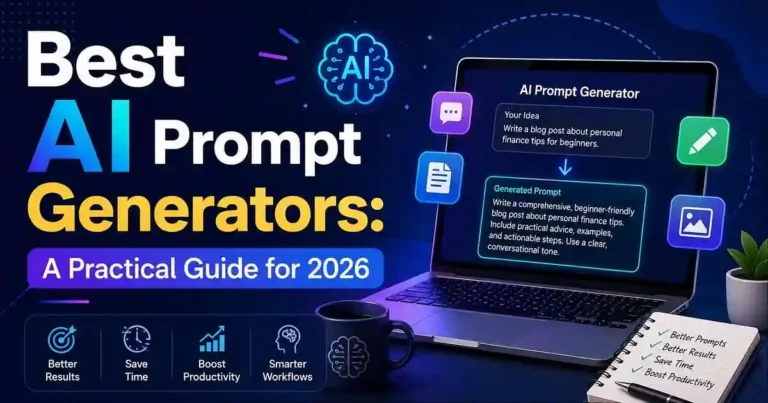
Instead of requiring you to grasp all nuances of prompt engineering, they can transform a plain description into a structured prompt. While some of these tools are meant to create prompts from scratch, others offer optimization services, template creation, prompt management, etc.
However, not all prompt generation tools are worth paying for.
It all depends on your goals. A freelance writer who prepares proposals, a software engineer who tests AI integration and an image generator have different needs.
Table of Contents
- What Is an AI Prompt Generator?
- Why Use AI Prompt Generators?
- Best AI Prompt Generators in 2026
- How to Choose the Right Prompt Generator
- Practical Examples
- How to Get Better Results
- Common Mistakes to Avoid
- Frequently Asked Questions
- Conclusion
What Is an AI Prompt Generator?
A prompt generator is a tool that will assist you in generating instructions for an AI model.
Instead of stating:
“Write a blog post about investing.”
you can use your prompt generator to complete tasks like:
“I have to write an informative blog post for young people who do not know anything about investing.”
Your prompt generator will transform your initial question into a prompt which will include all the details about your task.
Today, there exist five main types of prompt generators, including prompt generators, optimizers, prompt libraries, marketplaces, and prompt management systems. It is critical to note that one should not confuse the system of prompt storage with prompt generator.
An effective prompt includes all information that is necessary for the AI model to function properly: your expectations, target audience, restrictions, and other factors.
Why Use the Best AI Prompt Generators?
A prompt generator is not always required. In fact, simple prompts take less time when created on their own.
However, these applications start to play an important role when more structure is needed in your instructions.
1. Time-saving tool
Instead of trying to rewrite an ineffective prompt again and again, you will be able to explain your objective and get the generator to create a better one.
This is especially true for repetitive activities like:
• Blogging
• Posting on social media
• Creating emails
• Performing research
• Code writing
• Performing data analysis
• Conducting marketing campaigns
• Image making
• Business planning
2. Tool for beginners
Prompt engineering might turn out to be a very complicated process.
You might need to consider aspects like role, context, constraints, examples, tone, output format, and evaluation criteria.
3. They enable reusability
Although a good prompt doesn’t always have to be used only once,
a freelance writer might design a reusable prompt for the analysis of their client’s needs,
while a blogger might come up with one for outlining their articles based on research notes.
Thus, the prompt becomes a reusable workflow rather than just a question to ask.
4. They can ensure consistency
Since a prompt might include certain structure, it may become consistent.
According to studies of prompt engineering, a structured prompt and its reuse patterns may come in handy when it comes to controlling language-model behavior.
The crucial point here is “can.”
Best AI Prompt Generators in 2026
The market has changed considerably. There are some tools that will allow you to create prompts, while others will concentrate on prompt libraries, prompt optimization, testing, and other model-related workflow tools.
Here are some categories and tools that you may wish to consider.
1. Jotform AI Prompt Generator
Jotform AI Prompt Generator is a software application that will allow you to convert your basic instructions into advanced prompts.
The value of the tool is that it is quite easy to use. You do not have to understand any specific language of prompt engineering before using the tool.
Based on the comparison made by Jotform in 2026, their prompt generator will be compatible with numerous popular AI models and allows for unlimited prompt generation for free.
Good for: Beginners and general use cases.
2. AIPRM
This one is slightly different from the previous one.
Not only it is a generator but also an extensive prompt library that will allow you to work with different AI assistants, such as ChatGPT and Claude. According to its official website, it includes thousands of community-driven prompts and tools for management of them.
Good for: Marketers, writers, freelancers, etc.
3. PromptBase
PromptBase is better understood as a prompt marketplace and discovery platform than a simple prompt generator.
The advantage is access to prompts created for specific use cases and AI models.
This approach can make sense when you are looking for a specialized prompt rather than trying to generate one yourself.
Best for: Users looking for specialized prompts and prompt marketplace resources.
4. Prompt Manage
Prompt Manage focuses on turning goals, context, and rules into more structured prompts.
It is particularly interesting for users who want to create prompts systematically rather than simply search through a library.
Best for: People building reusable prompt workflows.
5. Prompt Cowboy
Prompt Cowboy takes an iterative approach to prompt creation. Instead of simply producing one prompt and stopping, its workflow is designed to help users refine their instructions.
That can be valuable when your first prompt isn’t quite right.
Best for: Users who want help improving prompts through iteration.
6. PromptHub
PromptHub focuses more heavily on prompt organization, optimization, and collaboration.
That makes it more relevant to teams than someone who simply wants a quick prompt for writing an email.
Best for: Teams and professionals managing multiple AI prompts.
7. PromptLayer
PromptLayer is aimed more toward developers and teams working with AI applications.
Instead of treating prompts as disposable text, it provides tools for testing, managing, and evaluating them across AI workflows.
Best for: Developers and AI teams.
8. Arize
Arize is another example of why the term “prompt generator” can be misleading.
Its focus extends into AI observability and evaluation rather than simply creating prompts.
For organizations building serious AI systems, evaluating whether prompts actually produce reliable results can be more important than generating another prompt.
Best for: Developers and teams building AI applications.
9. Native AI Prompt Generation Tools
It is possible to find cases when you will not have to employ any extra tool to produce your prompts.
Modern AI platforms provide tools that will allow you to develop your prompts in the ecosystem.
Such approach can be useful in case you know which AI model you would like to use to complete the task.
For example, when someone is working with one AI platform, it can be easier to use its development environment rather than to add an extra tool to the existing system.
Effective for: Developers who are experienced in a certain AI ecosystem.
10. Prompts Libraries and Communities
In some cases, it may save you time to study the process by looking at examples than to create a prompt.
A library or a community of prompts may teach you how to develop instructions for certain actions such as marketing, coding, researching, picture creation, productivity, and many others.
However, there is one drawback of using such an approach – the prompt developed for someone’s work process may not be suitable for your workflow.
Effective for: Study and inspiration.
How to Choose the Best AI Prompt Generator
Don’t go for a tool simply because it promises to create “better prompts.”
See how it integrates with your real workflow.
Think about what AI models you use
If you are working with ChatGPT, Claude, Gemini, Midjourney, or other multiple platforms, then compatibility with models is essential.
There are tools that cater to certain AI models and there are those that support several models. Presently, there is a vast difference in terms of model support between various prompt generators.
See what you need – generation or optimization
Both are slightly different things.
Generation: You have an idea and you need a prompt.
Optimization: You have a prompt but you want to make it better.
If you are capable of writing decent prompts yourself, then perhaps you don’t need a generator but an optimizer.
Review free plan constraints
Sometimes a free version can do perfectly well.
Before upgrading, ensure:
• The amount of prompts available
• Whether models are available
• The possibility to export your work
• Prompt saving
• Team functionality
• Optimization possibilities
• Use of commercial prompts
You don’t have to spend money on services you won’t use.
Think of privacy
This is particularly critical for freelancers and companies.
Make sure not to copy sensitive client data, passwords, private financial details, client base, or any other company information to a third-party prompt generator unless you know what that company does with your information.
Practical Examples
Imagine that you work as a freelancer.
Example of an irrelevant prompt:
“Write an article on budgeting.”
But a relevant prompt should have something like this:
“Write a 1,500-word article on budgeting. Include examples, short paragraphs, easy-to-understand tips and no promises in finances.”
Many more relevant prompts will be given to the AI.
Prompts may be generated by the prompt generator in case you lack ideas where to begin.
Image generator prompt
In opposition to:
“Illustrate a modern office.”
The prompt may look like:
• SUBJECT
• ENVIRONMENT
• LIGHTING
• COMPOSITION
• PERSPECTIVE
• STYLE
• ASPECT RATIO
• OBJECTS
How to Get Better Results From Prompt Generators
Prompt generation is not an illusion. The quality of the information that you provide is equally significant.
Use this simple process.
Step 1: Start with your true intention
Don’t start out with any notions of complex prompts.
This question should occur to you:
What exactly do I want to have generated by the AI?
Step 2: Add context
Tell us your target audience and the purpose of the output.
Step 3: Add constraints
This will include things like:
• Word Count
• Readability level
• Tone
• Format
• Required sections
• Things to leave out
Step 4: Define the Output
Describe the desired format of the output from the AI.
Some suggestions include: table, checklist, steps (numbered or bulleted), email, article, script, JSON format, etc.
Step 5: Test the Prompt
Never make an assumption that the prompt will yield something useful.
Feed it into your AI.
If not, pinpoint what is missing and edit the prompt accordingly.
Common Mistakes to Avoid
Using highly sophisticated prompts
More words do not mean good results.
The prompt containing 1,000 words may be even worse than the prompt that contains 100 words as the extra information is not required at all.
Using templates without any modifications
The templates that are meant for one situation are impossible to use in another.
Use the templates as a basis for your job.
Not checking the target AI model
The success of one AI using a particular prompt does not guarantee success of another one.
If possible, test the important prompts on the target AI.
Believing in error-free result
Even the best prompt does not guarantee the accuracy of the result.
Make sure of everything you need if the info is financial, legal, medical, or any other sensitive information.
Paying early
Start from free services.
It is possible that you will find that you do not need anything but a simple AI tool.
Frequently Asked Questions
1. Which is the best AI prompt generator?
The answer lies in what you need from your prompt generator. Is it prompt generation, prompt optimization, templates, image prompts, team collaboration, or development testing you require?
2. Are AI prompt generators free?
They are available for free in many cases. However, the amount of free prompts and other limitations differ.
3. Is there any kind of prompt generator which can help me make ChatGPT prompts?
Sure, there are many generators that will help you either to create your own prompt or to improve your existing one.
4. Is the usage of prompt generator essential for using AI efficiently?
Not really. You can make the prompts without using any kinds of generators. However, the generators will be helpful if you don’t have enough time or experience.
5. So, does it mean that the bigger the prompt is, the better?
No way. The prompt should consist of context, instruction, and constraints. The bigger the prompt is, the more complicated the instruction gets.
Conclusion
In The Best AI Prompt Generators case, it is not necessarily about using the one that has the most features. It will depend on what problem you solve.
For those who are beginners prompt engineers, simple prompt generators can assist in going from the general idea to the structured instruction. For those who are advanced prompt engineers, other types of tools, such as optimizers, prompt libraries, testing platforms, and model development platforms, might be more helpful.
The main conclusion here is that prompt generation must not be the purpose.
Your purpose is to make AI produce better output.
Define the goal, give the context, specify the expected result, test the prompt, and refine it depending on the output. When you have this process developed, you will need fewer prompt generators—and also become more efficient in working with AI tools.
And for freelancers, content creators, marketers, developers, and small business owners, it is going to save you a lot of time and efforts. Just remember that any AI output should be checked by humans—especially when you work with financial or business data.

Your comment will appear immediately after submission.