Introduction
The day starts with the list of topics to write articles about and the commitment to complete at least three blog posts before lunch. In a few hours, you cannot manage to write even a single paragraph due to spending too much time searching for keywords, and not even finding images to post your article on social media.
This is the exact reason why AI technology became an integral part of a successful blogger’s everyday life.
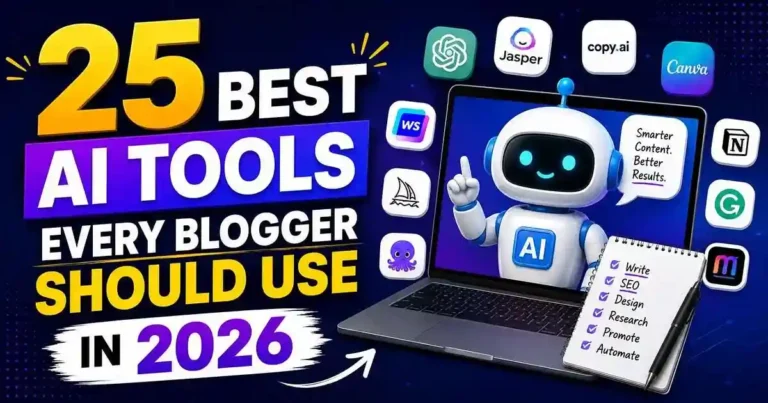
The Best AI Tools Every Blogger Should Use in 2026 don’t aim to diminish creativity. They are supposed to assist you in getting rid of boring and repetitive activities in order to be able to spend more time on researching and writing good articles, as well as building up your website.
There are many AI technologies that can help in outlining, optimizing SEO, generating unique pictures, summarizing papers, and doing content marketing automation. But the key to success is in using different types of AI tools for each particular stage in the blogging process rather than one tool for all actions.
In this article, we are going to discuss 25 AI tools that can make your work easier and quicker.
Table of Contents
- Why Bloggers Are Using AI More Than Ever
- How These AI Tools Were Selected
- Top 25 AI Tools Every Blogger Should Use
- Practical Tips for Using AI
- Common Mistakes to Avoid
- Frequently Asked Questions
- Final Thoughts
Why Bloggers Are Using AI More Than Ever
AI has revolutionized the way blogging is done.
No more wasting several hours trying to come up with good headlines or doing keyword research for your posts. This does not make any human effort obsolete; it merely makes things faster.
Some of the places where AI helps save time are:
• Content research
• Article outlining
• Grammar correction
• SEO optimization
• Image generation
• Video scripting
• Email marketing
• Social media caption writing
• Keyword grouping
• Content re-purposing
Great bloggers do not use AI to churn out more poor-quality posts; they use it to write better quality posts consistently.
How We Selected These AI Tools
Every one of these tools is selected based on usefulness rather than popularity.
We took into account:
• Skills of writing
• SEO functionality
• User-friendliness
• Price
• Accuracy
• Increased productivity
• Blogging workflow integration
• Tools’ usefulness to beginner bloggers as well as advanced ones
Some of these tools are free, while others have paid versions that will save you many hours each week.
1. ChatGPT
Best use of
Writing, content generation, idea creation, outlining, editing, and researching.
One of the most versatile tools which can prove useful in many situations. Bloggers make use of ChatGPT in order to create ideas for their blog posts, reword articles, summarize scientific work, write emails and overcome writer’s block.
ChatGPT cannot be regarded as an automated tool which writes articles for you. It becomes essential that you provide some prompt to it.
Advantages
• It is a reliable writing assistant
• Ideas can be generated instantly
• Editing purpose
• Multiple kinds of writings can be facilitated
Disadvantages
• Need to be checked for facts
• The better the prompt, the better results
2. Claude
Best for
Content creation and analyzing documents.
Claude is good at writing long content pieces and complicated documents. When writing thorough guideposts, pillar posts, or eBooks, it may be useful to organize your content well.
It features a conversational writing style which sounds more like how humans talk than other AI writing tools.
Pros
• Incredible long-form content output
• Good logic while organizing
• Good readability
Cons
• Advanced features require a premium subscription
3. Google Gemini
Best For
Productivity and Research.
Gemini is highly compatible with Google apps, and it is good for bloggers who have been using Google Docs, Gmail, and Google workspace.
The tool can be used to summarize documents, research, provide ideas, and plan content calendar.
Pros
• Good for research
• Highly integrated with Google
• Fast results
Cons
• The output needs to be edited
4. Jasper AI
Best For:
Blogging for marketing purposes.
Jasper is built for marketing and content creation. Templates include blog introductions, product reviews, ads, emails, and landing page.
The blogging affiliates will find it helpful due to its marketing-oriented workflow.
Pros:
• Professional templates
• Business voice
• Effective workflow management
Cons:
• Monthly fees are higher
5. Surfer SEO
Best For
SEO optimization of the page.
The work of writing a perfect article is done by half. Surfer SEO helps to optimize your content based on the current ranking of other websites on search engines.
Pros
• Suggests excellent SEO optimization techniques
• Good for improving your site’s rankings
• User-friendly optimization process
Cons
• Can be challenging for beginners
6. Frase
Best For:
Content briefs and competitor analysis.
Frase identifies pages ranking highly and writes comprehensive content briefs in minutes.
Bloggers can now learn in a few minutes about what the audience should know from the research that could otherwise take hours.
Pros:
• Timesaving
• Outstanding content briefs
• Great SEO tool
Cons:
• The premium services make it expensive
7. Grammarly
Best for
Grammatical and readable corrections.
Everyone makes minor errors now and then.
This is a highly thorough analysis of grammar, punctuation, spellings, readability, and tone.
Pros
• Easy to use
• Helps improve readability
• Not dependent on which website you use it on
Cons
• Premium service offers more features
8. Canva Magic Studio
Best For
Graphics for blogs.
Every blog needs graphics that at least look good.
Magic Studio created by Canva has been created using artificial intelligence and helps create social media graphics, blog banners, slideshows, thumbnails, marketing graphics, and other types of graphics.
Anyone with little experience can create stunning graphics using Canva.
Pros
• User-friendly
• Lots of templates
• Image editing using AI
Cons
• Premium templates
9. Midjourney
Best For
High-resolution AI images.
For blogs which rely on visual content that isn’t just run-of-the-mill stock photos, Midjourney provides high-quality images that will really make your posts shine.
Most suitable for blogs about tech, travel, lifestyle and creativity.
Pros
• Highest resolution images
• Extremely customizable
• Professional quality
Cons
• Taking prompts requires skill
10. Notion AI
Best For:
Content organization
Blogging is not just about writing blog posts; it is also about content organization, planning, and research.
Notion AI enables bloggers to organize their content calendar, note taking, task management, and all that in one place.
Pros:
• Perfect organizational tools
• AI Assistant
• Best collaboration tools
Cons:
• It takes time to build your workflow
11. Perplexity AI
Good for:
Faster research and finding reliable sources.
The hardest part of blogging is knowing how to distinguish quality information from old or wrong information. Perplexity AI makes research more efficient because it will provide you with a summary of the information and will point you toward credible sources.
It becomes particularly useful if you write posts based on data or tech-related posts.
Strengths:
• Provides a summary of the research
• Pointing out the credible sources
• Saves time from conducting manual research
Weaknesses:
• The facts need to be checked anyway.
12. Semrush AI Toolkit
Good for
Keyword research and SEO analysis.
But that is not all that bloggers can achieve from keyword research through Semrush. The AI powers of Semrush will ensure that bloggers do not have to guess the traffic potential of any topic but know it.
Pros
• Complete package of SEO tools
• Excellent keyword database
• Competitor analysis
• Suggestions for SEO optimized content
Cons
• Expensive for beginners
13. Ahrefs
Good for
Link building and content analysis.
Ahrefs is still one of the best SEO tools that can help bloggers to attract more visitors organically. Apart from link building, Ahrefs can be used to detect low competition keywords, gaps in content, and aged pages.
Most bloggers use Ahrefs prior to creating their next blog post in order to know what people search for.
Strengths
• Backlinks database is great
• Pricing for keywords statistics is affordable
• Extremely useful for content planning
Weaknesses
• Costly compared to other SEO tools
14. Writesonic
Best For
For writing first drafts and marketing texts.
Writesonic is a tool based on artificial intelligence, incorporating SEO in creating blog posts, landing pages, descriptions, and advertisements.
The tool becomes really helpful when you want to create a good first draft that can be improved further with your expertise and examples.
Pros
• Many writing templates available
• Fast creation of the content
• Convenient user interface
Cons
• The content needs editing
15. Copy.ai
Good for:
Content marketing and reusing content.
After posting a blog post, there is much more to do including sending out newsletters and sharing content on social media sites.
Copy.ai will help you reuse one blog post in several ways, thus saving time and keeping your message consistent.
Positive:
• Great for promotional content
• Simple workflow
Negative:
• Not good for long-form articles
16. Descript
Best for
Video and podcast editing.
Bloggers have started making YouTube videos and podcasts in addition to writing blog posts. Descript is able to make editing incredibly easy for audio and video by making it as simple as editing a text document.
This greatly speeds up the creation process for content creators who release on multiple platforms.
Pros
• Text-based editing
• AI voice cleanup
• Transcription
Cons
• Paid plans are necessary for advanced functionality
17. OpusClip
Useful For
Editing lengthy videos to create shorter snippets.
Whether it’s webinar videos, tutorial videos, or YouTube videos that you have recorded, OpusClip will detect the most interesting parts and edit them into short videos compatible with platforms such as Instagram Reels, TikTok, and YouTube Shorts.
This way, bloggers can access new audiences without having to make additional videos.
Advantages
• No editing effort required
• Optimized for social media
• Highlights are detected by AI
Disadvantages
• Sometimes requires manual tweaking
18. Otter.ai
Good for
Creating notes and transcribing interviews.
If you want to conduct an interview with an expert and publish something original on your blog, it will definitely take time to transcribe your conversation.
With Otter.ai, you don’t have to do that because this software turns your verbal conversation into text automatically.
Good things
• Transcription accuracy
• Searchable notes
Bad things
• Accuracy depends on audio quality
19. Zapier AI
Best For:
To automate repetitive blogging tasks.
As your blog expands, repetitive tasks start accumulating. Automate your repetitive blogging tasks using Zapier AI that integrates various applications and automates tasks like:
• Publication of blog posts
• Saving data for future use
• Mailing reminders via emails
• Update your spreadsheets
• Manage editorial workflow
The simplest automation saves you multiple hours per week.
Pros:
• Automation capabilities
• Multiple integrations
• Time-saving
Cons:
• Taking time to set-up advanced automation
20. Buffer AI Assistant
Best for:
Social media scheduling.
Just publishing your blog post is not enough. It is its continuous promotion on social media that helps drive traffic.
Buffer’s AI assistant allows you to create captions tailored to specific platforms, make suggestions for posting and schedule content on multiple social media platforms using one interface.
This makes it easier to follow a consistent posting schedule without wasting time writing social media posts.
Pros
• Simple scheduling
• AI captions
• Multiple platforms support
Cons
• Better analytics available on premium plans
Choosing the Right Combination of AI Tools
Of course, it would be convenient to find only one app that will do everything; however, it would be more logical to create a chain of the apps which will work together well. They may be the following apps:
• For Writing – ChatGPT or Claude
• For Research – Perplexity AI
• For SEO – Semrush, Ahrefs, or Surfer SEO
• For Spelling and Grammar checking – Grammarly
• For Creativity – Canva Magic Studio
• For Image creation – Midjourney
• For Project management – Notion AI
• For Automation of tasks – Zapier AI
• For Videos – Descript and OpusClip
• For Social media – Buffer AI Assistant
In such a way, you will be able to make perfect content.
21. NotebookLM
Best For
Research turned into an organized piece of content.
If you use reports, PDFs, case studies, or interviews in your work, then NotebookLM will be one of the most helpful blog creation platforms. Instead of looking through multiple pieces of paper, it will help you to analyze data, find conclusions, and give answers according to your uploaded references.
It is particularly helpful for bloggers from the finance, tech, education, or other research-oriented niches.
Pros
• Great platform to organize research data
• Analyses long documents fast
• Works with the uploaded references
Cons
• Benefits the most from quality reference materials
22. Adobe Firefly
Best For
Creating business-oriented AI images.
Visuals are key in retaining interest from the audience. With Adobe Firefly, bloggers can create graphics such as illustrations, background art, icons, and graphics to include in their blogs and marketing efforts.
Since it is connected to the Adobe creative suite, it will be of great benefit to bloggers who use Photoshop or Express.
Pros
• Good quality image production
• Convenient editing process
• Useful for marketing visuals
Cons
• Necessitates an Adobe subscription for advanced functions
23. Rank Math Content AI
Best For
Optimizing WordPress posts with SEO.
As you write on WordPress, Rank Math Content AI gives you suggestions. It suggests keywords, heading optimization, internal linking, and readability optimization all within your WordPress editor.
No need to wonder if your article is SEO optimized – you get suggestions before you click that Publish button.
Pros
• Integrated directly with WordPress
• Good SEO suggestions
• User-friendly for newbies
Cons
• Advanced AI features in premium version only
24. ElevenLabs
Good for
AI Voiceovers and Audio Content.
With more and more bloggers entering podcasting, YouTube, and audio blogging space, ElevenLabs provides high-quality AI voiceovers.
Turn your blog into audio so that those who prefer to listen could have access to it.
Strengths
• Natural Voices
• Multiple Language Support
• High Quality Audio Output
Weaknesses
• Limited Free Version Usage
25. Trello with AI Features
Good For
Creating editorial process flows.
Not everyone who is a writer understands how to publish regularly. Trello assists bloggers in creating plans, deadlines, checking on their articles and collaborating with the team.
Thanks to the AI function, Trello can provide summaries of the cards as well as descriptions of the tasks.
Pros
• Visual and easy-to-use UI
• Useful in the content creation
• Can be used individually and in a team
Cons
• Large projects require premium features
Practical Examples
Some examples are listed below on how bloggers can use all these tools in their daily activities.
Example 1: Writing a Blog Post
1. Conduct research on the subject via Perplexity AI.
2. Making an outline with the help of ChatGPT or Claude.
3. Keyword research via Semrush or Ahrefs.
4. First draft writing.
5. Optimization with the help of Surfer SEO or Rank Math Content AI.
6. Proofreading through Grammarly.
7. Creating a featured image with the use of Canva Magic Studio or Adobe Firefly.
8. Social media scheduling via Buffer.
Example 2: Recycling
It thus means that when you have a document with 2000 words, it will not be prudent to publish it only once. The following are some of the things that you could do with the document:
• Make your own newsletter.
• Publish the document on LinkedIn and Facebook.
• Come up with an infographic of the document.
• Release videos of yourself reading the document on YouTube.
• Release audio files of the document on podcasts provided by ElevenLabs.
• Come up with videos from the document using OpusClip.
One single document can be recycled differently.
Actionable Tips
To make the most of AI without any compromise on quality, you may follow these tips:
• Make use of AI in assisting your writing, not as a substitute for your own expertise.
• Cross check the facts pertaining to statistics, financial and other events before publishing your work.
• Add your own views and examples in all your articles.
• Revise your previous blogs by using the power of research and SEO through the help of AI.
• Build your own efficient process using multiple AI tools rather than just one tool.
• Keep your brand identity consistent throughout the AI content creation process.
Common Mistakes Bloggers Should Avoid
Bloggers implement AI fast but do not utilize it properly. Don’t make these typical errors:
• Uploading AI-created content without any corrections.
• Disregarding the search intent and concentrating exclusively on keywords.
• Overutilizing several AI tools for the identical job.
• Failing to check the information sources.
• Creating non-original material.
• Not paying attention to the internal links and on-page SEO.
• Believing that the AI knows more about your target audience than you.
Those bloggers who successfully use AI technologies are those who blend automation with competence and knowledge of their audience.
Frequently Asked Questions
1. Are AI technologies used to replace bloggers?
No. Even though AI performs all repetitive tasks including writing, researching, and editing, it requires human imagination, knowledge, and reasoning to produce authentic content.
2. What are the best free AI tools for bloggers?
Among the best free AI tools for bloggers, there are ChatGPT, Google Gemini, Canva Free, Grammarly Free, and Perplexity AI.
3. What is a good AI tool for SEO?
Surfer SEO, Semrush, Ahrefs, and Rank Math Content AI are among the best AI tools for SEO.
4. Can AI help boost blog traffic?
Yes, indirectly. AI can improve content quality, SEO optimization, speed up the process of publication, and make promotion easy, all of which can eventually result in more organic traffic.
5. Is it wise for novices to pay for AI tools?
No. Novices should start using free versions of AI software, figure out which one suits them, and then think about buying them when there is value in doing so.
Conclusion
The Best AI Tools Every Blogger Should Use in 2026 does not mean to replace writers but to enable them to become more efficient without compromising their quality of writing.
Whatever stage you are at whether a beginner blogger or have already grown into a successful content-based business, using appropriate AI tools can help you to become less busy, do better SEO, conduct research easily, beautify your images, and write consistently.
It all depends on how you perceive AI; you should consider it an ally for productivity. Utilize its potential to get your job done quickly, but use your experience, imagination, and critical judgment to make sure that your work has a value.











Your comment will appear immediately after submission.