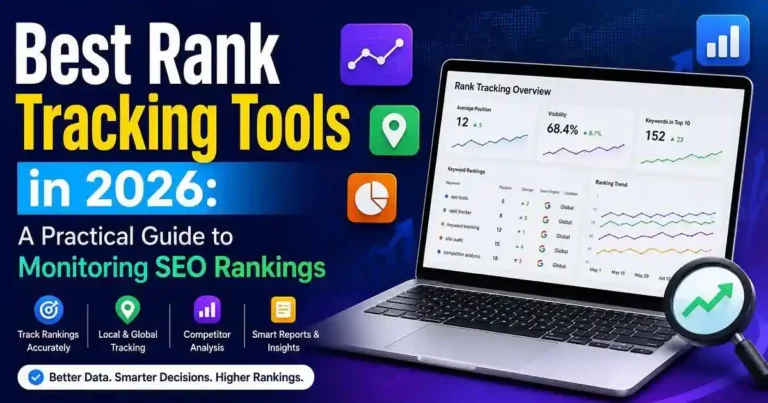
You post your latest article, fine-tune the title, update your internal linking, and wait. After a couple of weeks, you go to Google and find out that the page has jumped from 42nd position to 17th, but have no idea when it occurred or why it happened at all.
Here comes the place where a good rank tracking tool should be used.
Instead of manually checking Google for several dozen or even hundred keywords, the tracker shows you the history of rankings. You can see whether your SEO efforts have some effect, detect unexpected loss of rankings, compare yourself with your competitors, and get the list of keywords which can bring you on the first page very soon.
But here comes the key thing. The rank tracker is not the strategy of SEO on its own. A tool will show you that some keyword fell down from #8 to #14. But it will not automatically show you whether the reason for that lies in search intent, content quality, competition, backlinks, technical SEO, or something else.
You should look for a tool which provides you with valuable information rather than just big dashboard.
Table of Contents
- What Is Rank Tracking?
- Why Rank Tracking Matters for SEO
- Best Rank Tracking Tools in 2026
- How to Choose the Right Rank Tracker
- Practical Ways to Use Rank Tracking Data
- Common Rank Tracking Mistakes
- Frequently Asked Questions
- Conclusion
What Is Rank Tracking?
The rank tracking process involves checking where the webpage is placed in search engine results with respect to particular keywords.
For instance, let’s assume that you create an article with the targeted keyword “best freelance skills.” You begin with a 50th position, but after the optimization and proper link-building, the position gets to be 18 and eventually 7.
The rank tracking software keeps track of these changes.
According to the platform, you can keep track of the following elements:
• desktop and mobile rankings,
• various countries and cities,
• competitor rankings,
• Search Engine Results Page (SERP) features,
• local search results,
• ranking history,
• search visibility,
• keyword groups,
• search intent,
• AI-related search visibility.
Thus, rank tracking becomes much more efficient than simply looking at your keyword in Google every several days.
Why Rank Tracking Matters for SEO
It can take weeks and even months before one realizes the impact of SEO.
Without any past data available, it can become quite easy to base the decision on just one search.
Let us imagine that one of your articles falls from rank 6 to 11.
That surely sounds frightening.
But what if the page is actually receiving more traffic because of an increase in the search demand? Or what if Google introduced a new SERP feature to lower the number of organic rankings above the fold?
That is why the rankings need to be considered alongside:
• Organic clicks
• Impressions
• CTR
• Conversions
• Search volume
• SERP features
• Traffic value
Using a good rank tracker will help you understand the trend and not just the number.
Best Rank Tracking Tools in 2026
There isn’t a single tool that will suit every website. A freelancer working on a couple of websites will have entirely different demands compared to an SEO agency monitoring hundreds of keywords.
Some of the best tools to consider are listed below.
1. Semrush — Best All-In-One SEO Tool
Semrush
Semrush is among the best tools available if you want rank tracking along with keyword research, competitor analysis, site audit, backlinking, and other SEO tools.
Its Position Tracking tool enables you to track rankings by location and device, compete with your rivals, and monitor SERP features. Semrush also provides tracking of visibility on the new kind of search experiences including AI-related content.
Why choose Semrush?
It is clear if you are looking for something beyond a simple keyword position tracker.
You can do a number of things such as:
• Monitor keyword movements
• Compete with your rivals
• Track rankings in local searches
• Analyze SERP features
• Generate automated reports
• Relate your rankings with other SEO research
Best for
SEO experts, agencies, marketers, and website owners looking for an all-in-one tool.
But the drawback is that it might be too much tool for a small website.
2. Ahrefs – Ideal for SEO Research and Ranking Tracker
Ahrefs
The SEO tool is ideal if backlinks and competitor research play a vital role in your SEO work.
Ahrefs’ Rank Tracker has the capability to track mobile and desktop rankings, geo-tracking to city/ZIP-code level, SERP features tracking, comparison with competitors, historical ranking and position distribution.
One interesting thing about the tool is that you can add target URLs for the respective keyword. This helps in determining when the wrong URL is ranking or more than one page of your website is competing for the same keyword.
Why Ahrefs?
If you want to link ranking data with:
• Backlinks analysis
• Competitor analysis
• SEO traffic research
• Keyword research
• Content gap analysis
• SERP research
Then Ahrefs is the right choice.
Ideal For
For SEO experts, content teams, and companies that take organic search and competitor research seriously.
3. SE Ranking – Best for Balance and Simplicity
SE Ranking
The SE Ranking solution provides an extensive SEO suite but does not force you to use multiple services at once.
It has a Keyword Rank Tracker with location, search engine, language, and device filtering. In addition, you can track your ranking compared to the competitors’ search ranking and top search results.
It is especially useful for small agencies, freelancers, and rapidly developing websites that need SEO capabilities but do not want a complex process.
Best for
Freelancers, small businesses, bloggers, and agencies seeking balance in their SEO tool.
4. AccuRanker – Best for Dedicated Rank Tracking
AccuRanker
In case rank tracking is your primary concern, then AccuRanker is definitely worth considering.
The tool places a strong emphasis on keyword ranking statistics, SERP analysis, reports, and visibility statistics. The tool offers daily reports and the possibility to refresh individual keywords or domain names when required.
AccuRanker also offers information about SERPs, such as pixel positions, click-through rate-related statistics, and SERP features. The current version of the platform also offers tracking of visibility in AI search.
Best for
SEO experts, agencies, and teams that require dedicated rank tracking and reporting.
However, in case of a small blog with just a couple of dozens of keywords, these features may not be necessary.
How to Choose the Right Rank Tracking Tool
Choosing from the best rank tracking software becomes easy when you take your real needs into consideration.
1. Consider The Number of Keywords You Track
For instance, if you own a small blog that contains 50 keywords which matter to you, you don’t require an enterprise level software tool.
Whereas, if you are an agency with 20 clients, you will have to track thousands of keywords, historical data, user permissions and automated reporting.
Always try to estimate the number of keywords you want to track before buying any plan.
2. Look For Location Tracking Capabilities
Location can greatly influence the search results.
For instance, a local business located in Kolkata should be more concerned about its rankings in Kolkata than the overall average ranking in India.
3. Go beyond average position
Average position is quite helpful, yet it must not be the only SEO metric you track.
Consider the following case:
• Keyword A: #3
• Keyword B: #7
• Keyword C: #19
• Keyword D: #54
Sure, average position sounds okay, yet what about the crucial opportunity of getting to the first page for Keyword C?
A good tracker will allow you to split keywords and get more insights about such opportunities.
4. Look for SERP features tracking options
The Google search results no longer consist of just ten blue links.
It depends on the query; you might see:
• Featured snippets
• Local packs
• Videos
• Images
• People Also Ask
• AI Overviews
• Shopping results
• And many other SERP features
More and more advanced rank trackers monitor these SERP features these days. For instance, Ahrefs currently tracks many SERP features, including AI Overviews, whereas Semrush offers visibility tracking for AI Overviews, video carousels, and local packs.
This fact is essential because ranking #1 does not necessarily mean maximum visibility.
Practical Ways to Use Rank Tracking Data
It is when you take action on the results provided by your rank tracker that makes it useful.
Identify page two opportunities
Screen out keywords that are ranking from position 11 to position 20.
Such pages can be looked at because even little changes can push them up to the first page.
Consider:
• Search intent
• Leverage of content
• Internal links
• Page experience
• Ranking competitors
• Backlinks
• Title and meta description
Identifying rapid ranking falls
Don’t rush to tweak a page just because it fell three positions down in the ranking.
First of all, determine whether it is due to:
1. A fall for a certain or multiple keywords.
2. A similar event occurred with your competitors.
3. The SERP was reorganized by Google.
4. The search intent changed.
5. Any problems with the page.
6. Lower amount of organic traffic.
In this way, you will be able to prevent making any unnecessary adjustments to your SEO tactics.
Competitor research
Competitor research can help identify certain gaps that might be missed otherwise.
For example, if your competitor constantly ranks high for keywords that are linked with “freelancing for beginners,” you can analyze these pages to find out any possible content gap.
The idea here is not to copy your competitor.
It’s about understanding current relevance.
Common Rank Tracking Mistakes
Checking the rankings frequently
SEO will not significantly change from one day to the other.
It is unnecessary for people to check their rankings several times per day since they will become nervous and keep changing their SEO efforts.
For most sites, it is better if they check their rankings once every week.
The importance of ranking at position #1
Although it is important, there are other important factors such as traffic.
Disregarding search intent
A page can be fully optimized but have difficulties ranking because it’s targeting the wrong intent.
If Google always ranks product comparison pages for a certain keyword and yours is an informational article, then adding more keywords won’t help.
Monitoring too many keywords
Extra information isn’t necessarily good information.
Monitoring 20,000 keywords without ever analyzing the reports means that you’re just throwing money away.
Start off by monitoring keywords that are relevant to your business objectives and work from there.
Panicking over every single ranking drop
Rankings fluctuate.
A change once or twice is not necessarily indicative of anything needing to be done.
Frequently Asked Questions
1. Which rank tracking tools are the best for newcomers?
A newcomer may find the tool with an easy interface and with additional SEO tools more convenient. In this case, SE Ranking will be appropriate due to the balanced set of features, while Semrush and Ahrefs can serve the best to those who need more SEO research options.
2. Is Google Search Console a rank tracker?
Google Search Console helps to obtain valuable information about search performance – queries, impressions, clicks, CTR and average position. However, the dedicated rank trackers give more opportunities for tracking keywords, locations, competitors, history and SERP features.
3. What is the frequency with which I should track keyword ranking?
The process of checking keyword ranking on a weekly basis is sufficient for most of the websites. Monthly tracking provides you with a more reliable understanding of long-term trends. You will need to do it on a daily basis during any critical algorithm update or SEO campaign.
4. Is it worth paying for a rank tracking tool?
It depends. But it may be useful if your website is getting significant amounts of traffic or earnings from the search. The need to track competitors, local rankings, history, reporting and mass tracking of keywords will make it reasonable to pay for rank tracking tool.
5. Do I have to rank my competitors?
Yes, you should. Ranking your competitors will help you learn something about their advantages and disadvantages regarding the content or keywords. However, you should never rely only on competitor rankings.
Conclusion
However, the best rank tracking tools aren’t necessarily those with the most features. They should be picked according to how many keywords are managed, the significance of local SEO, necessity of competitor research, and the level of reporting and automation that one uses.
Semrush is a very versatile all-rounder here. Ahrefs makes sense for those who need rank tracking along with the rest of the comprehensive SEO and backlink research tool. SE Ranking provides a good compromise for small teams and developing websites. AccuRanker is designed especially for dedicated rank tracking and SERP analysis.
The crucial thing is to avoid letting the ranking numbers define SEO success completely.
Let the rank tracking help to discover opportunities, look into issues, monitor the progress and relate the results of the SEO efforts to the business goals – traffic, leads, sales, revenue.
This is where a rank tracker turns from just another dashboard into a decision-making tool.
Your comment will appear immediately after submission.