Now imagine you have finally succeeded to save your first $100. You feel like becoming an investor; however, you start to read numerous articles discussing tens of thousands of dollars, portfolio stocks, and complicated money management.
It may be tempting to consider yourself not able to invest because of your small income or savings.
Nothing could be further from the truth.
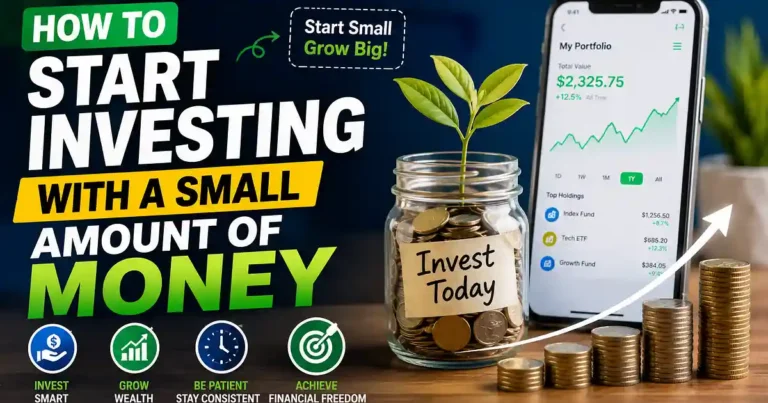
How to Start Investing with a Small Amount of Money is probably the most wise decision you can take as far as finance is concerned. With modern platforms for investments, fractional investing, and low-cost funds, you don’t need to put down a lot of money initially. The key to success here is the ability to invest regularly.
Below we’ll discuss how to start investing.
Why You Don’t Need a Lot of Money to Invest
Many people delay investing because they believe they need thousands of dollars before getting started.
In reality, technology has made investing more accessible than ever.
Today, many investment platforms allow beginners to:
- Invest small amounts regularly
- Buy fractional shares
- Access diversified funds
- Automate monthly investments
Starting small gives you valuable experience while reducing financial pressure.
Benefits of Starting with a Small Amount
Building Good Habits
Investing repetitively helps build good habits.
If you make small investments consistently, you will form a good habit that will help you in future.
Learn without Taking any Risks
Mistakes are quite usual when one learns something.
In order to learn, you will need to make small investments which will help you to grasp the idea of investing without any risk.
Take Advantage of Compound Interest
Time becomes more significant than the amount you have initially invested.
The small sums of money invested repeatedly for years will yield more money than huge investments later on.
Maintain Emotionless Investments
Smaller investments make it easier to stay calm during market fluctuations.
This helps beginners avoid panic selling.
Step 1: Set Your Financial Goals
Decide your reason for investing before making an investment.
These reasons could be:
- Retirement
- House purchase
- Wealth creation
- Education of children
- Financial freedom
Step 2: Establishing an Emergency Fund First
Investments shouldn’t be substituted for savings.
Before you invest much, try to save enough money to provide for your necessary expenses for several months.
Thus, the risk of having to liquidate your investments unexpectedly will be minimized.
Step 3: Choosing the Right Investment Account
Various types of investment accounts have their unique functions.
Depending on your location, you may be able to have:
- Brokerage accounts
- Retirement accounts
- Tax-advantaged investment plans
Step 4: Start Off with Easy Investment
Newbies do not have to make complex plans.
They can think of investment ideas like:
Index Fund
An index fund is one that tracks the performance of an index and is highly diversified.
Exchange Traded Funds (ETFs)
ETFs give diversification and at the same time are highly liquid.
Mutual Funds
A mutual fund that is professionally managed.
Fractional Shares
Platforms where you can invest in fractions of a stock of a particular company.
This way, investing becomes easier.
Step 5: Be Steady in Investment
Consistency is always preferable to predicting the markets.
Rather than waiting for the “right moment,” try to invest at consistent intervals, say monthly.
This is known as dollar cost averaging.
It helps to minimize the effects of market volatility.
Investment Options Comparison Table
| Investment Option | Minimum Investment | Risk Level | Diversification | Best For |
|---|---|---|---|---|
| Index Funds | Low (Often $0-$100) | Low-Medium | High | Long-term wealth building |
| ETFs | Low (Price of one share) | Low-Medium | High | Flexible investing |
| Mutual Funds | Varies ($0-$1,000+) | Medium | High | Professional management |
| Fractional Shares | Very Low ($1-$10) | Medium-High | Low | Starting with small amounts |
| Individual Stocks | Price of one share | High | Low | Experienced investors |
| Bonds | Varies | Low | Medium | Conservative investors |
Practical Illustration
Assuming that you invest $50 monthly.
Although this may appear like a small sum now, it will have great returns after some years, owing to consistent investments.
The most important thing here is not about where you start but rather about consistency.
How to Increase Your Investments Over Time
If your salary increases, you should gradually increase the amount of money that you save each month.
Little by little, you can see that there is great improvement.
For instance:
- Save $50 every month.
- Elevate it to $75 when you receive a salary increase.
- Eventually increase it to $100.
Common Beginner Mistakes
Here are some typical errors that should be avoided while investing:
- Waiting until one feels there is “enough” money
- Attempting to become rich quick
- Investing without researching
- Following trend investments
- Trading frequently
- Ignoring investment charges
- Investing money meant for immediate spending requirements
One of the most important qualities that an investor should have is patience.
Practical Tips for Success
- Begin as soon as you can.
- Invest consistently each month.
- Diversify your investment.
- Keep studying personal finance.
- Check your investment portfolio regularly.
- Concentrate on long-term plans.
- Don’t pay attention to market noises.
Frequently Asked Questions (FAQ)
Can I invest with a small amount of money?
Yes. Usually, most of the investment services provide an opportunity for investors to start their investments with small amounts of money.
What investment is the most secure for beginners?
Different diversified types of investment such as mutual funds or ETFs can be considered safe for beginners.
Should I invest on a monthly basis?
Investment on a monthly basis can help one to form the habit of investing and avoid making unnecessary predictions regarding changes on the market.
Is investing a risky activity?
Yes, but there are methods of minimizing this risk, for instance, diversification.
For how long should I stay with investments?
It is probably best for you to stay with your investments for a long time period.
What is dollar cost averaging?
Dollar cost averaging is investing a fixed amount of money at regular intervals regardless of market conditions. This strategy reduces the impact of market volatility and removes the need to time the market.
How much money do I need to start investing?
Many platforms now allow you to start with as little as $1 to $10, especially through fractional share investing or ETF purchases. The exact minimum depends on the platform you choose.
Conclusion
Learning How to Start Investing with a Small Amount of Money doesn’t focus on the size of your first investment; it’s rather about cultivating long-lasting financial practices.
It doesn’t matter whether you have a high salary or $1,000 to start. With regular investments, diversification, and concentration on your goals, you allow your money to grow.
What’s most difficult is making the first move.
Everything else comes after that.











Your comment will appear immediately after submission.