Introduction
Think of yourself producing high-quality blogs, but they are not performing well in the second or third page of Google Search Engine Result Pages. There is another blog that has fewer blogs than yours but ranks ahead of yours. It seldom has anything to do with poor writing but poor content marketing.
This is where topical authority SEO comes in. You don’t need to target specific keywords; you produce an abundant amount of content based on a particular topic. In the end, your website will be considered credible and start ranking well for competitive keywords.
In order to generate traffic organically in 2026, you have no other choice but to understand topical authority SEO.
Table of Contents
- What Is Topical Authority SEO?
- Why Topical Authority Matters
- How Google Understands Topical Authority
- Pillar Pages vs Topic Clusters
- How to Build Topical Authority Step by Step
- Practical Example
- Common Mistakes
- Frequently Asked Questions
- Conclusion
What Is Topical Authority SEO?
Topical Authority SEO means building extensive and interconnected content about the topic you are covering in such a way that your website is perceived as an authority site by search engines.
Unlike just writing individual pieces, you ensure that all possible questions, subtopics, and topics that belong to your niche are covered in the content.
Examples of such topical articles can be:
• How to Create a Blog
• Blog SEO
• Keyword Research
• Internal Links
• AI Tools for Bloggers
• Mistakes Made While Blogging
• Affiliate Marketing
• Content Writing
• WordPress Guides
• Income Generation from Blogging
Why Topical Authority Matters in 2026
The ranking algorithms developed by Google have gotten increasingly more adept at analyzing topic relationships rather than keyword matching alone.
There are several advantages to creating topical authority:
• High rankings for competitive keywords
• Better internal link-building capabilities
• Increased organic traffic
• Enhanced user engagement
• Increased crawl efficiency
• Easier to generate backlinks naturally
You don’t need one successful post when you have a whole content ecosystem backing each other up.
How Google Understands Topical Authority
Google assesses more than just keyword usage. It considers how comprehensively you have covered the topic on your site.
Some of the metrics are:
Comprehensive Content Coverage
Does your site address all the essential questions that people may have about the topic?
Semantic Relevance
Do you incorporate other relevant words and ideas in your content naturally?
Internal Linking
Are your articles interconnected in a way that is helpful to both visitors and the search engines?
Content Quality
Is the content accurate, organized, and valuable to readers?
User Experience
Does your website keep visitors engaged and make them interested in further reading?
Topical authority is not achieved in one step. It takes time and consistent efforts to build it.
Pillar Pages vs Topic Clusters
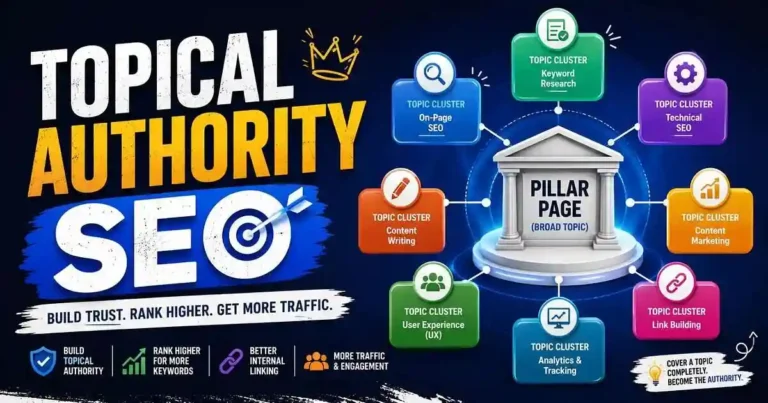
The best way to establish Topical Authority SEO is through the use of a pillar and clusters strategy.
Pillar Page
The pillar page explains the topic broadly and acts as the main resource page.
Example:
Complete Guide to Blogging in 2026
It gives you a brief summary while pointing to further articles on the matter.
Cluster Articles
Cluster articles explain each specific subtopic.
These are such as:
• Blogging Platforms
• Blogging SEO
• Blog Keywords
• SEO Friendly Blogging
• AI Tools for Bloggers
• Monetize Blogs
• Internal Linking Blogging
• WordPress SEO
All these cluster articles point back to the pillar page while the pillar points back to all the cluster articles.
How to Build Topical Authority SEO Step by
Step
Step 1: Choose One Core Topic
Choose a topic that is well suited to your website.
Examples:
• Personal Finance
• Blogging
• Artificial Intelligence
• Digital Marketing
• Freelancing
• Investing
It will be counterproductive to discuss topics that are completely irrelevant to your website.
Step 2: Map Every Related Subtopic
Brainstorm the questions that the target audience will ask.
These could be:
• Domain Names
• Website Hosting
• Search Engine Optimization
• Keyword Research
• Content Writing
• Affiliate Marketing
• Google AdSense
• Email Marketing
• AI Tools
• Analytics
The use of a content map will help to identify such gaps.
Step 3: Prioritize Search Intent
Understand why someone is searching.
Typical search intents include:
- Informational
- Commercial
- Transactional
- Navigational
Create content that aligns with each intent instead of forcing every article to sell something.
Step 4: Create High-Quality Content
Each article must:
• Solve an actual problem
• Provide practical illustrations
• Address relevant inquiries
• Use descriptive titles
• Be clear and understandable
• Keep pace with time
Producing superficial or redundant articles makes you look less authoritative.
Step 5: Build a Strong Internal Linking Structure
Internal links are one of the foundations of topical authority.
A good strategy includes:
- Linking pillar pages to cluster pages
- Linking cluster pages back to the pillar
- Connecting related cluster articles where relevant
- Using descriptive anchor text
This helps search engines understand the relationship between your content.
Step 6: Update Existing Content
SEO is not something that needs to be done once.
Go through your past articles and:
• Include additional information
• Supplement examples
• Update statistics
• Fix broken links
• Extend incomplete sections
Newer content can have more success.
Practical Example
Let’s assume that you run a finance blog.
You don’t write random blogs, instead you create an entire “Investing” hub.
Your hierarchy may consist of:
Pillar Page
• Complete Beginner’s Guide to Investing
Supporting Blogs
• Best Investment Apps
• ETFs Explained
• Mutual Funds Guide
• Dividend Investing
• Index Funds
• Risk Management
• Retirement Investing
• Tax-Efficient Investing
• Portfolio Diversification
• Common Investing Mistakes
With the growth of your content library, Google becomes sure about the comprehensiveness of your website on the subject matter.
Actionable Tips for Building Topical
Authority Faster
- Publish consistently within one niche.
- Cover beginner, intermediate, and advanced topics.
- Improve older articles instead of only creating new ones.
- Link related content naturally.
- Research competitor content gaps.
- Answer common user questions thoroughly.
- Focus on quality over quantity.
- Create original visuals and helpful examples.
- Monitor Search Console for new keyword opportunities.
- Keep your content updated throughout the year.
Common Mistakes
Several sites face difficulties due to the mistakes that could easily be avoided.
These may be:
• Focusing on unconnected subjects.
• Creating different articles for the same keyword.
• Not using internal linking.
• Creating low-quality content.
• Taking short-term approaches without thinking of long term.
• Not working on old articles.
• Posting content created by AI without edits or expertise.
Topical authority is built with consistency.
Frequently Asked Questions
1. What is Topical Authority SEO?
Topical Authority SEO is a method of producing content related to the entire topic that will make the search engines view your website as an authoritative source of information about the topic.
2. How long does it take to build topical authority?
This depends on the kind of business you have, as well as the frequency at which you produce new content; it can take months or even years for you to realize any results.
3. Is topical authority more efficient than keyword targeting?
Keyword research is still important, but topical authority provides a wider approach.
4. Should small websites require topical authority?
Yes, even smaller and new websites can achieve the required topical authority by narrowing down on one topic first and then moving to related ones.
5. Is internal linking useful for topical authority?
Yes, internal linking definitely helps in understanding the relation of content among the various pages.
Conclusion
SEO for Topical Authority is undoubtedly the most sustainable way of generating organic traffic in 2026. Rather than publishing random articles, establish a full-fledged content ecosystem around the topics which you are expert in. By establishing pillar pages, creating content clusters, effective use of internal links and continuous updating, you will be able to build a site that will be trustworthy for both search engines and the users.
Instead of publishing as many articles as possible, your main aim should be to publish the best possible content in your area of expertise.












Your comment will appear immediately after submission.