During a rain-affected limited-overs cricket match (ODI or T20), fans and commentators often ask: “What will be the revised target now?”
The scientific and ICC-approved answer to this challenge is the DLS Method. But do you know what DLS stands for in cricket? How does it recalculate targets when overs are lost? In this article, we cover the full form of DLS, its origin, resource percentages, and step-by-step calculation logic in simple terms.
What is the DLS Full Form in Cricket?
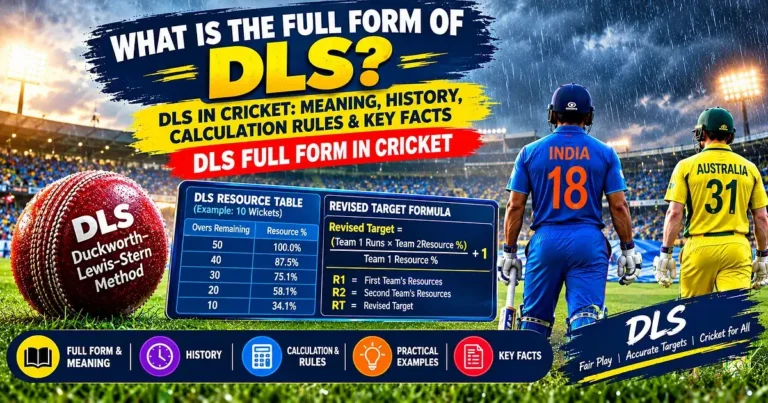
The full form of DLS in cricket is Duckworth-Lewis-Stern Method.
- DLS Full Form: Duckworth-Lewis-Stern Method
- Named After: Frank Duckworth, Tony Lewis, and Steven Stern.
- Governing Body Approval: Adopted by the International Cricket Council (ICC).
- Applied Formats: One Day Internationals (ODIs), T20 Internationals (T20Is), and franchise leagues like the IPL.
The meaning of the name “Duckworth-Lewis-Stern” (DLS)
The method is named directly after its creators and contributors who developed and updated the mathematical formula:
- Frank Duckworth & Tony Lewis: The two English statisticians who originally created and introduced the Duckworth-Lewis (D/L) method in the late 1990s to ensure fair and impartial outcomes for rain-affected matches.
- Steven Stern: The Australian statistician and professor who updated the formula in 2015 to adapt to modern, high-scoring T20 cricket, giving the method its present form (DLS).
It is a mathematical formula used to calculate fair revised targets for the team batting second when a limited-overs match is interrupted by rain, bad light, or weather delays.
History and Key Statistics of the DLS Method
Before DLS, older methods (like the Average Run Rate or Most Productive Overs rule) led to unfair match conditions—most famously during the 1992 World Cup semi-final, where South Africa needed 22 runs off just 1 ball due to flawed rules.
To eliminate these flaws, British statisticians Frank Duckworth and Tony Lewis devised the Duckworth-Lewis (D/L) method in 1996.
Key Milestones:
- First International Use: January 1, 1997 (Zimbabwe vs. England ODI at Harare Sports Club).
- Official ICC Adoption: Adopted globally ahead of the 1999 ICC Cricket World Cup.
- Modern Update (D/L to DLS): In 2015, Australian professor Steven Stern updated the calculation algorithm for modern high-scoring T20 cricket, renaming it to DLS.
Usage Statistics Across Formats:
- ODI Cricket: Applied in 300+ international matches over the last two decades.
- T20 Internationals & Leagues: Used in 700+ recognized T20 matches worldwide.
- IPL Matches: Used in 40+ IPL matches since 2008 (including the famous 2023 IPL Final, where CSK received a revised target of 171 in 15 overs to win the trophy).
Core Concept: “Resource Percentage”
The foundation of the DLS method revolves around a batting team’s available Resources. Resources depend on two critical factors:
- Overs Remaining
- Wickets in Hand
At the start of a 50-over inning, a team possesses 100% of its resources. As overs are bowled and wickets fall, this resource percentage decreases according to the official ICC DLS Resource Table.
How to Calculate DLS Target (Step-by-Step Example)
DLS determines the revised target using the following core formula:
Revised Target=(Team 1 Resource %Team 1 Runs×Team 2 Resource %)+1
(Note: Fractional results are rounded up to the next whole integer to set the winning target).
Step-by-Step Calculation Example:
Consider an ODI match between India (batting 1st) and Australia (batting 2nd).
Step 1 (First Inning – India):
India plays a full 50 overs and scores 250 runs for 5 wickets.
India utilized 100% of their available resources.
Step 2 (Rain Interruption – Australia):
Heavy rain delays the start of Australia’s chase, reducing their innings from 50 overs to 30 overs (with all 10 wickets intact).
According to the ICC DLS resource chart, 30 overs with 10 wickets in hand equals 75.1% resource.
Step 3 (Applying the Values into the DLS Formula):
- India’s Score: 250India’s Resource: 100%Australia’s Resource: 75.1%
Calculation Steps:
Multiply Team 1 score by Team 2 resource: 250×75.1=18,775

Divide by Team 1 resource: 18,775÷100=187.75

Rounding Rule: Since fractional runs are not possible in cricket, 187.75 is rounded up to the next integer, which is 188.
Final Result: Australia needs 188 runs in 30 overs to win the match.
Minimum Overs Rule for DLS Application
For a match result to be declared via DLS, both teams must complete a minimum number of overs:
- T20 Matches (T20I / IPL): The team batting second must face at least 5 overs.
- ODI Matches: The team batting second must face at least 20 overs.
If interruptions prevent reaching these minimum thresholds, the match is declared a “No Result”.
Frequently Asked Questions (FAQ)
What does DLS stand for in cricket?
DLS stands for Duckworth-Lewis-Stern Method.
Is the DLS method used in Test cricket?
No. DLS is strictly designed for limited-overs formats (ODIs and T20s) because Test matches do not have set over limits per innings.
What is a Par Score in DLS?
A Par Score is the target score a chasing team needs to equal at any given point in an interrupted match to avoid losing if play cannot resume.

Your comment will appear immediately after submission.