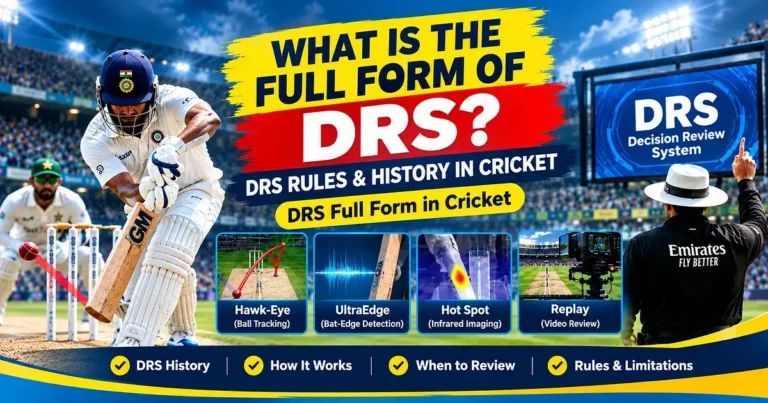
A ball hits the batter’s pad. The fielding team appeals for LBW, but the on-field umpire says, “Not Out.” The captain believes the decision is wrong and requests a review. Within moments, ball-tracking graphics appear on the screen, UltraEdge checks for contact with the bat, and the third umpire examines the evidence.
This is the power of DRS in modern cricket.
The Decision Review System has transformed how important umpiring decisions are reviewed in international cricket. It allows teams to challenge certain on-field decisions under specific playing conditions, using technology and video evidence to help determine the correct outcome.
But what is the full form of DRS? How does it work? What is Umpire’s Call, and why can a decision remain unchanged even after a review?
This comprehensive guide explains the full form, history, rules, technologies, advantages, limitations and frequently asked questions about DRS in cricket.
What Is the Full Form of DRS?
The full form of DRS is Decision Review System.
It is a system used in cricket to review certain decisions made by on-field umpires. When a team believes a decision is incorrect, it can request a review according to the applicable playing conditions. The third umpire then examines the available video footage and technological evidence before confirming or overturning the original decision.
The primary objective of DRS is to reduce the impact of incorrect decisions and make cricket fairer.
- DRS Full Form: Decision Review System
- Purpose: Reviewing eligible on-field umpiring decisions
- Common Applications: LBW decisions, catches and possible contact between the bat and ball
- Who Can Request a Review? The batting or fielding team, through its designated players and according to the applicable rules
Why Is DRS Important in Cricket?
Cricket umpires often have to make difficult decisions in a fraction of a second. A fast delivery, a faint edge or a ball passing close to the stumps can be difficult to judge accurately with the naked eye.
Imagine a bowler appealing for LBW. The umpire rules the batter not out, but the fielding team believes the ball missed the bat and would have hit the stumps. A review allows the team to request further examination of the incident.
Technology can then help assess the ball’s trajectory, possible contact with the bat and other relevant evidence.
The main benefits of DRS include:
- Correcting potential errors: Eligible decisions can be reconsidered using additional evidence.
- Improving LBW assessments: Ball tracking helps determine the projected path of the delivery.
- Reviewing catches: Video and available detection technologies can help establish whether the ball touched the bat or the ground.
- Increasing transparency: Decisions can be supported by visible technical evidence.
- Supporting fair competition: Important incidents can receive further scrutiny under established rules.
However, DRS does not guarantee that every decision will be perfectly accurate. Technology has limitations, and certain decisions must be interpreted according to the Laws of Cricket and the applicable playing conditions.
History of DRS: When Was It First Used in Cricket?
The use of technology to review umpiring decisions developed as broadcasters and cricket authorities explored ways to improve decision-making.
The first experimental use of the Decision Review System in international cricket took place on 23 July 2008, during a Test match between India and Sri Lanka in Colombo.
The system subsequently evolved through further trials, technological improvements and changes to its playing conditions.
| Period | Key Development |
|---|---|
| 2008 | DRS was first experimentally used in the India–Sri Lanka Test series |
| 2009 | International cricket continued evaluating and developing the review system |
| 2011 | Technology-assisted reviews became more prominent in major competitions, including the Cricket World Cup |
| Following years | Ball tracking, UltraEdge and other technologies continued to develop |
| Modern era | DRS is used in various international and domestic competitions, depending on the applicable regulations |
It is important to remember that DRS is not implemented identically in every competition. The available technologies, number of reviews and procedures depend on the relevant playing conditions.
How Does DRS Work in Cricket?
DRS is not a single technology. It combines video analysis, specialised technological tools and established cricket rules.
A typical review follows these steps:
- The on-field umpire makes a decision. The batter may be given out or not out, depending on the incident.
- A team requests a review. The team must follow the prescribed procedure and time limit.
- The third umpire examines the incident. Available video footage and relevant evidence are reviewed.
- Appropriate technologies are used. These may include ball tracking, UltraEdge and other available systems.
- The decision is communicated. The third umpire applies the relevant rules to confirm or overturn the original decision.
The third umpire does not simply guess what happened. The available evidence must be assessed in accordance with the applicable cricket laws and review procedures.
What Technologies Are Used in DRS?
Several technologies can support the DRS process. Each has a different purpose and helps investigate particular types of incidents.
1. Hawk-Eye and Ball Tracking
Ball-tracking technology is one of the most important tools used in reviewing LBW decisions.
Using data captured by multiple cameras, the system models the ball’s trajectory. It helps estimate where the ball pitched, where it struck the batter and the path it would have followed towards the stumps.
During an LBW review, the third umpire uses this information to assess whether the ball would have hit the stumps.
However, ball tracking is a technological prediction rather than a direct observation of what would have happened. Its results must be interpreted according to the applicable LBW law and DRS rules.
2. UltraEdge or Snickometer
UltraEdge helps determine whether the ball made contact with the bat or glove in situations where the evidence is not immediately clear.
The system analyses audio signals alongside video footage to help identify possible contact.
For example, if a batter is caught behind, the third umpire may need to establish whether the ball touched the bat before reaching the wicketkeeper. UltraEdge can provide important supporting evidence.
The displayed waveform is not automatically a final verdict. The third umpire must interpret it alongside the video and the circumstances of the incident.
3. High-Speed Cameras and Slow-Motion Replay
High-speed cameras and slow-motion replays help umpires examine incidents that happen too quickly for the naked eye to assess confidently.
They can be useful when checking:
- Whether the ball touched the bat.
- Whether a catch was completed cleanly.
- Whether the ball touched the ground before being caught.
- Whether a fielder maintained control of the ball.
- Other reviewable incidents requiring detailed visual examination.
The reliability of a review can depend on the available camera angles, visibility and quality of the footage. Multiple views may be examined when available.
4. Hot Spot
Hot Spot is an infrared imaging technology that has been used to identify thermal marks associated with contact between the ball and the bat or other surfaces.
It can sometimes help investigate whether the ball made contact with the bat. However, it is not available in every competition and is not used in every DRS review.
The technologies available for a particular match depend on the event’s technical arrangements and playing conditions.
What Are the Main Rules of DRS?
Teams must follow the applicable DRS rules when requesting a review. They cannot challenge any decision at any time simply because they disagree with the umpire.
1. Who Can Request a Review?
Under the applicable playing conditions, the batting or fielding team may request a review through the designated player or captain.
The request must be made using the prescribed procedure and within the permitted time.
The types of decisions that can be reviewed and the exact process depend on the competition’s regulations.
2. How Many Reviews Are Allowed Per Innings?
The number of reviews available depends on the format and the applicable playing conditions.
Test cricket, One Day Internationals (ODIs) and Twenty20 Internationals (T20Is) may have different provisions, and regulations can change over time.
For this reason, the playing conditions for the specific match should be checked before stating the exact number of reviews available to each team.
3. What Happens When a Review Is Successful?
If the evidence justifies changing the original decision, the umpire’s decision may be overturned.
For example, if a batter is initially given not out but the review establishes that the relevant LBW conditions are satisfied, the batter may be given out.
How a successful review affects the team’s remaining review allowance depends on the applicable playing conditions.
4. What Happens When a Review Is Unsuccessful?
If the evidence does not provide sufficient grounds to overturn the original decision, the on-field decision may stand.
An unsuccessful review can reduce the team’s remaining review allowance. However, Umpire’s Call is an important exception in relevant LBW reviews, where the original decision remains unchanged under the applicable rules without the review being treated like an ordinary unsuccessful review.
5. Is It Legal to Receive Signals from the Dressing Room or Dugout?
External assistance is prohibited when it involves improper signals used to influence a review request.
Players must follow the prescribed on-field review procedure. Using unauthorised signals from the dressing room or dugout to decide whether to request a review may breach the applicable playing conditions or conduct regulations.
The precise consequences depend on the circumstances and the rules governing the competition.
How Does DRS Work in an LBW Review?
LBW stands for Leg Before Wicket.
A batter can be dismissed LBW when a delivery strikes the batter’s body rather than the bat and the relevant conditions of the Laws of Cricket are satisfied.
During an LBW review, the third umpire generally examines several factors:
- Where the ball pitched.
- Whether the ball struck the bat before hitting the batter.
- Where the ball hit the batter’s pad or body.
- Whether the ball would have hit the stumps.
- Whether the other requirements of the LBW law are satisfied.
Ball tracking plays an important role in this assessment. However, the projected trajectory alone does not determine every LBW decision. The pitching location, point of impact, possible contact with the bat and other legal requirements also matter.
What Does Umpire’s Call Mean in DRS?
Umpire’s Call is an important part of the DRS process, particularly during LBW reviews.
When ball-tracking results fall within specified marginal zones, the original on-field decision may remain unchanged under the applicable rules. This situation is known as Umpire’s Call.
Consider a delivery that strikes the batter’s pad close to the line of the stumps. The ball-tracking projection may suggest that the ball would only marginally clip the stumps. If the result falls within the relevant Umpire’s Call zone, the original decision is retained.
If the on-field umpire originally gave the batter not out, that decision may remain not out. If the original decision was out, it may remain out.
Important: Umpire’s Call does not mean the ball definitely would not have hit the stumps. It means the result falls within a defined marginal zone in which the applicable rules preserve the on-field umpire’s decision.
It is also not simply a universal rule that the decision depends on whether 50% of the ball hits the stumps. The relevant ball-tracking thresholds, point of impact and applicable playing conditions determine how Umpire’s Call is applied.
What Happens When a DRS Review Is Successful?
A successful review can change the original on-field decision. The outcome depends on the incident and the relevant cricket rules.
Examples include:
- LBW: A batter initially given not out may be dismissed if the review establishes that the relevant conditions are satisfied.
- Bat contact: A batter given out caught behind may be ruled not out if the evidence shows that the ball did not make the relevant contact and the dismissal cannot stand.
- Catch review: A catch decision may be overturned if the available evidence shows that the ball touched the ground before the catch was completed.
The effect of a successful review on the team’s remaining review allowance depends on the applicable playing conditions.
Advantages and Limitations of DRS
DRS has made important cricket decisions more evidence-based, but it also has limitations.
| Advantages | Limitations |
|---|---|
| Provides an opportunity to correct certain incorrect decisions | Not every competition uses the same technologies |
| Helps assess the projected path of the ball | Ball tracking is a technological prediction |
| Helps examine catches and possible bat contact | Camera angles and video quality can limit the available evidence |
| Improves transparency in decision-making | Some decisions remain unchanged under specific rules |
| Provides additional evidence in crucial moments | The review process can take additional time |
The main advantage of DRS is that it gives umpires additional evidence when reviewing important incidents. Understanding its limitations and the rules governing its use is equally important.
What Is the Difference Between DRS and the Third Umpire?
DRS and the third umpire are closely related, but they are not the same thing.
The third umpire is an official who examines video footage and relevant technological evidence to assist with particular decisions.
DRS is the broader decision-review system, incorporating the review procedure, available technologies and the third umpire’s assessment under the applicable playing conditions.
In simple terms, the third umpire is an important part of DRS, but DRS refers to the overall review process rather than just one official.
Common Misconceptions About DRS in Cricket
Several misconceptions about DRS can cause confusion among cricket fans.
Misconception 1: DRS Eliminates Every Umpiring Error
DRS can reduce the likelihood of incorrect decisions, but it does not guarantee perfect accuracy in every situation. Technology, available evidence and the applicable rules can affect the final outcome.
Misconception 2: A Ball Projected to Hit the Stumps Always Means LBW
Not necessarily. LBW decisions also depend on where the ball pitched, where it struck the batter, whether it hit the bat first and whether the other requirements of the law are satisfied.
Misconception 3: Umpire’s Call Means the Review Was Wrong
This is incorrect. Umpire’s Call is a defined situation in which the technological result falls within a marginal zone and the original decision is retained under the applicable rules.
Misconception 4: Every Cricket Match Allows the Same Number of Reviews
The number of reviews and the conditions governing their use depend on the competition’s playing conditions. Different formats or events may apply different provisions.
Which Was the First Match to Use DRS Technology?
The first experimental use of DRS in international cricket took place on 23 July 2008, during the Test match between India and Sri Lanka in Colombo.
The match marked an important milestone in cricket’s adoption of technology-assisted decision reviews.
Frequently Asked Questions (FAQ)
What Is the Full Form of DRS in Cricket?
DRS stands for Decision Review System. It allows eligible umpiring decisions to be reviewed using video footage and available technologies under the applicable cricket rules.
Why Is DRS Used in Cricket?
DRS helps teams challenge certain on-field decisions and gives the third umpire additional evidence to assess them. Its purpose is to reduce the impact of incorrect decisions and improve fairness.
When Was DRS First Used in International Cricket?
DRS was first experimentally used in international cricket on 23 July 2008, during the India–Sri Lanka Test match in Colombo.
What Is Umpire's Call in DRS?
Umpire’s Call applies to certain marginal LBW review situations in which the ball-tracking result falls within a defined zone. Under the applicable rules, the original on-field decision remains unchanged.
What Is the Role of Hawk-Eye in DRS?
Hawk-Eye-based ball tracking models the delivery’s trajectory and helps determine whether the ball would have hit the stumps. It is particularly important in LBW reviews.
Why Is UltraEdge Used in DRS?
UltraEdge helps detect possible contact between the ball and the bat or glove by analysing audio signals alongside video evidence. It is useful in situations such as caught-behind decisions.
Can Players Request a Review After Receiving a Signal from the Dressing Room?
Answer coming soon…
Does DRS Always Produce the Correct Decision?
No system guarantees perfect accuracy in every situation. DRS improves decision-making by providing additional evidence, but technological limitations and the applicable rules can affect the outcome.

Your comment will appear immediately after submission.