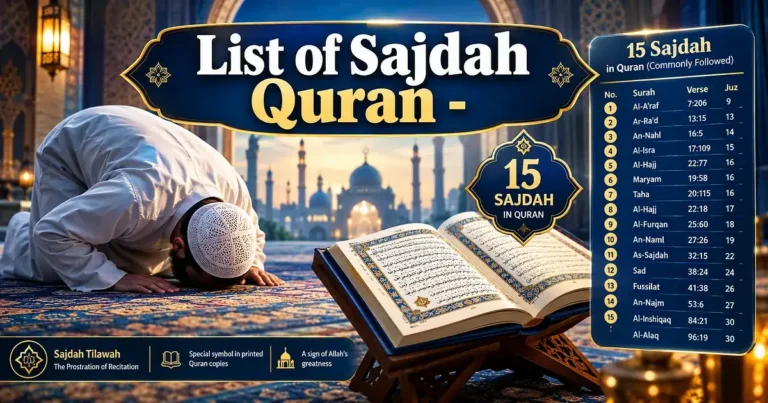
During the recitation of the Quran, there are specific verses at which Muslims perform Sajdah Tilawah, also known as the prostration of recitation. These places are usually marked with a special Sajdah symbol in printed copies of the Quran, making them easier to identify.
According to the commonly followed 15-Sajdah count, the Quran contains 15 places of Sajdah Tilawah. However, some scholars and schools of Islamic jurisprudence count 14. This difference does not mean that different Quranic texts exist; rather, it results from differences in the scholarly classification of certain verses, particularly Surah Al-Hajj 22:77 and Surah Sad 38:24.
How Many Sajdah Are There in the Quran?
The commonly used 15-Sajdah list is given below in sequential order. The table also shows the Surah, verse number, and Juz in which each Sajdah occurs.
| No. | Surah | Verse | Juz |
|---|---|---|---|
| 1 | Al-A’raf | 7:206 | 9 |
| 2 | Ar-Ra’d | 13:15 | 13 |
| 3 | An-Nahl | 16:50 | 14 |
| 4 | Al-Isra | 17:109 | 15 |
| 5 | Maryam | 19:58 | 16 |
| 6 | Al-Hajj | 22:18 | 17 |
| 7 | Al-Hajj | 22:77 | 17 |
| 8 | Al-Furqan | 25:60 | 19 |
| 9 | An-Naml | 27:26 | 19 |
| 10 | As-Sajdah | 32:15 | 21 |
| 11 | Sad | 38:24 | 23 |
| 12 | Fussilat | 41:38 | 24 |
| 13 | An-Najm | 53:62 | 27 |
| 14 | Al-Inshiqaq | 84:21 | 30 |
| 15 | Al-Alaq | 96:19 | 30 |
This list shows that Surah Al-Hajj contains two Sajdah locations, at verses 18 and 77. The remaining Surahs in the 15-Sajdah list contain one location each.
15 Sajdah Locations in the Quran
| label | value |
|---|---|
| 1. Al-A'raf — Surah 7, Ayah 206 | 7 |
| 2. Ar-Ra'd — Surah 13, Ayah 15 | 13 |
| 3. An-Nahl — Surah 16, Ayah 50 | 16 |
| 4. Al-Isra — Surah 17, Ayah 109 | 17 |
| 5. Maryam — Surah 19, Ayah 58 | 19 |
| 6. Al-Hajj — Surah 22, Ayah 18 | 22 |
| 7. Al-Hajj — Surah 22, Ayah 77 | 22 |
| 8. Al-Furqan — Surah 25, Ayah 60 | 25 |
| 9. An-Naml — Surah 27, Ayah 26 | 27 |
| 10. As-Sajdah — Surah 32, Ayah 15 | 32 |
| 11. Sad — Surah 38, Ayah 24 | 38 |
| 12. Fussilat — Surah 41, Ayah 38 | 41 |
| 13. An-Najm — Surah 53, Ayah 62 | 53 |
| 14. Al-Inshiqaq — Surah 84, Ayah 21 | 84 |
| 15. Al-Alaq — Surah 96, Ayah 19 | 96 |
What Is Sajdah Tilawah in the Quran?
Sajdah Tilawah means the prostration performed in connection with reciting or hearing a designated verse of the Quran. It is distinct from the two prostrations performed within each Rak’ah of Salah because Sajdah Tilawah is associated specifically with these marked Quranic passages.
The detailed ruling concerning Sajdah Tilawah—including whether it is obligatory or recommended, the requirement of Wudu, facing the Qiblah, and the circumstances of the reciter or listener—can differ according to the school of Islamic jurisprudence.
For this reason, Muslims should follow the reliable guidance of the scholar or school of jurisprudence they normally follow when applying the ruling in practice.
Why Do Some Lists Have 14 Sajdahs and Others Have 15?
The difference between 14 and 15 Sajdah locations is primarily a matter of jurisprudential classification.
Two passages are particularly important when explaining this difference:
- Surah Al-Hajj, 22:77
- Surah Sad, 38:24
Some scholarly classifications include both passages in the Sajdah list, while other classifications treat one of them differently. As a result, a Quran reference may show 14 Sajdah locations while another reliable reference may show 15.
Therefore, seeing either number does not indicate a difference in the Quranic text itself. The difference comes from how scholars classify particular passages for the purposes of Sajdah Tilawah.
Is Surah Sad 38:24 a Sajdah Verse?
Surah Sad 38:24 is counted as a Sajdah location in the traditional Hanafi classification. Other scholars have differed regarding its precise legal status and whether it should be included among the standard Sajdah Tilawah locations.
This is one of the main reasons readers may encounter a 14-Sajdah list and a 15-Sajdah list. The underlying Quranic verse is the same; the difference concerns its jurisprudential classification.
Why Is Surah Al-Hajj 22:77 Included in Some Sajdah Lists?
Surah Al-Hajj 22:77 commands believers to bow and prostrate and to worship their Lord. Because of the wording and its connection with prostration, some scholars classify this verse as a Sajdah Tilawah location.
Other juristic opinions do not count it as a separate Sajdah Tilawah location. This difference contributes to the variation between commonly circulated 14-Sajdah and 15-Sajdah lists.
How Many Sajdah Locations Are in the 30th Juz?
According to the commonly followed 15-Sajdah list, the 30th Juz contains two Sajdah locations:
- Surah Al-Inshiqaq — 84:21
- Surah Al-Alaq — 96:19
Surah Al-Alaq 96:19 is the final Sajdah location in the commonly used 15-location sequence.
This makes the last part of the Quran particularly important for readers who are memorizing the Sajdah locations. After the Sajdah in Surah Al-Inshiqaq, the final one occurs in Surah Al-Alaq.
How Can You Identify a Sajdah Verse While Reading the Quran?
In many printed copies of the Quran, a special Sajdah symbol or the word “Sajdah” appears near the relevant verse. This visual marking helps readers recognize the location without having to memorize every reference.
Digital Quran applications may also highlight or label these verses separately. Nevertheless, knowing the Surah and verse numbers provides a reliable way to locate them quickly.
For the 30th Juz, the two locations are:
Al-Inshiqaq 84:21 → Al-Alaq 96:19
Complete List of the 15 Sajdah Locations at a Glance
For quick reference, the commonly followed 15-location sequence is:
- Al-A’raf — 7:206
- Ar-Ra’d — 13:15
- An-Nahl — 16:50
- Al-Isra — 17:109
- Maryam — 19:58
- Al-Hajj — 22:18
- Al-Hajj — 22:77
- Al-Furqan — 25:60
- An-Naml — 27:26
- As-Sajdah — 32:15
- Sad — 38:24
- Fussilat — 41:38
- An-Najm — 53:62
- Al-Inshiqaq — 84:21
- Al-Alaq — 96:19
In Which Juz Are the Sajdah Verses Found?
The Sajdah locations are spread across several Juz of the Quran rather than being concentrated in one section.
| Juz | Sajdah Location(s) |
|---|---|
| 9 | Al-A’raf 7:206 |
| 13 | Ar-Ra’d 13:15 |
| 14 | An-Nahl 16:50 |
| 15 | Al-Isra 17:109 |
| 16 | Maryam 19:58 |
| 17 | Al-Hajj 22:18, 22:77 |
| 19 | Al-Furqan 25:60, An-Naml 27:26 |
| 21 | As-Sajdah 32:15 |
| 23 | Sad 38:24 |
| 24 | Fussilat 41:38 |
| 27 | An-Najm 53:62 |
| 30 | Al-Inshiqaq 84:21, Al-Alaq 96:19 |
One important correction for quick reference is that Surah Al-A’raf 7:206 is in Juz 9, not Juz 7. Likewise, the Sajdah in Surah Al-Isra is 17:109, not 17:107.
Conclusion
The commonly followed list contains 15 Sajdah locations in the Quran, beginning with Surah Al-A’raf 7:206 and ending with Surah Al-Alaq 96:19. These locations are distributed across several Juz, with two occurring in Surah Al-Hajj and two in the 30th Juz.
At the same time, some scholars count 14 Sajdah locations because of differences in the jurisprudential classification of particular verses. Therefore, encountering a 14-Sajdah or 15-Sajdah list does not mean that the Quranic text is different.
For practical Quran reading, the most useful approach is to know the commonly recognized locations, understand the reason for the 14-versus-15 difference, and follow the Sajdah Tilawah ruling of a reliable scholar within one’s school of jurisprudence.








Your comment will appear immediately after submission.