
This guide is for general education and exam preparation, not legal advice. Check the India Code and Parliament’s websites for official texts.
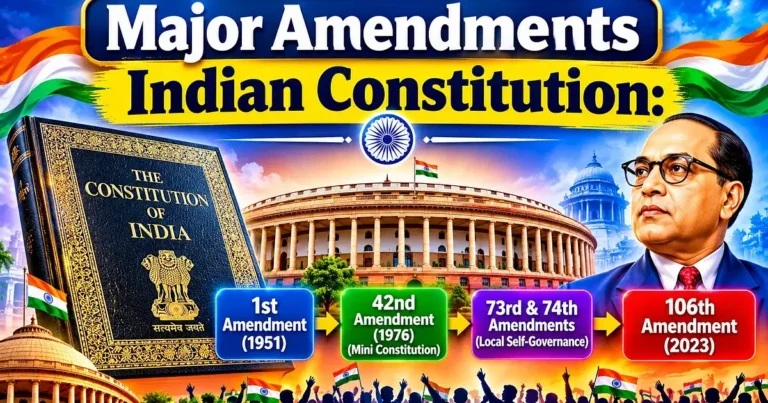
When India’s Constitution came into force on January 26, 1950, its framers deliberately made it neither too rigid nor too flexible. Seventy-six years later, it has been amended 106 times, and each amendment tells a story: a land-reform battle, a wartime Emergency, a push to give villages their own governments, a new national tax, a promise to women. Some changes reshaped the country’s map. Others rewrote the balance between Parliament and the courts, and one was struck down for threatening judicial independence.
This guide walks through the major amendments in order, explains how the amendment process works, and covers the 2024–2026 bills that are still shaping debate. That includes the April 2026 defeat of the 131st Amendment Bill, a development older guides do not mention.
Indian Constitutional Amendments at a Glance
| Detail | Information |
|---|---|
| Total amendments enacted | 106 (as of November 2026) |
| First amendment | Constitution (First Amendment) Act, 1951 |
| Latest enacted amendment | 106th Amendment Act, 2023 (women’s reservation) |
| Constitutional basis | Article 368 (Part XX) |
| Largest single amendment | 42nd Amendment (1976), the “Mini-Constitution” |
| Limit on amending power | The “basic structure” doctrine (Kesavananda Bharati, 1973) |
| Pending or failed bills | 129th (One Nation, One Election) with a Joint Parliamentary Committee; 130th with a committee; 131st defeated in Lok Sabha on April 17, 2026 |
A note on numbering: An amendment gets its number only after it becomes law. A bill’s number can be much higher than its eventual Act number, because many bills never pass. For example, the 106th Amendment Act of 2023 was introduced as the 128th Amendment Bill. That is why bills numbered 129, 130 and 131 exist while the Act count remains 106.
How the Constitution Is Amended
Article 368 gives Parliament the power to amend the Constitution. There are three routes.
1. Simple Majority (Outside Article 368)
Certain provisions can be changed by an ordinary law passed by a simple majority of members present and voting. These are not treated as amendments under Article 368. Examples include the admission or creation of new states, changes to state boundaries and names, and the creation or abolition of legislative councils in states.
2. Special Majority
Most amendments, including those affecting fundamental rights and directive principles, need two things in each House of Parliament:
- a majority of the total membership of the House, and
- a two-thirds majority of members present and voting.
3. Special Majority Plus Ratification by States
Amendments that touch the federal structure also need approval from at least half of the state legislatures. These cover matters such as the election of the President, the distribution of powers between the Union and the states, representation of states in Parliament, the Supreme Court and High Courts, and Article 368 itself. The GST amendment (101st) is a well-known example.
The Basic Structure Doctrine
Parliament’s power to amend is wide, but not unlimited. In Kesavananda Bharati v. State of Kerala (1973), the Supreme Court held that Parliament cannot alter the “basic structure” of the Constitution. Later cases such as Minerva Mills (1980) and I.R. Coelho (2007) applied and extended the principle. Courts have struck down parts of several amendments, and one entire amendment, on these grounds.
The Early Years: 1950s and 1960s
1st Amendment (1951): Land Reform and Limits on Speech
Enacted in June 1951, the first amendment was a response to court rulings that had struck down early land-reform and press-related measures. It:
- added Article 31A and Article 31B and created the Ninth Schedule, shielding listed laws from challenge on fundamental-rights grounds;
- inserted Article 15(4), allowing special provisions for socially and educationally backward classes and for Scheduled Castes and Tribes;
- added grounds for restricting free speech under Article 19(2): public order, friendly relations with foreign states and incitement to an offence, and made the restrictions “reasonable.”
It remains one of the most debated amendments, praised for enabling social reform and criticized for restricting expression.
4th Amendment (1955): Compensation for Property
Made the adequacy of compensation for acquired property non-justiciable, meaning courts could not question the amount.
7th Amendment (1956): Reorganizing the States
Following the States Reorganisation Act, this amendment abolished the old Part A, B, C and D classification of states and created 14 states and 6 union territories, largely on linguistic lines. It also allowed common High Courts for groups of states.
Territorial Amendments (1960–1963)
- 9th (1960): gave effect to an India–Pakistan agreement on the Berubari Union and other enclaves
- 10th (1961): incorporated Dadra and Nagar Haveli
- 12th (1962): incorporated Goa, Daman and Diu
- 13th (1962): created Nagaland as a state with special provisions (Article 371A)
- 14th (1962): incorporated Puducherry
21st Amendment (1967): Sindhi Added
Added Sindhi to the Eighth Schedule as the 15th recognized language.
The 1970s: Power, Property and the Emergency
24th Amendment (1971)
Passed after the Golak Nath ruling, it declared that Parliament can amend any part of the Constitution, including fundamental rights, and made the President’s assent to amendment bills mandatory.
25th Amendment (1971)
Replaced “compensation” with “amount” in the property-acquisition article and added Article 31C, giving priority to certain directive principles over some fundamental rights.
26th Amendment (1971)
Abolished the privy purses and privileges of former princely rulers.
31st and 36th Amendments (1973 and 1975)
The 31st raised the Lok Sabha’s maximum strength from 525 to 545 elected seats. The 36th made Sikkim the 22nd state of India.
39th Amendment (1975)
Placed disputes over the election of the Prime Minister and the Speaker beyond judicial review. The Supreme Court struck down part of it in Indira Nehru Gandhi v. Raj Narain (1975).
42nd Amendment (1976): The “Mini-Constitution”
Passed during the Emergency on the recommendations of the Swaran Singh Committee, the 42nd Amendment changed more of the Constitution than any other. It:
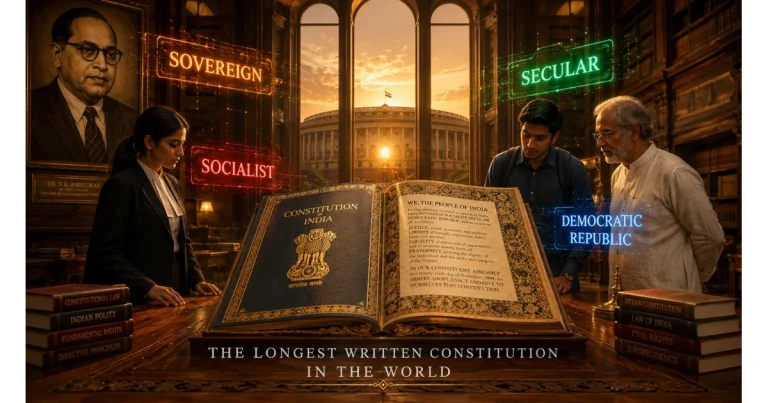
- added the words “Socialist,” “Secular” and “Integrity” to the Preamble;
- introduced Fundamental Duties (Part IVA, Article 51A);
- made the President bound by the advice of the Council of Ministers;
- extended the term of the Lok Sabha and state assemblies from five to six years;
- tried to bar courts from reviewing constitutional amendments and gave directive principles primacy over fundamental rights;
- added new directive principles on free legal aid, worker participation in management and protection of the environment;
- moved subjects such as education and forests to the Concurrent List.
The Supreme Court later struck down the provisions barring judicial review and giving directive principles supremacy over fundamental rights in Minerva Mills v. Union of India (1980).
The Rollback: 44th Amendment (1978)
After the Emergency ended, the Janata government passed the 44th Amendment to undo many of the 42nd’s changes and to guard against a repeat of the Emergency. It:
- restored the five-year term of the Lok Sabha and state assemblies;
- replaced “internal disturbance” with “armed rebellion” as a ground for declaring a national Emergency, and required the Cabinet’s written recommendation;
- ensured that the rights to life and personal liberty (Article 21) and protection in respect of conviction (Article 20) cannot be suspended during an Emergency;
- removed the right to property from the list of fundamental rights, making it an ordinary legal right under Article 300A.
That last change is why property is no longer a fundamental right in India.
1980s and 1990s: Defection, Voting Age and Grassroots Democracy
52nd Amendment (1985): Anti-Defection Law
Added the Tenth Schedule, disqualifying legislators who defect from their parties. The Supreme Court upheld its validity in Kihoto Hollohan (1992).
61st Amendment (1988): Voting Age Lowered
Reduced the voting age for Lok Sabha and assembly elections from 21 to 18.
69th Amendment (1991): Delhi
Created the Legislative Assembly and Council of Ministers for the National Capital Territory of Delhi (Article 239AA).
73rd Amendment (1992): Panchayati Raj
Gave constitutional status to rural local government. It added Part IX, the Eleventh Schedule listing 29 subjects, regular elections and reservation of seats for women and for Scheduled Castes and Tribes. It came into force in April 1993.
74th Amendment (1992): Municipalities
Did the same for urban local bodies, adding Part IXA and the Twelfth Schedule with 18 subjects. It came into force in June 1993.
Together, the 73rd and 74th Amendments created a third tier of government in India.
2000s: Education, Cabinet Size and Reservation
86th Amendment (2002): Right to Education
Inserted Article 21A, making free and compulsory education a fundamental right for children aged 6 to 14. It also added a fundamental duty for parents to provide educational opportunities. The Right to Education Act followed in 2009.
91st Amendment (2003): Limits on Ministers and Defectors
Capped the Council of Ministers at 15 percent of the strength of the House and tightened the anti-defection law by removing the exemption for splits.
92nd Amendment (2003)
Added Bodo, Dogri, Maithili and Santhali to the Eighth Schedule.
93rd Amendment (2005)
Allowed the state to make special provisions for backward classes, Scheduled Castes and Scheduled Tribes in admission to educational institutions, including private unaided ones (Article 15(5)).
2010s: Cooperatives, Judges, Borders and a National Tax
97th Amendment (2011): Cooperative Societies
Gave constitutional status to cooperatives. In 2021, the Supreme Court struck down the part dealing with state-level cooperatives because it had not been ratified by the required number of states, while upholding it for multi-state cooperative societies.
99th Amendment (2014): The NJAC
Created the National Judicial Appointments Commission to replace the collegium system for selecting judges. In October 2015, the Supreme Court struck down the amendment in the Fourth Judges Case, holding that it violated judicial independence, part of the basic structure. The collegium system continues.
100th Amendment (2015): Land Boundary Agreement with Bangladesh
Gave effect to the India–Bangladesh Land Boundary Agreement, exchanging enclaves between the two countries. India transferred 111 enclaves to Bangladesh and received 51 in return, ending decades of uncertainty for the people who lived in them.
101st Amendment (2016): Goods and Services Tax
Introduced the GST, creating Articles 246A, 269A and 279A and the GST Council. It required ratification by the states and came into effect on July 1, 2017.
102nd Amendment (2018)
Gave constitutional status to the National Commission for Backward Classes (Article 338B).
103rd Amendment (2019): EWS Reservation
Provided up to 10 percent reservation in education and public employment for economically weaker sections outside the existing reservation categories (Articles 15(6) and 16(6)). The Supreme Court upheld it in November 2022 by a 3–2 majority.
104th Amendment (2019)
Ended the nomination of Anglo-Indian members to the Lok Sabha and state assemblies and extended reservation for Scheduled Castes and Scheduled Tribes in legislatures by ten years, to 2030.
The 2020s: Backward Classes and Women’s Reservation
105th Amendment (2021)
Restored the power of state governments to identify socially and educationally backward classes for their own purposes, after a Supreme Court ruling on Maratha reservation had interpreted the 102nd Amendment as removing it.
106th Amendment (2023): Women’s Reservation
Passed as the Nari Shakti Vandan Adhiniyam, the 106th Amendment provides:
- reservation of one-third (33 percent) of seats for women in the Lok Sabha, state legislative assemblies and the Delhi Assembly, through new Articles 330A, 332A and 334A;
- sub-reservation within that quota for Scheduled Caste and Scheduled Tribe women;
- a validity of 15 years, which Parliament can extend.
The Lok Sabha passed the bill on September 20, 2023 by 454 votes to 2, and the Rajya Sabha passed it unanimously the next day, with 214 votes in favor. The President gave assent on September 28, 2023.
The Act ties the reservation to the first census held after it came into effect and to a delimitation exercise based on that census. That condition is why the quota has not yet been applied to any election, and why 2026 became politically charged.
What Happened in 2024–2026: Bills Still in Play
The 129th Amendment Bill (One Nation, One Election)
Introduced in December 2024, this bill seeks to hold Lok Sabha and state assembly elections simultaneously. It was referred to a Joint Parliamentary Committee, which has continued its work through 2026. The committee stated in July 2026 that it considers the framework consistent with the Constitution. The bill has not become law.
The 130th Amendment Bill (Removal of Ministers on Detention)
Introduced in August 2025, this bill proposes removing the Prime Minister, chief ministers or ministers who are held in custody for a prolonged period on serious charges. It is with a parliamentary committee.
The 131st Amendment Bill (2026): Defeated
On April 16, 2026, the government introduced the Constitution (131st Amendment) Bill, along with a Delimitation Bill and a Union Territories Laws Bill. The package aimed to implement women’s reservation sooner, without waiting for the next census, by linking it to delimitation on the basis of the 2011 census and by raising the maximum strength of the Lok Sabha from 550 to 850.
On April 17, 2026, the bill failed in the Lok Sabha. It received 298 votes in favor and 230 against, short of the 352 votes needed to reach a two-thirds majority of the 528 members present and voting. The government then withdrew the two companion bills.
The debate reflected a split between two positions. The government argued that waiting for the census and a fresh delimitation would delay women’s representation unnecessarily. Opposition parties said they supported women’s reservation in principle but objected to tying it to seat expansion and delimitation, with several, including parties from southern states, raising concerns about how such changes would affect representation. Because the bill was defeated, the 106th Amendment remains the latest amendment enacted, and its original conditions still apply.
Quick Reference Table: Major Amendments
| Amendment | Year | What it did |
|---|---|---|
| 1st | 1951 | Ninth Schedule; Article 15(4); new limits on free speech |
| 7th | 1956 | Reorganized states on linguistic lines |
| 21st | 1967 | Added Sindhi to the Eighth Schedule |
| 24th | 1971 | Affirmed Parliament’s power to amend fundamental rights |
| 26th | 1971 | Abolished privy purses |
| 36th | 1975 | Made Sikkim a state |
| 42nd | 1976 | “Mini-Constitution”; Preamble words; Fundamental Duties |
| 44th | 1978 | Rolled back the 42nd; property no longer a fundamental right |
| 52nd | 1985 | Anti-defection law (Tenth Schedule) |
| 61st | 1988 | Voting age lowered to 18 |
| 73rd | 1992 | Panchayati Raj |
| 74th | 1992 | Municipalities |
| 86th | 2002 | Right to Education (Article 21A) |
| 91st | 2003 | Cap on size of Council of Ministers |
| 99th | 2014 | NJAC, struck down in 2015 |
| 100th | 2015 | India–Bangladesh land boundary |
| 101st | 2016 | Goods and Services Tax |
| 103rd | 2019 | 10 percent EWS reservation |
| 104th | 2019 | SC/ST reservation extended to 2030; Anglo-Indian nomination ended |
| 105th | 2021 | States’ power to identify backward classes restored |
| 106th | 2023 | One-third reservation for women |
Why Amendments Matter
The pattern behind these 106 changes is revealing. Many amendments responded to court decisions, whether to enable land reform (1st), reverse a ruling on fundamental rights (24th) or restore a state power (105th). Others reflected moments of political stress, from the Emergency (42nd) to the Emergency’s repudiation (44th). Still others quietly expanded democracy at the grassroots (73rd and 74th) or reshaped the economy (101st). Through it all, the basic structure doctrine has acted as a boundary, a reminder that Parliament’s power to amend is not a power to rewrite the Constitution’s core identity.
Conclusion
The amendment history of the Indian Constitution is, in effect, the history of independent India: its land reforms and linguistic states, its constitutional crises and recoveries, its attempts to broaden participation for villages, backward classes and women. As of November 2026, the 106th Amendment remains the latest enacted change, while the 129th and 130th bills sit in committee and the defeat of the 131st shows how contested amending the Constitution still is. Whatever comes next will have to pass the same test as everything before it: a special majority in Parliament and, where the federal structure is touched, the consent of the states.
Frequently Asked Questions
How many amendments have been made to the Indian Constitution so far?
As of November 2026, the Constitution of India has been amended 106 times. The first amendment was enacted in 1951 and the 106th, the women’s reservation amendment, in 2023. Bills for further amendments have been introduced since then, but none has yet become law.
Which is the latest amendment to the Indian Constitution?
The 106th Amendment Act of 2023, known as the Nari Shakti Vandan Adhiniyam, is the most recent enacted amendment. It provides one-third reservation for women in the Lok Sabha, state assemblies and the Delhi Assembly. The 131st Amendment Bill of 2026 was defeated in the Lok Sabha, so the next Act number remains open.
When was the first amendment to the Indian Constitution passed?
The Constitution (First Amendment) Act was enacted in June 1951. It added Articles 31A and 31B and the Ninth Schedule to protect land-reform laws, inserted Article 15(4) for special provisions for backward classes, and added new grounds for restricting free speech.
Which amendment is called the Mini-Constitution and why?
The 42nd Amendment (1976) is called the Mini-Constitution because it changed more of the Constitution than any other. It added the words Socialist, Secular and Integrity to the Preamble, introduced Fundamental Duties, made the President bound by the Council of Ministers’ advice, and extended the term of the Lok Sabha and state assemblies to six years. The Supreme Court later struck down some of its provisions in Minerva Mills (1980).
What is the difference between the 1st and the 44th Amendment?
The 1st Amendment (1951) created the Ninth Schedule to shield land-reform laws and added restrictions on free speech. The 44th Amendment (1978) reversed many changes made by the 42nd, restored the five-year term of legislatures, added safeguards against misuse of Emergency powers and removed the right to property from the fundamental rights. The two amendments address very different eras and concerns.
Did the 44th Amendment restore judicial review?
Not by itself in full. The 44th Amendment reversed several 42nd Amendment changes and added Emergency safeguards. The provisions of the 42nd that barred judicial review of constitutional amendments were struck down by the Supreme Court in Minerva Mills v. Union of India (1980).
What does Article 368 say about amending the Constitution?
Article 368 in Part XX gives Parliament the power to amend the Constitution and lays down the procedure. Most amendments need a majority of the total membership of each House plus two-thirds of members present and voting. Amendments affecting the federal structure also need ratification by at least half of the state legislatures.
What is the difference between a simple majority and a special majority amendment?
Some provisions, such as the creation of new states or the abolition of state legislative councils, can be changed by a simple majority of members present and voting, outside Article 368. Special majority amendments need a majority of the total membership of each House and two-thirds of members present and voting. This route covers fundamental rights, directive principles and most other constitutional changes.
Which amendments need ratification by the states?
Amendments that affect the federal structure need approval from at least half of the state legislatures after passing Parliament by a special majority. These include the election of the President, the distribution of powers between the Union and states, the representation of states in Parliament, the Supreme Court and High Courts, and Article 368 itself. The GST amendment (101st) is a well-known example.
What is the basic structure doctrine?
The doctrine holds that Parliament can amend the Constitution but cannot alter its basic structure. It comes from Kesavananda Bharati v. State of Kerala (1973) and was developed in later cases such as Minerva Mills (1980) and I.R. Coelho (2007). Courts have used it to strike down parts of several amendments.
Can Parliament amend fundamental rights?
Yes, within limits. The 24th Amendment (1971) affirmed Parliament’s power to amend any part of the Constitution, including fundamental rights, and Kesavananda Bharati (1973) accepted that power but ruled that the basic structure cannot be destroyed. Amendments that violate the basic structure can be struck down.
What is the Ninth Schedule?
The Ninth Schedule was added by the 1st Amendment in 1951 to protect listed laws, mainly land-reform measures, from challenge on the ground of violating fundamental rights. In I.R. Coelho (2007), the Supreme Court held that laws placed in it after April 24, 1973 can be reviewed against the basic structure.
Which amendment removed the right to property from the fundamental rights?
The 44th Amendment (1978) removed the right to property from the list of fundamental rights by deleting Article 19(1)(f) and Article 31. It was made an ordinary legal right under Article 300A, which says no person shall be deprived of property except by authority of law.
Which amendment added Socialist, Secular and Integrity to the Preamble?
The 42nd Amendment (1976) added the words Socialist, Secular and Integrity to the Preamble. It is the only amendment to the Preamble so far.
Which amendment introduced Fundamental Duties?
The 42nd Amendment (1976) added Part IVA and Article 51A, introducing Fundamental Duties. The 86th Amendment (2002) later added a duty for parents and guardians to provide educational opportunities to children between 6 and 14.
Which amendment introduced the anti-defection law?
The 52nd Amendment (1985) added the Tenth Schedule, which disqualifies legislators who defect from their party. The Supreme Court upheld its validity in Kihoto Hollohan (1992). The 91st Amendment (2003) later removed the exemption for party splits.
Which amendment lowered the voting age to 18?
The 61st Amendment (1988) reduced the voting age for Lok Sabha and state assembly elections from 21 to 18 years.
Which amendments introduced Panchayati Raj and Municipalities?
The 73rd Amendment (1992) gave constitutional status to Panchayats through Part IX and the Eleventh Schedule, listing 29 subjects. The 74th Amendment (1992) did the same for Municipalities through Part IXA and the Twelfth Schedule, listing 18 subjects. They came into force in April and June 1993 and created a third tier of government.
Which amendment made education a fundamental right?
The 86th Amendment (2002) inserted Article 21A, making free and compulsory education a fundamental right for children aged 6 to 14. The Right to Education Act, passed in 2009, put it into practice.
Which amendment introduced the GST?
The 101st Amendment (2016) introduced the Goods and Services Tax by creating Articles 246A, 269A and 279A and establishing the GST Council. It required ratification by the states and came into effect on July 1, 2017.
Which amendment gave 10 percent reservation to economically weaker sections?
The 103rd Amendment (2019) provides up to 10 percent reservation in education and public employment for economically weaker sections outside existing reservation categories, through Articles 15(6) and 16(6). The Supreme Court upheld it in November 2022 by a 3 to 2 majority.
What did the 104th Amendment do?
The 104th Amendment (2019) ended the nomination of Anglo-Indian members to the Lok Sabha and state assemblies. It also extended reservation of seats for Scheduled Castes and Scheduled Tribes in legislatures by ten years, to 2030.
What was the 99th Amendment and why was it struck down?
The 99th Amendment (2014) created the National Judicial Appointments Commission to replace the collegium system for choosing judges. In October 2015, the Supreme Court struck it down in the Fourth Judges Case, holding that it violated judicial independence, which is part of the basic structure. The collegium system continues.
Which amendment gave effect to the India-Bangladesh land boundary agreement?
The 100th Amendment (2015) gave effect to the India-Bangladesh Land Boundary Agreement. India transferred 111 enclaves to Bangladesh and received 51 in return, ending decades of uncertainty for the people living in them.
What did the 7th Amendment do?
Passed after the States Reorganisation Act, the 7th Amendment (1956) abolished the old Part A, B, C and D classification of states. It created 14 states and 6 union territories, largely on linguistic lines, and allowed common High Courts for groups of states.
What is the 106th Amendment?
The 106th Amendment (2023), the Nari Shakti Vandan Adhiniyam, provides one-third reservation for women in the Lok Sabha, state legislative assemblies and the Delhi Assembly, with sub-reservation for Scheduled Caste and Scheduled Tribe women. It was passed 454 to 2 in the Lok Sabha and 214 to 0 in the Rajya Sabha, and received presidential assent on September 28, 2023.
What is the reservation percentage for women under the 106th Amendment?
It reserves one-third, or about 33 percent, of seats for women in the Lok Sabha and state assemblies, and SC and ST women get a sub-reservation within that quota. The reservation lasts for 15 years unless Parliament extends it. It does not cover the Rajya Sabha or state legislative councils.
When will women's reservation under the 106th Amendment come into effect?
The Act ties the reservation to the first census held after its commencement and to a delimitation exercise based on that census. According to LiveLaw, the Union Government notified the Act’s commencement with effect from April 16, 2026. The reservation has not yet been applied to any election, because the census and delimitation conditions remain to be met.
What was the 131st Amendment Bill and what happened to it?
The Constitution (131st Amendment) Bill, 2026, introduced on April 16, 2026, sought to implement women’s reservation sooner by linking it to delimitation based on the 2011 census and by raising the Lok Sabha’s maximum strength from 550 to 850. On April 17, 2026, it failed in the Lok Sabha with 298 votes in favor and 230 against, short of the 352 needed for a two-thirds majority. The government then withdrew the companion Delimitation Bill and Union Territories Laws Bill.
Why did the 131st Amendment Bill fail?
It did not reach the two-thirds majority of members present and voting that constitutional amendments require. The government argued that waiting for the next census and delimitation would delay women’s representation. Opposition parties said they supported women’s reservation in principle but objected to linking it with delimitation and seat expansion, with concerns raised by several parties including some from southern states.
What is the One Nation, One Election bill?
The Constitution (129th Amendment) Bill, 2024, introduced in December 2024, seeks to hold Lok Sabha and state assembly elections simultaneously. It was referred to a Joint Parliamentary Committee, which stated in July 2026 that the framework conforms to the Constitution. The bill has not yet become law.
What is the 130th Amendment Bill?
The Constitution (130th Amendment) Bill, 2025, introduced in August 2025, proposes removing the Prime Minister, chief ministers or ministers who are held in custody for a prolonged period on serious charges. It is with a parliamentary committee and has not become law.
Why do amendment bill numbers differ from Act numbers?
An amendment receives its Act number only after it becomes law. Many amendment bills never pass, so bill numbers run ahead of Act numbers. For example, the 106th Amendment Act of 2023 was introduced as the 128th Amendment Bill, which is why bills numbered 129, 130 and 131 exist while the count of Acts remains 106.





Your comment will appear immediately after submission.