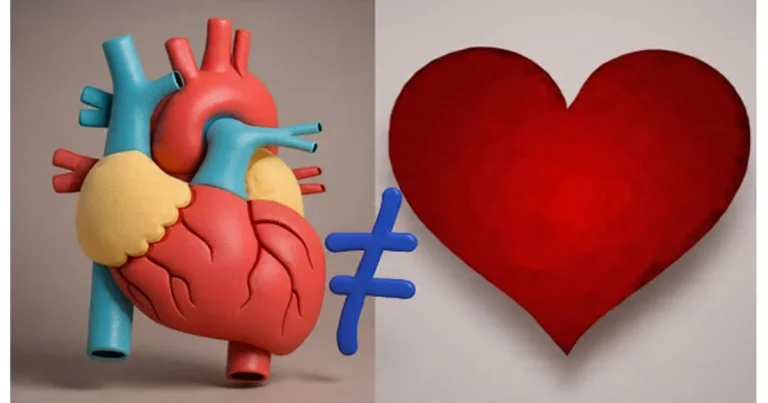
Biologically, the heart is a tireless pump. It works day and night, filtering blood to remove CO2 and replenishing it with oxygen before circulating it to every cell for vital biological reactions. It is a masterpiece of engineering, yet it has no cognitive ability to “feel.”
So, how did this muscular organ become the universal ambassador of love and sadness while our brain remains the actual control center for emotions?
The Palpitation Paradox: A Biological Misunderstanding
In ancient times, humanity lacked the advanced neurological knowledge we possess today. People were unaware that emotions like love, hate, and fear were generated within the complex networks of the brain. However, they did notice a very physical reaction to emotional stimuli: extreme heartbeats and palpitations.
When ancient people saw someone they loved or faced a terrifying situation, their heart raced. Naturally, they concluded that the heart was the actual epicenter of these feelings. They believed the heart created the emotion, rather than simply reacting to the brain’s hormonal signals.
The Mystery of the Heart Shape
If you look at a biological heart, it resembles the shape of a closed fist—far from the symmetrical, smooth-curved icon we see on Valentine’s cards. So, where did our “love heart” shape come from?
The answer lies in the ancient world and a plant called Silphium.
- The Romantic Flora: Silphium was a medicinal plant in ancient Cyrene. Its seeds were distinctively heart-shaped, and its flowers featured bright pink, heart-shaped petals.
- Aristotle’s Influence: Great thinkers like Aristotle and Galen described the heart as a three-chambered organ with a rounded top and a pointed bottom.
In the medieval era, artists and illustrators took these philosophical descriptions and combined them with the visually pleasing aesthetics of the Silphium plant. Over time, the “Silphium heart” became the standard artistic representation of the human heart.
A Philosophical Mistake that Simplified Life
While scientifically inaccurate, this historical “mistake” by our ancestors has undeniably made our lives easier. Imagine a world where we had to be scientifically accurate to express our feelings. Instead of drawing a simple, symmetrical heart, we would have to sketch a complex, anatomically correct brain or a fist-shaped muscular organ every time we wanted to say “I love you.”
The heart symbol provides a visual shorthand for the most complex human emotions. It is a beautiful irony that a misunderstanding of anatomy gave us the most recognizable symbol of affection in human history.











Your comment will appear immediately after submission.