
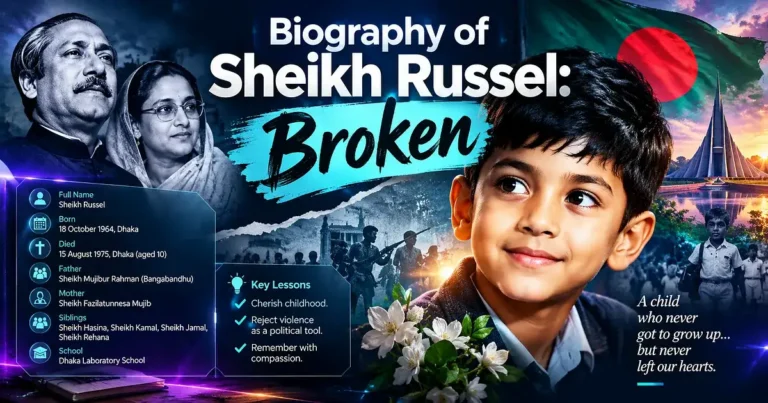
Some lives are remembered for what they achieved. Others are remembered for everything they never got the chance to become. Sheikh Russel was ten years old when he was killed. He never gave a speech, led a movement or held an office, yet his name and his face, a small boy with wide, curious eyes, have stayed in Bangladesh’s collective memory for decades. This is the story of that child, the family he was born into, and the reasons his short life still matters.
Quick Facts
| Detail | Information |
|---|---|
| Full Name | Sheikh Russel |
| Born | 18 October 1964, Dhaka |
| Died | 15 August 1975, Dhaka (aged 10) |
| Father | Sheikh Mujibur Rahman (Bangabandhu) |
| Mother | Sheikh Fazilatunnesa Mujib |
| Siblings | Sheikh Hasina, Sheikh Kamal, Sheikh Jamal, Sheikh Rehana |
| School | Dhaka Laboratory School |
Who Was Sheikh Russel?
Sheikh Russel was the youngest son of Sheikh Mujibur Rahman, the leader of Bangladesh’s independence movement, and Sheikh Fazilatunnesa Mujib. He was born into one of the most politically significant families in the country’s history.
On 15 August 1975, during a military coup, he was killed along with his father, his mother and most of his immediate family. Because of his age and his complete distance from politics, he is remembered in Bangladesh as a symbol of childhood innocence and of the human cost of political violence.
Birth and Early Life
Born Into a Household of History
Russel was born in Dhaka on 18 October 1964, while his father was a central figure in Bengali politics, repeatedly jailed for demanding the rights of the Bengali people. Commonly cited accounts say he was named in admiration of the British philosopher and peace advocate Bertrand Russell. The household he grew up in was shaped by political struggle, long absences and uncertainty, but also by the warmth of a close-knit family.
A Childhood of Play and Affection
Family members describe Russel as cheerful, curious and playful. As the youngest of the family, he was its center of affection. He had a close bond with his mother and his siblings, particularly his elder sister Sheikh Hasina, who later became prime minister of Bangladesh. By these accounts he loved pets and birds, enjoyed riding his bicycle, and liked listening to the conversations of adults around him. In many ways his childhood was an ordinary one: school, games, mischief and the comfort of home.
Education
Russel studied at Dhaka Laboratory School. Like any schoolboy, his daily world was made of classrooms, friends and playgrounds. It was a normal, quiet routine in a house that was anything but ordinary, and one that would be cut short before he could finish his schooling.
Growing Up in a Newly Independent Nation
The Liberation War
Russel was six when the Liberation War began in 1971. His father was arrested, and family members spent months in confinement and uncertainty. For a small child, these were frightening years that he could only partly understand.
Life After Independence
Bangladesh became independent when Russel was seven. His father became the nation’s first head of government, and the family moved into the center of national life. The household at Dhanmondi Road 32 in Dhaka became a place of constant visitors, official business and public attention. Even so, the family continued to live there in a modest way, and that house would become the site of the tragedy.
August 15, 1975: The Morning That Changed Everything
The Assassination
In the early hours of 15 August 1975, a group of military officers attacked the Dhanmondi residence. Sheikh Mujibur Rahman, Sheikh Fazilatunnesa, their sons Kamal and Jamal, the wives of Kamal and Jamal, and several relatives and household members were killed. Sheikh Russel was among the dead. He was ten years old.
Why Hasina and Rehana Survived
Only two members of the immediate family survived: Sheikh Hasina and Sheikh Rehana. Both were in West Germany at the time. They were unable to return to Bangladesh for years and lived in exile.
Why Russel’s Death Is Remembered Differently
Many people died that morning, but the killing of a ten-year-old carries a particular emotional weight. Russel had no role in politics and no part in any dispute. His death became shorthand for the cruelty of political violence, and it is often cited when people discuss why children must be shielded from the conflicts of adults.
The Legacy of a Child Who Never Grew Up
A Symbol of Childhood and Innocence
In Bangladesh, Sheikh Russel is widely regarded as a symbol of childhood. His birthday, 18 October, has been observed as Sheikh Russel Day, with events for children such as art, essay and recitation competitions, alongside remembrance programs.
Memorials and Institutions
Various institutions, parks and sports clubs in Bangladesh have carried his name over the years, including the football club Sheikh Russel Krira Chakra in Dhaka. Which names and observances continue has varied with political changes, a reminder that memory in Bangladesh is closely tied to politics.
A Contested Political Memory
It is worth saying plainly that the events of August 1975, and how they are commemorated, are tied to Bangladesh’s partisan politics. Observances linked to 15 August, including National Mourning Day, were established and abolished by different governments, and changes after the political transition of 2024 reopened public debate over official commemoration. The grief over the loss of a child is widely shared, even among people who disagree sharply about the politics surrounding that period.
Why Sheikh Russel’s Story Still Matters
Children and Political Violence
Russel’s story speaks to a universal principle: children should never be casualties of political conflict. Child rights advocates in Bangladesh and elsewhere often draw on stories like his to call for stronger protection of children in times of unrest.
The Value of Memory
Remembering a child like Russel is also a way of insisting that history is made of individual lives and not only of events and leaders. Behind every date in a textbook are real people, including those too young to have chosen any side.
Lessons From Sheikh Russel’s Life
- Cherish childhood. A society’s treatment of its children reveals its values.
- Reject violence as a political tool. The killing of a ten-year-old shows where political violence ultimately leads.
- Remember with compassion. Honoring victims does not require agreeing on every political question.
- Protect the vulnerable. Children depend on adults to keep them safe.
Conclusion
Sheikh Russel lived for only ten years, but his story has reached far beyond them. He was a boy who loved his family, played with his siblings and lived in a house that history turned into a place of tragedy. His story endures not because of what he accomplished, but because of what was taken from him, and because it reminds every generation that no cause justifies harming a child.
Frequently Asked Questions
Who was Sheikh Russel?
Sheikh Russel was the youngest son of Sheikh Mujibur Rahman (Bangabandhu) and Sheikh Fazilatunnesa Mujib. He was killed on 15 August 1975, at the age of ten, in the coup in which most of his family was assassinated. In Bangladesh he is remembered as a symbol of childhood and innocence.
When was Sheikh Russel born and what was his childhood like?
He was born on 18 October 1964 in Dhaka. By family accounts, his childhood was warm and affectionate, with close bonds to his parents and siblings, including his elder sister Sheikh Hasina. He grew up during politically turbulent years, including the 1971 Liberation War, but in a loving home.
Why is Sheikh Russel so important in Bangladesh's history?
Although he had no political role, his death at ten became a powerful symbol of the human cost of political violence. His story is often invoked in discussions about children’s rights and the protection of children from conflict.
When is Sheikh Russel Day observed?
Sheikh Russel Day is observed on 18 October, his birthday. It has traditionally featured events for children and remembrance programs. Some sources and earlier materials link his memory to 15 August, but that date is the anniversary of the 1975 assassinations and was long marked as National Mourning Day. Official observance of both dates has changed with political developments, so the latest status is best checked with government announcements.
What lessons can young people learn from Sheikh Russel's life?
His story teaches the value of compassion, the importance of standing against violence and injustice, and the responsibility every generation has to protect children and build a peaceful society. It also shows why history should be remembered through individual lives and not only through political events.
Was Sheikh Russel involved in politics?
No. He was a schoolboy with no political role. That is a central reason his death is remembered with such sorrow and why his story is so often used to argue that children must never be harmed in political conflict.
Who survived the events of 15 August 1975 in Sheikh Russel's family?
Only his sisters, Sheikh Hasina and Sheikh Rehana, survived, because they were in West Germany at the time. They remained outside Bangladesh for several years afterward.
Where did the tragedy take place?
It took place at the family’s residence on Dhanmondi Road 32 in Dhaka. The house later became a site of remembrance, and how it has been used and commemorated has itself been part of the country’s political debates.
How is Sheikh Russel remembered today?
He is remembered through observances, children’s events and institutions that carry his name, such as the Dhaka football club Sheikh Russel Krira Chakra. Public commemoration has shifted with political changes, but his story remains widely recognized as a symbol of lost childhood.
Why was Sheikh Russel named Russel?
According to commonly cited accounts, he was named in admiration of the British philosopher and peace advocate Bertrand Russell. The name is often seen as reflecting his family’s respect for learning and humanist ideals.








Your comment will appear immediately after submission.