Biography of Bhimrao Ambedkar: Architect of the Indian Constitution and Great Social Reformer
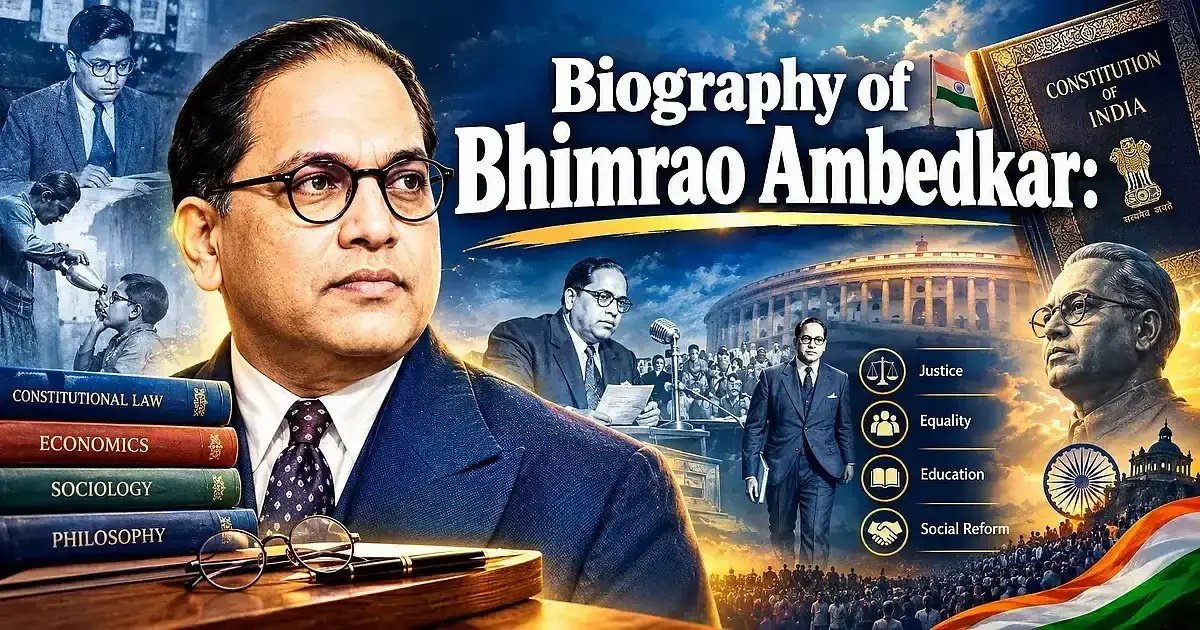
As a schoolboy, he sat apart from his classmates. If he was thirsty, he waited for a peon to pour water into his hands from a height, because touching the vessel was forbidden. Decades later, that same boy chaired the committee that drafted the Constitution of independent India, a document that outlawed the very practice that had humiliated him. Bhimrao Ramji Ambedkar, revered across India as Babasaheb, was a jurist, economist, social reformer, politician and writer. But above all, he spent his life insisting that every human being carries equal dignity. This biography follows his life from a military cantonment in 1891 to his final days in 1956, covering his education, his movements, his role in the Constitution, his conversion to Buddhism and his enduring legacy.
Dr. B. R. Ambedkar at a Glance
| Detail | Information |
|---|---|
| Full name | Bhimrao Ramji Ambedkar |
| Popular title | Babasaheb (“Respected Father”) |
| Born | April 14, 1891 |
| Birthplace | Mhow cantonment, Central Provinces (now Dr. Ambedkar Nagar, Madhya Pradesh) |
| Died | December 6, 1956, Delhi (aged 65) |
| Parents | Ramji Maloji Sakpal and Bhimabai |
| Community | Mahar, a community then treated as “untouchable” |
| Education | Elphinstone College, Bombay; Columbia University (MA, PhD); London School of Economics (MSc, DSc); Gray’s Inn (Barrister-at-Law) |
| Key roles | Chairman of the Constitution Drafting Committee; India’s first Law Minister; Member of Rajya Sabha |
| Highest honor | Bharat Ratna (1990, posthumous) |
| Memorial | Chaityabhoomi, Dadar, Mumbai |
Early Life: Born Into Exclusion
Birth in Mhow
Ambedkar was born on April 14, 1891, in the military cantonment of Mhow in present-day Madhya Pradesh. He was the fourteenth and last child of Ramji Maloji Sakpal, a subedar in the British Indian Army, and Bhimabai. The family’s ancestral village was Ambavade in Maharashtra’s Ratnagiri district, which is the origin of the surname Ambedkar.
A Father Who Valued Education
His father was literate, valued education and encouraged his children to study. That support mattered enormously, because the world outside the home offered Bhimrao little else.
The Classroom as a Place of Humiliation
At school, Bhimrao was made to sit separately from other students, and he depended on others to give him water. These experiences were not isolated cruelties. They were the everyday mechanics of caste discrimination, and they planted the conviction that would drive his life’s work.
Moving to Bombay
The family eventually settled in Bombay, where Bhimrao studied at Elphinstone School. In 1906, following the custom of the time, he was married to Ramabai. Poverty and prejudice shadowed his studies, but he refused to let go of them.
Education: From Bombay to New York and London
Elphinstone College and the Baroda Scholarship
Ambedkar earned his bachelor’s degree from Elphinstone College, University of Bombay. The Maharaja of Baroda, Sayajirao Gaekwad III, was impressed by his promise and offered a scholarship for study abroad.
Columbia University
At Columbia University in New York, he earned a master’s degree in economics (1915) and later a PhD (formally conferred in 1927). In the United States he found an intellectual atmosphere where democracy and social justice were openly debated, and those ideas stayed with him.
London School of Economics and Gray’s Inn
In London, he completed an MSc (1921) and a DSc (1923) at the London School of Economics and qualified as a barrister at Gray’s Inn (1922). Abroad, he met no one who treated him as untouchable. Back home, the old discrimination awaited him.
The Economist
Ambedkar was far more than a social reformer. His book The Problem of the Rupee examined India’s currency system, and many historians believe his research influenced the thinking that led to the creation of the Reserve Bank of India.
The Struggle Against Untouchability
Mooknayak and the Bahishkrit Hitakarini Sabha
In 1920, Ambedkar began publishing the newspaper Mooknayak (“Leader of the Voiceless”). In 1924 he founded the Bahishkrit Hitakarini Sabha, an organization to promote education and social welfare among communities then excluded by caste. His motto, widely associated with him, was: educate, agitate, organize.
The Mahad Satyagraha (1927)
In March 1927, Ambedkar led a satyagraha at Mahad in Maharashtra to assert the right of all people to draw water from the Chavdar Tank. In December that year, he symbolically burned a copy of the Manusmriti, a text associated with caste hierarchy, as an act of protest. Mahad established him as a mass leader.
The Kalaram Temple Movement (1930)
In 1930, he led a satyagraha at the Kalaram Temple in Nashik, demanding the right of temple entry for all. It was a campaign for equal access to places of worship.
The Round Table Conferences and the Poona Pact
Ambedkar represented the “depressed classes” at the Round Table Conferences in London (1930–32), where he argued for separate electorates for them. When the British announced the Communal Award along those lines, Mahatma Gandhi began a fast unto death in Yerwada Jail in protest. After intense negotiations, Ambedkar and Gandhi signed the Poona Pact in 1932. Separate electorates were replaced by reserved seats within the general electorate.
The Poona Pact is still debated. Gandhi’s supporters view it as a solution that preserved social unity and averted violence. Ambedkar’s followers and many scholars argue he signed under heavy pressure and was forced to give up a gain for his community. Ambedkar himself later criticized its limitations.
Political Career
From the Legislative Council to Labour Member
Ambedkar sat in the Bombay Legislative Council from 1926 to 1937. In 1936 he founded the Independent Labour Party to represent workers and the oppressed, and in 1942 he established the Scheduled Castes Federation. From 1942 to 1946 he served as Labour Member in the Viceroy’s Executive Council, working on issues such as labour rights and working conditions.
Annihilation of Caste (1936)
In 1936, he prepared a speech for a conference in Lahore. The organizers objected to its contents, and it was never delivered. Ambedkar published it as Annihilation of Caste, a searing critique of the caste system and of the scriptural authority behind it. It remains one of the most widely discussed texts on caste in India.
Architect of the Indian Constitution
Chairman of the Drafting Committee
After independence, the Constituent Assembly set up a Drafting Committee. On August 29, 1947, Ambedkar was chosen as its Chairman. Because other members were absent or unwell, much of the work fell on him.
From Draft to Republic
The draft Constitution was presented in February 1948. The Constituent Assembly adopted it on November 26, 1949, and it came into force on January 26, 1950. Provisions on equality before the law, the abolition of untouchability, fundamental rights and social justice carry the strong imprint of his thinking.
Was He the “Author” of the Constitution?
Writing the Constitution was a collective effort. Constitutional adviser B. N. Rau prepared the initial draft, and many members of the committee and the Assembly contributed. Ambedkar led the Drafting Committee and defended the draft in the Assembly, so “chief architect” describes his role more accurately than “sole author.”
India’s First Law Minister and the Hindu Code Bill
In independent India’s first cabinet, Ambedkar became Law Minister. He worked on the Hindu Code Bill, which proposed reforms in inheritance, marriage and divorce rights for women. When the bill stalled in Parliament, he resigned from the cabinet in 1951. Parts of it were later passed as separate laws. He later served in the Rajya Sabha from 1952 until his death, having lost the 1952 general election.
Conversion to Buddhism
A Long Search
In 1935, Ambedkar declared that although he was born a Hindu, he would not die one. For over two decades afterward, he studied different religions.
Nagpur, October 14, 1956
On October 14, 1956, at Deekshabhoomi in Nagpur, Ambedkar formally embraced Buddhism, and a very large number of his followers converted with him. Estimates range widely, though sources commonly mention several hundred thousand people. The movement is known as the Dalit Buddhist or Navayana movement. His last major work, The Buddha and His Dhamma, was published posthumously.
Major Writings
- The Problem of the Rupee: India’s currency and economic system
- Annihilation of Caste (1936): a critique of the caste system
- Thoughts on Pakistan (1940): analysis of the partition debate
- Who Were the Shudras? (1946): a study of the origins of the Shudra varna
- The Buddha and His Dhamma (1957): his interpretation of Buddhism
Personal Life and Death
Ambedkar’s first wife, Ramabai, died in 1935. Several of their children died in infancy. In 1948, he married Dr. Sharda Kabir, who became Savita Ambedkar. His health declined in his final years, with diabetes among his ailments. He died in his sleep in Delhi on December 6, 1956, and was cremated at Dadar in Mumbai, now the site of Chaityabhoomi.
Honors and Legacy
Bharat Ratna
In 1990, India posthumously awarded him the Bharat Ratna, its highest civilian honor.
Remembrance Days
April 14 is observed as Ambedkar Jayanti, his birth anniversary. December 6 is Mahaparinirvan Diwas, when hundreds of thousands gather at Chaityabhoomi to pay respects. Statues and memorials in his honor stand across India.
Why He Still Matters
Debates on reservation, social justice, secularism and constitutional rights regularly invoke Ambedkar. Different political and social groups interpret him in different ways, but almost all acknowledge his central role in building the case for equality and human dignity in India.
Conclusion
Bhimrao Ambedkar turned humiliation into a lifelong argument for equality. A child once forced to sit apart rose through education to help shape the legal foundation of the world’s largest democracy. His constitutional work, his campaigns for the excluded, his push for women’s rights and his turn to Buddhism all share one thread: an unyielding belief that no human being is born lesser. More than six decades after his death, that belief remains one of the most powerful ideas in modern Indian life.
Frequently Asked Questions
Who was Bhimrao Ambedkar?
Bhimrao Ramji Ambedkar was an Indian jurist, economist, social reformer and politician. He chaired the committee that drafted the Constitution of India and served as the country’s first Law Minister. He is revered as Babasaheb for his lifelong fight against caste discrimination and untouchability.
When and where was B. R. Ambedkar born?
He was born on April 14, 1891, in the military cantonment of Mhow in the Central Provinces, now Dr. Ambedkar Nagar in Madhya Pradesh. He was the fourteenth and last child of his parents. His birthday is observed every year as Ambedkar Jayanti.
Who were Ambedkar's parents?
His father, Ramji Maloji Sakpal, was a subedar in the British Indian Army, and his mother was Bhimabai. His father valued education and encouraged his children to study. The family’s ancestral village was Ambavade in Maharashtra’s Ratnagiri district, which gave rise to the surname Ambedkar.
Which community was Ambedkar born into?
He was born into the Mahar community, which was treated as untouchable in the caste hierarchy of the time. As a child he was made to sit apart at school and depended on others to give him water. These experiences shaped his lifelong fight against caste discrimination.
Why is Ambedkar called Babasaheb?
Babasaheb means Respected Father. His followers and the wider public use the title out of respect and gratitude, especially among communities that saw him as a guardian of their rights.
What was Ambedkar's educational background?
He graduated from Elphinstone College, University of Bombay, then earned an MA (1915) and a PhD from Columbia University, awarded formally in 1927. At the London School of Economics he completed an MSc (1921) and DSc (1923), and he qualified as a barrister at Gray’s Inn in 1922.
Who funded Ambedkar's studies abroad?
The Maharaja of Baroda, Sayajirao Gaekwad III, offered him a scholarship after being impressed by his promise. This support enabled him to study at Columbia University in the United States.
Was Ambedkar a judge?
No. Ambedkar was a jurist and barrister, as well as an economist, social reformer and politician. He is sometimes wrongly called a judge because of his legal expertise.
Was Ambedkar an economist?
Yes. He studied economics at Columbia University and the London School of Economics. His book The Problem of the Rupee examined India’s currency system, and many historians believe his research influenced the thinking behind the Reserve Bank of India.
What was Ambedkar's main contribution?
His chief contributions were leading the drafting of India’s Constitution, campaigning against untouchability and caste discrimination, and fighting for social justice. He also worked on labour rights and women’s rights, produced major economic and social writings, and led a mass conversion movement to Buddhism.
Was Ambedkar the author of the Indian Constitution?
He was the chairman of the Drafting Committee and defended the draft in the Constituent Assembly, so he is often called the chief architect of the Constitution. However, writing it was a collective effort. B. N. Rau prepared the initial draft, and many members of the committee and the Assembly contributed.
When did Ambedkar become chairman of the Drafting Committee?
He was chosen as Chairman of the Drafting Committee on August 29, 1947. The draft Constitution was presented in February 1948 and adopted by the Constituent Assembly on November 26, 1949.
When did the Indian Constitution come into force?
It came into force on January 26, 1950, which India celebrates every year as Republic Day. The Constituent Assembly had adopted it earlier, on November 26, 1949.
Was Ambedkar India's first Law Minister?
Yes, he served as Law Minister in independent India’s first cabinet. He resigned in 1951 after the Hindu Code Bill stalled in Parliament.
What was the Hindu Code Bill?
It was a proposed set of reforms in Hindu personal law, including women’s rights in inheritance, marriage and divorce. When it stalled in Parliament, Ambedkar resigned from the cabinet in 1951. Parts of it were later passed as separate laws.
What was the Mahad Satyagraha?
In March 1927, Ambedkar led a satyagraha at Mahad in Maharashtra to assert the right of all people to draw water from the Chavdar Tank. In December of that year, he symbolically burned a copy of the Manusmriti in protest against caste hierarchy. The campaign established him as a mass leader.
What was the Kalaram Temple Movement?
In 1930, Ambedkar led a satyagraha at the Kalaram Temple in Nashik, demanding the right of temple entry for all people regardless of caste. It was a campaign for equal access to places of worship.
What is the Poona Pact?
The Poona Pact was an agreement signed in 1932 between Ambedkar and Mahatma Gandhi. It replaced separate electorates for the depressed classes with reserved seats within the general electorate. Gandhi had been fasting in Yerwada Jail in protest against the British Communal Award.
Why is the Poona Pact controversial?
Gandhi’s supporters see it as a solution that preserved social unity and averted violence. Ambedkar’s followers and many scholars argue that he signed under heavy pressure and had to give up a gain for his community. Ambedkar himself later criticized its limitations.
What is Annihilation of Caste?
It is a 1936 text based on a speech Ambedkar prepared for a conference in Lahore. The organizers objected to its content and it was never delivered, so he published it himself. It is a searing critique of the caste system and of the scriptural authority behind it, and it remains one of the most widely discussed texts on caste.
What was Mooknayak?
Mooknayak, meaning Leader of the Voiceless, was a newspaper Ambedkar began publishing in 1920. It gave a public voice to communities excluded by caste.
What political parties and organizations did Ambedkar found?
He founded the Bahishkrit Hitakarini Sabha in 1924, the Independent Labour Party in 1936 and the Scheduled Castes Federation in 1942. He also served in the Bombay Legislative Council (1926–1937) and as Labour Member in the Viceroy’s Executive Council (1942–1946).
Why did Ambedkar convert to Buddhism?
He did not find equality and dignity within the caste system of Hindu society. In 1935 he declared that though he was born a Hindu, he would not die one. After studying different religions for two decades, he chose Buddhism as a path of equality, reason and compassion.
When did Ambedkar convert to Buddhism?
He formally embraced Buddhism on October 14, 1956, at Deekshabhoomi in Nagpur, and a very large number of his followers converted with him. Estimates vary, though sources commonly mention several hundred thousand people. The movement is known as the Dalit Buddhist or Navayana movement.
What are Ambedkar's most important books?
His notable works include The Problem of the Rupee, Annihilation of Caste (1936), Thoughts on Pakistan (1940), Who Were the Shudras? (1946) and The Buddha and His Dhamma, published posthumously in 1957.
Who was Ambedkar's wife?
His first wife, Ramabai, married him in 1906 and died in 1935. In 1948 he married Dr. Sharda Kabir, who became known as Savita Ambedkar.
When and how did Ambedkar die?
He died in his sleep on December 6, 1956, in Delhi at the age of 65. His health had declined in his final years, with diabetes among his ailments. He was cremated at Dadar in Mumbai.
Where is Ambedkar's memorial?
Chaityabhoomi in Dadar, Mumbai, marks the place where he was cremated and is his principal memorial. Hundreds of thousands of people gather there each December 6 to pay their respects.
Did Ambedkar receive the Bharat Ratna?
Yes, India posthumously awarded him the Bharat Ratna, its highest civilian honor, in 1990.
What are Ambedkar Jayanti and Mahaparinirvan Diwas?
Ambedkar Jayanti is observed on April 14, his birth anniversary. Mahaparinirvan Diwas is observed on December 6, the day of his death, when his followers gather to pay tribute, especially at Chaityabhoomi in Mumbai.
What was Ambedkar's motto?
The motto widely associated with him is educate, agitate, organize. It describes education as the first step to freedom, organization as the source of strength, and agitation as the way to claim rights.

Recommended for You
-
ARTICLE

Ashok Sharma Biography: Age, Career, Bowling Speed, Profile, IPL, Domestic & International Stats
Cricket Arif
-
ARTICLE

The Life Story of Virat Kohli: A Unique Journey from Childhood to Legendary Success
Cricket Arif -
ARTICLE

Manav Suthar Biography: Age, Career, Personal Details, IPL & Test Debut Statistics
Cricket Arif -
ARTICLE
Sheikh Mujibur Rahman: The Father of the Nation’s Journey from Struggle to Triumph
Shamima Begum
-
ARTICLE

The Echoes of Andara/ Chapter -5
kishore karunik
-
ARTICLE

Harshit Rana Biography: Personal Information and Statistics
Cricket Arif
Your comment will appear immediately after submission.