
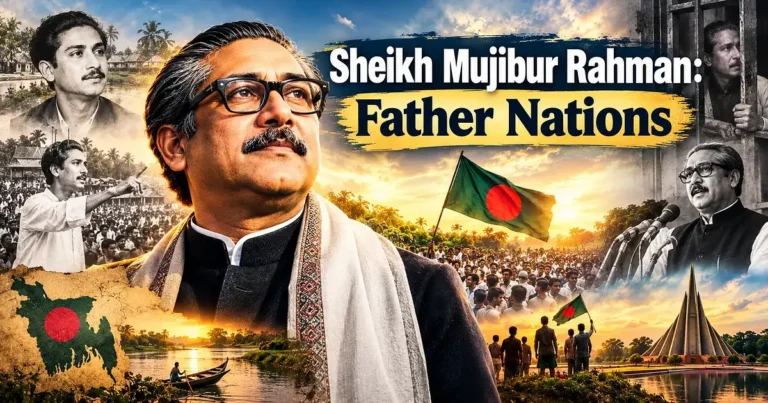
A boy from a riverside village in Gopalganj, who took to the streets for the suffering of others while still in school, grew into the voice of tens of millions. Prison walls, case after case and threats on his life could not stop him. This is the story of Sheikh Mujibur Rahman, whom Bengalis call “Bangabandhu,” the Friend of Bengal.
Early Life and Family Background
Sheikh Mujibur Rahman was born on March 17, 1920, in Tungipara, a village in the Gopalganj district of present-day Bangladesh. His father, Sheikh Lutfur Rahman, was a court clerk, and his mother was Sayera Khatun. He was the third of four daughters and two sons, and the family called him “Khoka.”
Several traits from his boyhood foreshadowed the leader he would become:
- Compassion: He gave away his own belongings to help classmates who had less.
- Natural leadership: He was quick to step forward in school sports and debates.
- Defiance of injustice: Even as a teenager, he refused to stay silent when he saw unfair treatment.
Education and Entry into Politics
After schooling in Gopalganj, he enrolled at Islamia College in Calcutta, where he first entered active politics. Mentors such as Huseyn Shaheed Suhrawardy shaped his political thinking. After the 1947 partition, he moved to Dhaka and enrolled in law at the University of Dhaka.
In 1948, he helped found the East Pakistan Muslim Students’ League. In 1949, he led a protest in support of the university’s lowest-paid employees and was expelled for it. The sacrifice did not slow him down. It hardened his resolve.
The Awami League and the Language Movement
In 1949, the Awami Muslim League was formed, later renamed the Awami League. He was elected joint secretary while still in jail, and he became general secretary in 1953.
He stood in the front line of the fight for the Bengali language. During the Language Movement of 1952, he supported the cause from prison, including through a hunger strike. After the United Front’s victory in the 1954 provincial election, he joined the provincial cabinet.
The Six-Point Movement: A Charter of Freedom
On February 5, 1966, at an opposition conference in Lahore, he presented the Six-Point program, a demand for autonomy for East Pakistan. Bengalis came to call it the “Charter of Freedom.” Its core ideas included:
- A federal, parliamentary government elected by universal adult franchise
- Federal control limited to defense and foreign affairs
- Separate currencies, or a safeguarded system that stopped capital flowing out of the East
- Taxation and revenue collection in the hands of the provinces
- Separate foreign trade accounts and foreign exchange earnings for each wing
- A separate paramilitary force for East Pakistan
He was arrested repeatedly for promoting the program.
The Agartala Case and the Title “Bangabandhu”
In 1968, the Pakistani authorities named him the principal accused in the “Agartala Conspiracy Case.” The aim was to crush the movement, but it backfired. Under pressure from a mass uprising led by students and the public, the case was withdrawn in February 1969 and he was freed. On February 23, 1969, at a public reception in Dhaka, he was given the title “Bangabandhu.”
The 1970 Election and the Refusal to Transfer Power
In the 1970 general election, the Awami League won 160 of the 162 seats allotted to East Pakistan. That gave it an absolute majority in the National Assembly. By democratic principle, the right to form the government was his.
Instead, Pakistan’s ruling establishment stalled. Talks dragged on, the Assembly session was postponed, and tension across East Pakistan escalated.
The Historic Speech of March 7
On March 7, 1971, he addressed a vast crowd at the Ramna Racecourse Ground (now Suhrawardy Udyan) in Dhaka. He spoke without a written text, and the speech lasted under twenty minutes. It combined anger, restraint and clear direction, and its closing lines declared that the struggle was a struggle for freedom and independence. In 2017, UNESCO added the speech to its Memory of the World Register.
The Liberation War and the Declaration of Independence
On the night of March 25, 1971, the Pakistan army launched a brutal crackdown on unarmed Bengalis. A declaration of independence was transmitted on March 26, and the nine-month Liberation War began. He was arrested and held in a prison in West Pakistan. Even from captivity, he remained the symbol of the struggle. Bangladesh achieved victory on December 16, 1971.
Return Home and Rebuilding the Nation
He returned to a free Bangladesh on January 10, 1972, and took office as Prime Minister to rebuild a devastated country. Key steps of this period included:
- Adopting the 1972 constitution, built on nationalism, socialism, democracy and secularism
- Securing the withdrawal of Indian forces from the country
- Rehabilitating millions of refugees and displaced people
- Winning Bangladesh’s admission to the United Nations in 1974, where he addressed the General Assembly in Bangla
His government faced severe famine, economic collapse and political unrest. In early 1975, constitutional changes established a one-party system with him as President. Critics have judged that decision harshly, and it remains a point of debate in assessments of his legacy.
August 15, 1975
In the early hours of August 15, 1975, a group of army officers killed him at his residence in Dhanmondi, Dhaka. His wife, Sheikh Fazilatunnesa, and three of his sons, Kamal, Jamal and young Russel, were among those killed, along with other family members. His daughters Sheikh Hasina and Sheikh Rehana survived because they were abroad.
Legacy and Mujib Year
In 2020, the Bangladesh government celebrated Mujib Year to mark his birth centenary. Assessments of his time in power are still debated, but his central role in the movement that created Bangladesh is undisputed. His name remains bound to Bengali identity, language and the struggle for independence.
Frequently Asked Questions
Who was Sheikh Mujibur Rahman?
Sheikh Mujibur Rahman was the founding leader of Bangladesh and is widely regarded as the “Father of the Nation.” He led the political movement that culminated in independence in 1971. He is known by the title “Bangabandhu,” meaning Friend of Bengal.
When was Sheikh Mujibur Rahman born?
He was born on March 17, 1920, in Tungipara, a village in the Gopalganj district of present-day Bangladesh. His birthday is observed each year in Bangladesh.
What were Sheikh Mujibur Rahman's major political achievements?
He played a central role in the Bengali struggle for autonomy and independence from Pakistan. He presented the Six-Point program in 1966 and led the Awami League to a landslide victory in the 1970 elections. After independence, he served as the first Prime Minister of Bangladesh.
What is the significance of the Six-Point Movement?
The Six-Point program, announced in 1966, demanded broad autonomy for East Pakistan in political, economic and defense matters. It galvanized Bengali public opinion and became the foundation of the independence movement. Its popularity made it a direct challenge to the central government in Pakistan.
When and how did Sheikh Mujibur Rahman die?
He was killed in a military coup on August 15, 1975. Most of his family members were killed the same day.
What is Mujib Year?
Mujib Year marked the birth centenary of Sheikh Mujibur Rahman. The Bangladesh government observed it in 2020 with a year of commemorative events.
Where was the historic March 7 speech delivered?
It was delivered at the Ramna Racecourse Ground in Dhaka, now called Suhrawardy Udyan. Hundreds of thousands of people were there to hear it.
How did Sheikh Mujibur Rahman contribute to the independence of Bangladesh?
He gave political leadership to the movement through the Six-Point program, the 1970 election victory and the March 7 speech. After his arrest in March 1971, he became the symbol of the Liberation War. Bangladesh won the war on December 16, 1971, and he returned home on January 10, 1972.
What was his role as the first Prime Minister?
He focused on rebuilding a war-torn country, including resettling refugees, reviving the economy and drafting a constitution. His government faced famine, economic hardship and political instability. His record in this period remains debated, particularly the move to one-party rule in 1975.
How is Sheikh Mujibur Rahman remembered today?
He is honored as the Father of the Nation in Bangladesh, with his birthday marked each March 17. His memory is preserved through monuments, institutions and commemorative days. Views on his political record differ, but his place in the independence story is widely acknowledged.
Why is he called the "Father of the Nation"?
The title reflects his leading role in guiding Bengalis to independence. He fought for their political and cultural rights and became the central figure in the creation of Bangladesh.
How did he get the title "Bangabandhu"?
He received the title on February 23, 1969, at a mass reception in Dhaka after his release in the Agartala Conspiracy Case. It was conferred by students and the public in recognition of his stand for Bengali rights.
What was the Agartala Conspiracy Case?
In 1968, the Pakistani government accused him and others of plotting secession with Indian help. Mass protests forced the government to withdraw the case in early 1969. The episode raised his standing sharply across East Pakistan.
How did the Awami League perform in the 1970 election?
It won 160 of the 162 seats allotted to East Pakistan, which gave it a majority in the National Assembly. The refusal to hand over power afterward set off the crisis that led to the war.
When did he return to independent Bangladesh?
After his release from prison in Pakistan, he traveled via London and Delhi and arrived in Dhaka on January 10, 1972. Huge crowds gathered to welcome him.
Why has the March 7 speech received international recognition?
It was delivered without a prepared text, yet it set out a clear path for a nation’s struggle. UNESCO recognized its documentary value in 2017 by including it in the Memory of the World Register.







Your comment will appear immediately after submission.