Are you asking yourself the same question at the end of every month: What have I been doing with my income? You have settled your payments, bought food supplies, eaten out occasionally, and probably made a few purchases online. However, none of these steps was extravagant, yet you cannot see much difference in your savings.
Such cases occur pretty frequently, especially among those people who have no experience in handling their finances. The main advantage of budgeting is that it requires no special knowledge in finances. To start budgeting, one should just know his or her income, trace expenses, and plan how to use the money.
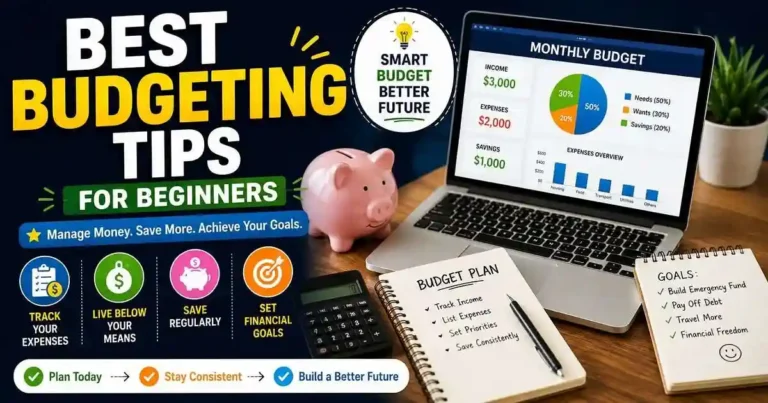
The manual below contains Best Budgeting Tips for Beginners.
Why Budgeting Matters
A budget is not intended to constrain your actions; rather, it will enable you to utilize your funds more purposefully.
By knowing precisely where your money is going each month, you can:
- Contribute to savings on a regular basis
- Avoid unnecessary borrowing
- Be ready for any eventualities
- Attain your financial targets quickly
- Cut down on money worries
How to Build a Budget That Works
In order to get to the budget tips, here are the three aspects that should be incorporated into your budget.
Find Out Your Monthly Income
Determine how much you earn in a month after paying your tax bills.
In case your monthly income changes from time to time, then try finding out what your average income is depending on the amount you have earned in the previous few months.
List Down All Your Expenses
People usually know the amount they spend but they fail to include all the little things they buy, like their coffee and food orders.
Differentiate Between Needs and Wants
All expenses do not weigh equally.
Needs are:
- Housing
- Bills
- Food
- Insurance
- Transport
Wants are:
- Subscribing to Netflix
- Eating out
- Unnecessary expenditures
- Recreational Activities
Best Budgeting Tips for Beginners
1. Establish Well-Defined Financial Goals
It is easier to budget once you know what your goal is.
Some examples of your goals could be:
- Establishing an emergency fund
- Repaying debt
- Buying a vehicle
- Planning a trip
- Saving for retirement
Having clear goals gives you something to work towards on those difficult budgeting months.
2. Adhere to the 50/30/20 Budgeting Principle
This widely followed approach to managing finances is based on the idea of allocating your money in the following way:
- 50% for basic necessities
- 30% for your personal desires
- 20% for savings and loan repayments
Although not applicable in all cases, it provides an outstanding initial basis.
3. Log All Expenses
Even small amounts may actually have a big effect.
Keeping track of expenses allows one to pinpoint unnecessary habits.
One will be surprised by how much money is spent in such activities.
4. Start an Emergency Fund
Things happen out of nowhere.
Medical bills, car repairs, and other such things could very well put a damper on your financial plans if you do not have an emergency fund set up.
It does make a difference even if you start small.
5. Pay Yourself First
Instead of saving whatever remains at the end of the month, transfer money into savings immediately after receiving your income.
This simple habit increases the likelihood of reaching your savings goals.
6. Reduce Impulse Buying
Impulse purchases usually provide temporary satisfaction but can seriously damage your budget.
Before making non-essential purchases, consider waiting 24 hours.
Often, the desire disappears after some time.
7. Check Your Subscription List
Subscriptions are easy to forget because they’re automatic monthly charges.
Check your subscription list now and unsubscribe from things you don’t use often.
A few dollars saved monthly will add up to big savings annually.
8. Use Budgeting Apps
The purpose of using budgeting apps is to facilitate the process of tracking expenses and visualizing spending habits.
Most budgeting apps categorize expenses on their own, which helps stay under the limit of the monthly budget.
The most efficient budgeting app is the one that you will actually use.
9. Plan Ahead
Food is among the largest expenses that most families face each month. Without having an organized plan, you will spend more than you should when buying takeout and snacks.
With planning, you will be able to achieve the following:
- Buy only what you really need
- Reduce the wastage of food
- Avoid making any orders in the last minute
- Have money left by saving
If you prepare your own lunch just a few times in a month, the savings will increase throughout the year.
10. Use Cash for Some Purchasing Sectors
If you often exceed your budget in spending categories such as dining out, entertainment, or shopping, you may want to use cash rather than a debit card or a credit card.
Once the cash runs out, that means that your maximum expenditure in that sector has been met.
11. Reassess Your Budget Monthly
It is very important that your budget does not stay exactly the same all the time.
There will be changes in terms of your income and expenses and priorities.
Make sure to spend 20 to 30 minutes each month analyzing the following areas:
- Your spending pattern
- Your savings progress
- Any unforeseen expenses
- How you can do better
12. Avoid Lifestyle Inflation
As your income increases, it’s tempting to spend more on upgraded lifestyles, expensive gadgets, or luxury purchases.
Instead, try increasing your savings and investments before increasing your spending.
This habit can significantly improve your long-term financial stability.
13. Automate Your Savings
One of the easiest budgeting strategies is automation.
Arrange for a fixed amount of money to be transferred automatically into your savings account every payday.
Since you never “see” that money in your checking account, you’re less likely to spend it.
14. Leave Space for Fun
Most people tend to make overly stringent budgets as beginners.
When your budget doesn’t allow for any fun expenses at all, then it’s likely you won’t be able to follow it.
Give yourself some space for your leisure activities while following the budget as a whole.
An effective budget beats an unrealistic one any day of the week.
15. Have Patience and Be Consistent
A budget is not meant for perfection within the first month.
Sometimes there will be situations where there might be unexpected costs incurred or more money being spent than what was intended.
The key here is to learn from that experience and move on from there.
Consistency generally works out well than perfection.
Budgeting Methods Comparison
| Method | Allocation | Best For | Difficulty Level |
|---|---|---|---|
| 50/30/20 Rule | 50% Needs, 30% Wants, 20% Savings | Beginners | Easy |
| Zero-Based Budgeting | Income – Expenses = 0 | Detailed planners | Medium |
| Envelope System | Cash for each category | Overspenders | Medium |
| Pay Yourself First | Save before spending | Goal-oriented savers | Easy |
| 80/20 Rule | 80% Expenses, 20% Savings | Minimalists | Very Easy |
Practical Example
Think about two individuals who have an equal income every month.
Rahul is someone who is conscious of his expenses, manages his finance with budgets, saves automatically, and analyzes his financial position often. Rahul has complete awareness of his spending and starts saving for an emergency fund.
Amit doesn’t have any record of his expenses. Purchases on the Internet, food deliveries, and other subscriptions cost him a lot of money every month.
It’s not about their income, but about finances.
Some Practical Tips
Here are some practical tips which can assist you during the early stage:
- Note down your income every month.
- Distinguish fixed and flexible costs.
- Come up with an attainable goal of saving.
- Remember to maintain record of all your costs for 30 days.
- Budget analysis should be done on weekly basis.
- Give up on one unnecessary cost every month.
- Always celebrate if you make any financial achievement.
These little things make a lot of difference.
Common Budgeting Mistakes
Unrealistic Goals
- It is natural to feel annoyed while attempting to save up to half of what you earn immediately.
- Select realistic goals and work on it gradually.
Ignoring Irregular Expenditures
Expenditure on insurance, gifts, travel expenses, repairs on the car and others irregular costs must be kept in mind during the process of budget preparation.
Ignoring Trivial Expenses
Costs involved in drinking coffee and having snacks everyday may appear to be trivial at first.
But in total, they amount to a pretty substantial sum monthly.
Using Credit Cards For Regular Expenses Without Repayment Plan
Using credit cards for regular payments without a repayment plan for the borrowed money will soon lead you into debts.
Giving Up on the Budget After First Bad Month
- It is natural that everyone makes some mistakes while budgeting.
- Do not abandon budget due to first failed month.
Frequently Asked Questions (FAQ)
What kind of budgeting would be good for beginners?
The simplest way to make the budget would be to use 50/30/20 rule. It will give an opportunity to manage your expenses and savings in the easiest way.
How much money should I save being a beginner?
In this case there is no definite answer. Better to save regularly regardless of the sum (like 10 percent of income) than to have unrealistic expectations.
Is it necessary to use budgeting software?
No. You can choose budgeting software, notebook, spreadsheet, or any other tool according to your preferences. The best thing would be to find the tool you could stick to.
When do I need to change my budget?
You need to change it at least once a month or even weekly to find out all your problems.
Why do most budgets fail?
The reason why most budgets fail is their rigidity or complete ignoring.
What is the 50/30/20 rule?
The 50/30/20 rule is a budgeting method where you allocate 50% of your income to needs, 30% to wants, and 20% to savings and debt repayment. It’s a simple framework for beginners.
How can I stop overspending?
Track every expense, use cash for discretionary spending, wait 24 hours before impulse purchases, and review your budget weekly to stay on track.
Conclusion
The Best Budgeting Tips for Beginners aren’t really about difficult equations but rather creating healthy habits that will serve you well. Budgeting provides you with better control over your finances, which prepares you for emergencies, alleviates financial stress, and ensures that you’re making headway towards your targets.
It should be noted that your first budget doesn’t have to be perfect. All that you need is a decent system of tracking your expenditures, and you’ll get better with each month that passes.












Your comment will appear immediately after submission.