Introduction
You are all set to write the next blog post. The blank document is ready, and now suddenly you realize that you don’t know where to begin.
This is exactly the time when a good prompt can help you.
You may be thinking, “Hey, why don’t I just tell ChatGPT to write an article.” But the success of your output depends entirely upon the success of your prompt, and a good prompt leads to good output.
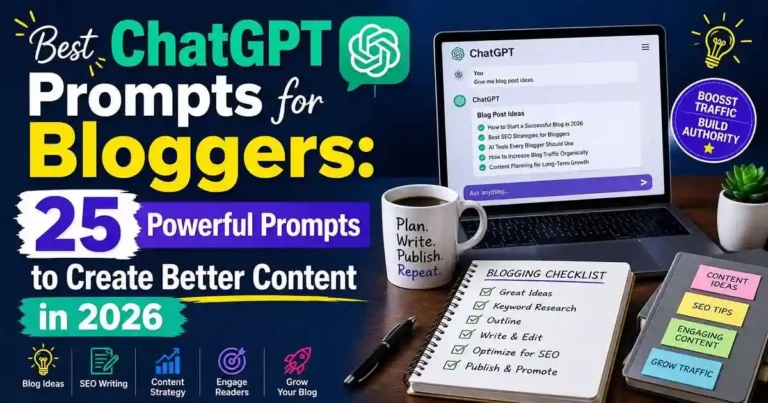
In this guide, we are going to discuss the Best ChatGPT Prompts for Bloggers with examples.
Table of Contents
- Why Prompts Matter
- How to Write Better AI Prompts
- 25 Best ChatGPT Prompts for Bloggers
- How Bloggers Can Build an AI Workflow
- Common Prompt Mistakes
- Frequently Asked Questions
- Conclusion
Why Prompts Matter
ChatGPT should be treated as an expert helper and not as some kind of telepathic being.
If your prompt is vague, then so will be your output. But if your prompt is written for specific purposes, such as targeting a particular audience, tone, structure, etc., then your output will definitely improve.
The proper use of the prompt can help bloggers in the following ways:
• Saving time
• Brainstorming ideas
• Structuring essays
• SEO optimization
• Writing blocks
• Content reuse
Please note that the objective of using this technology is to enhance productivity, not creativity.
How to Write Better AI Prompts
Here are some of the factors which one can take into account when trying to analyze the existing prompts that have been already written:
• Target Audience
• Tone
• Format of Information
• Word Count
• SEO Details
• Objectives
• Limitations
The more precise the prompt would be, the more precise would be the answer to it.
25 Best ChatGPT Prompts for Bloggers
1. Blog Topic Ideas
Prompt:
“Suggest 30 unique blog post ideas about [your niche] that target beginner readers and have strong long-term SEO potential.”
2. Keyword Research
Prompt:
“Generate 50 long-tail keyword ideas related to [topic] grouped by search intent.”
3. SEO Blog Outline
Prompt:
“Create an SEO-friendly outline for a 2,000-word article about [topic] with H2 and H3 headings.”
4. Article Introduction
Prompt:
“Write an engaging introduction that starts with a relatable problem and naturally introduces the primary keyword.”
5. Better Headlines
Prompt:
“Generate 20 click-worthy SEO titles for an article about [topic] without using clickbait.”
6. Meta Description
Prompt:
“Write five compelling meta descriptions under 160 characters using the target keyword.”
7. FAQ Section
Prompt:
“Create five frequently asked questions with concise, helpful answers for readers searching about [topic].”
8. Content Expansion
Prompt:
“Expand this section with practical examples while maintaining a conversational tone.”
9. Simplify Complex Topics
Prompt:
“Explain this concept in simple English suitable for beginners.”
10. Internal Linking Suggestions
Prompt:
“Suggest ten relevant internal linking opportunities for this article.”
11. Conclusion Writing
Prompt:
“Write a conclusion that summarizes the article and encourages readers to take action.”
12. Blog Post Summary
Create concise summaries for newsletters or article previews.
13. Social Media Captions
Generate engaging posts for Facebook, LinkedIn, X, or Instagram.
14. Email Newsletter
Turn a blog post into an informative email campaign.
15. SEO Improvement
Ask ChatGPT to identify missing SEO opportunities within your draft.
16. Competitor Analysis
Compare your article structure with common topics covered by competitors and identify content gaps.
17. Content Calendar
Generate a six-month blogging calendar around your niche.
18. Evergreen Content Ideas
Discover topics that remain relevant for years instead of weeks.
19. Affiliate Content
Create comparison tables and buying guides with balanced analysis.
20. Product Reviews
Develop objective review structures without exaggeration.
21. Case Study Framework
Generate a professional outline for presenting business or marketing case studies.
22. Statistics Checklist
Ask ChatGPT which types of statistics would strengthen your article so you can verify them from reliable sources.
23. Editing Assistant
Review grammar, readability, clarity, and sentence flow while preserving your writing style.
24. Featured Snippet Optimization
Rewrite answers in a concise format suitable for Google’s featured snippets.
25. Content Repurposing
Transform one blog article into:
- LinkedIn posts
- Twitter threads
- Facebook posts
- Email newsletters
- YouTube video outlines
- Pinterest descriptions
This helps maximize the value of every article you publish
Practical Example
Let’s suppose you are writing an article titled “Passive Income Ideas.”
Instead of instructing,
“Write a blog.”
Why don’t you instruct?
“Write an SEO optimized article about passive income ideas for beginners. It must use conversational language, contain H2 and H3 headings, be action-oriented, contain an FAQ section and must target the keywords ‘passive income ideas for beginners.’”
This way ChatGPT gets all the information to create a useful article.
How Bloggers Can Build an AI Workflow
An effective blogging workflow might look like this:
- Brainstorm topics with ChatGPT.
- Perform keyword research.
- Create a detailed outline.
- Draft the article section by section.
- Improve readability.
- Generate SEO title and meta description.
- Create FAQs.
- Repurpose the article into social media posts.
- Review and fact-check everything before publishing.
This approach saves time while maintaining quality.
Actionable Tips
To get the best results:
- Be specific with every prompt.
- Mention your target audience.
- Define the desired tone.
- Request structured outputs.
- Ask for examples.
- Edit AI-generated content before publishing.
- Verify statistics and factual claims.
Add your own insights and expertise
Common Mistakes
The following is the list of some aspects to avoid while using ChatGPT.
Vague prompts
If your prompts are dull, you are going to receive dull answers from the AI.
One perfect response
You should not consider the generated piece of writing by the AI to be the last one but only the first one.
Fact-checking nothing
It always comes in handy to fact-check everything before using anything.
Editing nothing
Nothing beats your point of view and editing skills.
SEO
Without keywords, no article.
Frequently Asked Questions
1. Can I write an entire blog post via ChatGPT?
Of course, but what works best in this case is the use of ChatGPT along with your knowledge to generate drafts and outlines.
2. Do ChatGPT prompts help with SEO?
Absolutely. They will help create outlines, keywords, meta descriptions, FAQs, and good content.
3. Does the use of ChatGPT affect my Google ranking?
The use of AI doesn’t influence your ranking in any way. What matters is that you should create quality content.
4. What is the optimal number of prompts to use for one article?
It is better for most bloggers to use a number of prompts in different stages of work on an article, not one prompt for everything at once.
5. Should I post my AI-written content directly to my website without making any alterations?
Definitely no.
Conclusion
However, the Best ChatGPT Prompts for Bloggers do not imply the use of any sort of hacks; it implies writing efficiently without lowering the standards of the editing process. The best way to overcome the writer’s block and write quality content that will bring benefits to your readers is by using quality prompts.
However, ChatGPT can only work effectively when used together with a proper human approach implying creative thinking and editing according to one’s experience and insights.


Your comment will appear immediately after submission.