Introduction
It may take you a couple of hours or even more hours just to research, write, edit, and publish a blog post. Yet after pushing the “publish” button, you think visitors would soon come to your blog; however, after several days, your analytic tool only shows few visitors.
Sound familiar?
Building a blog with organic traffic can take time; however, it is one of the best ways for a sustainable blog building practice. As opposed to paid marketing, organic traffic keeps sending visitors even after the content has been published.
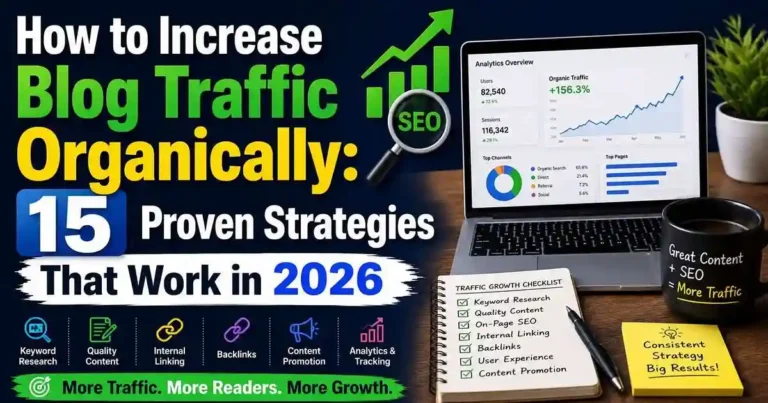
Here is how to increase blog traffic organically in 2026.
Table of Contents
- What Is Organic Blog Traffic?
- Why Organic Traffic Matters
- 15 Proven Ways to Increase Blog Traffic Organically
- Practical Example
- Actionable Tips
- Common Mistakes
- Frequently Asked Questions
- Conclusion
What Is Organic Blog Traffic?
What is organic traffic?
It is the visitors who come to your blog through free search engine result pages.
For instance, when people search on Google using keywords like “top budgeting apps” or “how to create a blog,” and they click your page, then such visits are known as organic traffic.
Why Organic Traffic Matters
Organic traffic is a source of numerous benefits such as:
• Freedom from marketing costs
• Great credibility
• Ongoing presence on the website
• Converting opportunities
• Evolution of the blog
• Domain authority
While the generation of organic traffic requires time, the ROI (return on investment) may prove to be much more impressive than the use of paid advertising.
15 Proven Ways to Increase Blog Traffic
Organically
1. Publish Helpful, In-Depth Content
Search engines reward content that genuinely helps readers.
Instead of writing short articles that briefly cover a topic, create comprehensive guides that answer common questions, provide examples, and solve real problems
2. Focus on Search Intent
Before writing, ask:
- What is the reader trying to learn?
- What problem are they trying to solve?
- What information would completely answer their question?
Matching search intent is one of the strongest ranking factors.
3. Perform Keyword Research
Blogging success begins with knowing how people search.
Search for:
• Keywords with long tail
• Low competition
• Well-defined intent
• Evergreen subject
By choosing proper keywords, search engines will be able to interpret your blog post easily.
4. Optimize Your Headlines
The headline will impact your ranking and CTR.
What should a good headline have?
• The main keyword
• The benefit explained well
• Without misleading the audience
Example:
How to Get More Visitors for Your Blog: 15 Ways to Drive Organic Traffic in 2026
5. Improve On-Page SEO
Basic SEO optimization involves:
• Title tag
• Meta description
• H1 and H2 tags
• Internal linking
• Image ALT attributes
• Good URL construction
Minor changes in all these aspects will result in a noticeable effect.
6. Write for Humans First
SEO helps readers discover your content.
Readability encourages them to stay.
Use:
- Short paragraphs
- Clear language
- Bullet points
- Practical examples
- Logical flow
7. Build Internal Links
Internal links will allow readers to navigate through your website and allow search engines to see the connection between your content.
For instance:
A piece about blogging software can easily make references to articles on keyword research, affiliate marketing, and basic SEO.
8. Refresh Older Content
Older articles often lose rankings over time.
Regular updates may include:
- New examples
- Updated statistics
- Better formatting
- Additional FAQs
- Improved internal links
Refreshing content is often faster than creating new articles from scratch.
9. Improve Website Speed
A slow website can increase bounce rates.
Consider:
- Compressing images
- Using caching
- Choosing reliable hosting
- Removing unnecessary plugins
Fast websites create a better user experience and support stronger SEO performance.
10. Create Topic Clusters
Instead of publishing unrelated articles, organize content around central topics.
Example:
Main Topic:
Blogging
Supporting articles:
- Blogging SEO
- Keyword research
- AI writing tools
- Affiliate marketing
- Blogging mistakes
- Blog monetization
This structure helps establish topical authority.
11. Optimize for Featured Snippets
Snippets may be found in various Google searches before the normal search results begin appearing.
To increase your chances, try doing the following:
• Answeryour questions
• Use numbered lists
• Give short definitions
• Structure your content intelligently
12. Earn Quality Backlinks
Backlinking is one of the most effective ranking signals in Google’s ranking algorithm.
Some of the natural ways that you can earn backlinks are:
• Conducting original research
• Producing comprehensive guides
• Creating valuable content
• Guest blogging
• Nurturing relationships with other bloggers
13. Promote Content Consistently
Publishing alone isn’t enough.
Share your articles through:
- Email newsletters
- YouTube
- Online communities
Promotion increases visibility and may lead to valuable backlinks.
14. Monitor Performance
Use analytics tools to understand:
- Which articles perform best
- Where visitors come from
- Keywords driving traffic
- User engagement
These insights help refine your content strategy.
15. Stay Consistent
Most successful blogs publish regularly for many months before experiencing any growth.
Blogging is similar to building a library.
Every new blog post enhances your website’s authority.
Practical Example
Consider the example of two bloggers who cover personal finance topics.
One blogger just publishes whatever he wants to publish whenever he feels like publishing.
The second blogger does his keyword research, creates topic clusters, reuses content, creates internal links, and writes just one good quality blog post a week.
Who do you think will have better search engine ranking after a year? It could be someone who opted for a different approach than simply blogging.
Actionable Tips
Now comes the part where you need to start:
1. Write at least one outstanding article each week.
2. Do keyword research before writing.
3. Optimize at least two articles each month.
4. Use internal links in all your new articles.
5. Use Alt tags in all your images.
6. Improve your website’s loading time.
7. Check your rankings and traffic monthly.
8. Create connections with other bloggers.
9. Focus on evergreen content.
10. Be patient and consistent.
Common Mistakes
Watch out for these common mistakes:
No Keyword Research While Publishing
Creating content without keyword research will make you rank even harder.
Not Paying Attention To Search Intent
Highly written content might not be successful due to its failure to address search intent.
Lack Of Internal Links
Content that is orphaned is much more difficult to find for users and search engines.
Overuse Of Keywords
Keyword stuffing will make content hard to understand and may damage SEO.
Immediate Success
Organic growth takes time.
Frequently Asked Questions
1. How long is going to take for me to drive organic traffic to my blog?
Six to twelve months is the period that I am going to require in order to generate some amount of organic traffic from my blog depending upon the competitiveness of the blog, the quality of the content, and frequency of posting.
2. Do I require SEO in order to gain organic traffic?
Yes, as through SEO I can inform the search engines about the existence of my content.
3. How many articles do I have to post in one month?
Posting too many articles is not a good practice, rather I should be posting a few high-quality articles. Four articles in a month are enough.
4. Is it possible to increase traffic without using backlinks?
Yes, particularly when focusing on less competitive keywords and producing excellent content. Quality backlinks can help you grow faster.
5. What is the most crucial ranking factor?
There isn’t one, but there are factors that can affect your ranking such as content usefulness, search intent, topical relevance, backlinks, etc.
Conclusion
Organic Ways to Grow Your Blog’s Traffic is more about a process that you can follow consistently rather than achieving instant results. By making use of valuable content, knowing your target audience, SEO optimization, and consistency, you can gradually increase traffic on your blog without having to pay anything.
Firstly, always consider the needs of your reader. The more useful your page becomes compared to others through your content, the more chances there are for it to get recognized by search engines.







Your comment will appear immediately after submission.