Introduction
Consider taking the trouble to write blogs, only to realize that no one seems to read your work. That is true for those who are just starting to blog and do not know how to go about their blogging venture.
However, it will not disappoint you since although it may be tough work, there is no doubt that it is one of the best means of establishing yourself online and earning money along the way. The first thing that needs to be learned is how to do basic blogging.
Below are some tips to get you going with your blogs.
Table of Contents
- What Is Blogging?
- Why Start a Blog in 2026?
- How to Start Blogging for Beginners
- Essential Blogging Skills
- Growing Your Blog
- Making Money from Blogging
- Practical Examples
- Actionable Tips
- Common Mistakes
- Frequently Asked Questions
- Conclusion
What Is Blogging?
Blog is a site where you post articles, tutorials, views or any guide related to a particular subject.
Some of the common topics for bloggers are:
• Personal finance
• Technology
• Health & fitness
• Food
• Travel
• Education
• Digital marketing
• Personal development
A good blog should help solve your reader’s problems instead of just giving them information.
Why Start a Blog in 2026?
With all the competition in this field, blogging is still considered one of the most efficient means of creating authority and getting traffic.
The advantages that one can derive from blogging:
• Knowledge sharing
• Branding for oneself or for one’s organization
• Passive income
• Attracting clients
• Something that will stay in the internet forever
• The practice of writing
The blog will continue to attract visitors even several years after the publication of the article.
Blogging for Beginners: Step-by-Step Guide
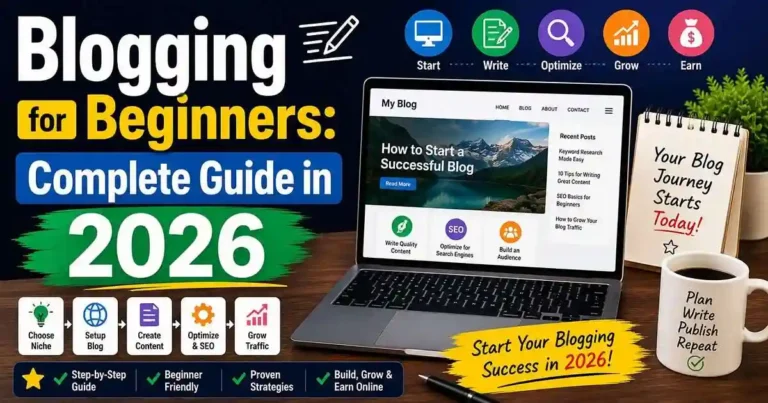
Step 1: Choose a Niche
Pick a topic you enjoy that has a long-term demand.
A great niche usually includes:
• The blogger’s interest
• The audience’s demand
• Opportunities for monetization
Do not pick topics that cover various unrelated niches.
Step 2: Choose a Blogging Platform
WordPress is the most popular option because it’s flexible, beginner-friendly, and scalable.
Other platforms exist, but WordPress offers the widest range of themes, plugins, and customization options.
Step 3: Buy a Domain and Hosting
Choose a domain name which is:
• Small
• Easily memorable
• Spellable easily
• Niche relevant.
Quality hosting can make your website speedier and user-friendly.
Step 4: Design Your Blog
Keep your design simple.
Focus on:
- Fast loading speed
- Mobile responsiveness
- Easy navigation
- Readable typography
- Clean layout
A professional appearance builds trust with visitors.
Step 5: Plan Your Content
Pre-plan what you want to write.
Consider:
• Guides for novices
• Tutorials
• FAQs
• Comparison guides
• Resource pages
Pre-planning will avoid writer’s block and keep you on track.
Step 6: Write Helpful Articles
What readers look for are solutions, not lengthy introductions.
Each and every writing should have:
• An enticing title
• Easily understood headings
• Brief paragraphs
• Concrete examples
• Specific suggestions
• Useful conclusions
Step 7: Learn Basic SEO
Search Engine Optimization helps readers find your blog.
Important SEO basics include:
Keyword Research
Find keywords people are actively searching for.
Search Intent
Understand what readers expect before writing.
Internal Linking
Connect related articles across your website.
Meta Titles and Descriptions
Write compelling snippets that encourage clicks.
Image Optimization
Compress images and use descriptive ALT text.
Essential Blogging Skills
Consistent writing
Regular posting will help build your credibility.
Be realistic about your expectations as opposed to being unrealistic and having too much expectation from yourself.
Research
Good bloggers do their research; they cross-check information, make sure the sources used are credible and they know their target audience.
Editing
Editing will improve the readability of your blog.
A good blogger must edit his/her blogs to improve:
• grammatical aspect
• readability
• Structure
• Format
• Accuracy
Time management
Effective bloggers manage their week.
An Example Week
Monday
Keyword Research
Tuesday
Draft Blog
Wednesday
Edit Blog
Thursday
Optimize SEO
Friday
Publish Blog
Blogging for Beginners: Growing Your
Audience
SEO Factors to Consider
Search engines are going to remain one of the most optimal sources of traffic for you.
Ensure that you give people answers to their questions.
Mailing List
Give your readers:
• Free guides
• Templates
• Checklists
• Newsletter
Your email subscribers are likely to be your most loyal readers.
Share Your Articles
Share your articles on:
• Facebook Groups
• X (Twitter)
• Relevant online forums
It’s not about promotion, it’s about providing value.
Revise Your Old Articles
Make sure that you revise the content to keep it current.
Revise:
• Statistics
• Screenshots
• Links
• Examples
• FAQs
How Beginners Can Make Money Blogging
Many bloggers start without expecting immediate income.
As your audience grows, monetization options include:
- Affiliate marketing
- Display advertising
- Sponsored posts
- Digital products
- Online courses
- Freelance services
- Consulting
Focus on helping readers first. Revenue usually follows trust.
Practical Examples
Example 1: Personal finance blog
The new blogger posts his budgeting article weekly, and then after some time his traffic will increase because he is writing an article for each frequently asked financial question.
Example 2: Travel blog
This blogger does not have to write about every possible travel destination; he only needs to stick to writing about budget travel in Southeast Asia in order to gain authority amongst his audience.
Example 3: Small business blog
The small business writes blog articles answering their clients’ questions. In this way, they will gradually attract visitors who will become paying customers eventually.
Actionable Tips
1. Choose one niche and focus on it alone.
2. Blog frequently, not often.
3. Gain knowledge about SEO and then proceed further.
4. Make plans for your content strategy.
5. Update the old content.
6. Measure your blog statistics every month.
7. Start developing your mailing list right away.
8. Study the successful blogs but only to gain inspiration.
9. Improve one skill every week.
10. Be patient since blogging is a long-term activity.
Common Mistakes to Avoid
Beginners may hinder their own progress through the following errors:
• Selecting too many topics.
• Failing to conduct keyword research.
• Inconsistent content distribution.
• Writing solely for search engines.
• Hoping for instant success.
• Lack of consideration for website loading time.
• Not using internal links.
• Quietly giving up on the project.
Frequently Asked Questions
1. Would it be beneficial for me to start a blog in 2026?
Yes, it would, since it is popular, traffic generator, authority and income maker because of its useful content.
2. How often should I write articles as a novice?
Maybe, once a week could be enough for me as a beginner.
3. Do I have to know any programming to create my blog?
No, since nowadays there are numerous blogging sites which allow creating blogs even without any programming skills.
4. When will I get my first subscribers?
It will take some time but many bloggers manage to have their first subscribers in several months.
5. Can I make money as a rookie blogger?
Yes, since there are many ways to earn money as a blogger such as affiliate marketing, advertisement, sponsorship, digital products and services.
Conclusion
“Learning Blogging for Beginners” is about laying the proper foundation without trying to cut corners. Find your own niche, produce good content, learn at least some basics of SEO, and solve problems of your audience.
Blogging rarely gives any quick success, but after some time all pieces come together. Each post you write makes your site, your knowledge, and even your income better. Go slow, do not try to rush things, and after a year you will be glad that you made your choice.












Your comment will appear immediately after submission.