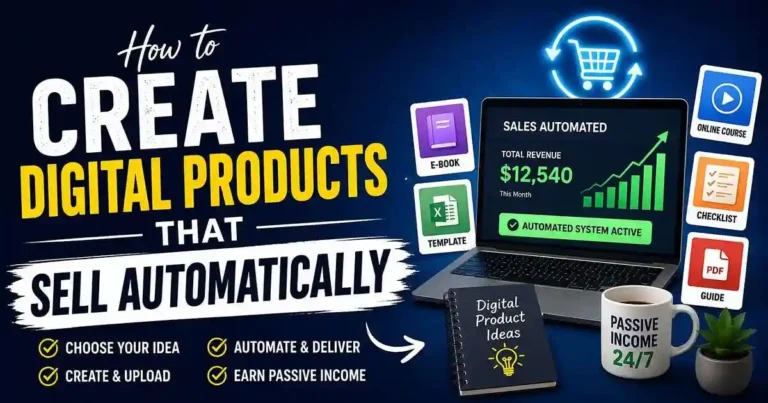
Think of yourself waking up one morning and seeing an email informing you that you have just sold three items overnight without responding to the clients’ queries, packaging your products, and shipping them. This is the essence of having digital products, since once created and marketed correctly, they can keep generating sales for you without requiring too much effort each day.
Unfortunately, not all digital products become money-making machines since many developers put in weeks of work creating something that will not be bought simply because of lack of research or the lack of interest of potential customers.
Here is your step-by-step guide to creating digital products that will sell themselves.
What Are Digital Products?
A digital product is a product that can be downloaded or accessed via the internet. This means that no physical inventory needs to be kept on hand or shipped.
Some examples of digital products include:
- E-books
- Printable planners
- Online courses
- Templates
- Stock photographs
- Presets
- Spreadsheets
- Checklists
- Design elements
- Software
- Membership tools
Since an item can be sold multiple times, digital products have great profit margins after their creation costs are paid off.
Why Digital Products Are a Great Business Model
Online companies tend to gravitate towards digital products due to their scalability.
Advantages of going digital include:
- No inventory cost
- Immediate delivery
- High-profit margins
- Global market reach
- Low operational costs
- Automation capability
- Unequaled sales capacity
You are not trading time for dollars but building something that will keep on generating profits even after its initial launch.
How to Create Digital Products That Sell Automatically
1. Begin With an Actual Problem
The most effective digital products solve a concrete problem.
Questions you can ask yourself:
- What are people having problems with?
- What activities consume much time?
- What info are people looking up constantly?
Examples of such problems include:
- Freelancers require invoices.
- College students need planners.
- Small business owners require social media templates.
When your product is able to save some time, relieve stress or make money, it is much easier to sell it.
2. Conduct Market Demand Research
You shouldn’t build something and then prove its value later.
Rather, conduct market research before spending hours on product development.
Such research can be conducted on:
- Google suggestions
- Reddit forums
- Quora
- YouTube comments
- Facebook Groups
- Etsy best sellers
- Gumroad marketplaces
Pay attention to repeating questions and complaints.
When there are hundreds of people asking the same thing, it means that there is a market for it.
3. Choose the Right Product Format
Different audiences prefer different formats.
Popular options include:
E-books: Ideal for teaching knowledge.
Examples:
- Investing basics
- Freelancing guides
- Budget planning
Templates: Perfect for saving customers time.
Examples:
- Resume templates
- Excel dashboards
- Notion templates
- Canva templates
Online Courses: Useful for complex topics requiring detailed explanations.
Examples:
- Graphic design
- Coding
- Photography
- Personal finance
Printables: Simple to create yet highly profitable.
Examples:
- Habit trackers
- Meal planners
- Budget worksheets
- Wedding planners
Digital Design Assets: Popular among designers and creators.
Examples include:
- Fonts
- Icons
- Illustrations
- Mockups
4. Create High-Quality Content
Not all successful products need to be long. They just have to be:
- User-friendly
- Well designed
- Logically organized
- Regularly updated
- Designed for solving one problem
Would you consider your product worth its price?
This is the better question to ask yourself than trying to make it unnecessarily long.
5. Design Matters More Than You Think
People often judge quality before opening your product.
Invest time in:
- Professional cover design
- Consistent typography
- Clean layouts
- Easy navigation
- Attractive visuals
A polished presentation builds trust immediately.
6. Choose Where to Sell
Your Own Website
Pros:
- Full control
- Better branding
- Higher profits
- Customer email collection
Cons:
- Requires traffic generation.
Digital Marketplaces
Examples include:
- Gumroad
- Etsy
- Payhip
- Creative Market
Pros:
- Existing buyers
- Easier setup
Cons:
- Platform fees
- Greater competition
Many successful creators use both.
7. Price Your Product Correctly
Pricing too low often hurts sales more than pricing slightly higher.
Consider:
- Time saved
- Value delivered
- Competitor pricing
- Product uniqueness
- Target audience
For example:
A budgeting spreadsheet that saves someone ten hours may easily justify a $29 price tag.
Focus on value instead of page count or file size.
8. Build an Automated Sales System
This is where passive income becomes possible.
A simple automated workflow looks like this:
Visitor → Landing Page → Payment → Instant Download → Follow-up Email
Automation tools can handle:
- Payments
- Product delivery
- Email receipts
- Customer onboarding
- Upsells
- Email sequences
After setup, most of the process runs without manual work.
9. Create a Landing Page That Converts
There are three basic questions your product page needs to address:
- How will this solve your problem?
- Why is this unique?
- Why would you buy now?
Your product page must contain:
- Title
- Product description
- Advantages
- Testimonials
- Questions & Answers
- Money back guarantee
- Powerful call-to-action
10. Market Your Product Consistently
Creating the product is only part of the process.
One can’t buy what one doesn’t know about.
Marketing platforms that are effective are:
Blogging: Write articles using keywords.
For instance, if one needs a spreadsheet for financial management, write articles about saving money or expense management.
Pinterest: It’s very helpful in making printables, planners, recipes, and templates. Traffic from pins continues month after month.
Email Marketing: Begin your email list by giving away something for free. Promote your paid product through emails afterwards.
YouTube: Making educational videos automatically creates trust. People generally prefer buying from people who taught them.
Social Media: One shouldn’t be busy selling the product all the time; one should offer useful content. Educate first. Sell later.
11. Improve Your Product Over Time
You don’t have to write an ideal first draft.
Take heed of your customer’s advice.
Updates include:
- Novel features
- Better formatting
- Numerous templates
- More detailed instructions
- Extra materials
Small updates can make huge differences.
Digital Product Comparison Table
| Product Type | Ease of Creation | Profit Margin | Time to Create | Best For |
|---|---|---|---|---|
| E-books | Medium | High | 1-3 months | Writers, Experts |
| Templates | Easy | Very High | 1-4 weeks | Designers, Organizers |
| Online Courses | Hard | Very High | 2-4 months | Educators, Experts |
| Printables | Very Easy | High | 1-2 weeks | Creatives, Planners |
| Design Assets | Medium | High | 1-2 months | Designers |
| Software/Plugins | Hard | Very High | 3-6 months | Developers |
Practical Example
Assume that Sarah is a freelance designer.
She observes that her clients usually request proposal templates.
To avoid the tedious process of designing templates again and again, she designs a proposal template.
She charges $25 for it.
If four people purchase it every day:
4 x $25 = $100 per day
Which results in:
- Approximately $3,000 per month
- And $36,000 per year
The product requires some effort to promote and update from time to time.
Common Mistakes
Many creators struggle because they make avoidable mistakes.
Watch out for these:
- Creating products nobody requested
- Ignoring customer research
- Poor product design
- Weak product descriptions
- No email marketing
- Underpricing quality work
- Giving up too quickly
- Not collecting customer feedback
- Failing to improve existing products
Remember, successful digital products usually evolve over time.
Frequently Asked Questions (FAQ)
What is the easiest digital product to create?
Printables, templates, and checklists are among the easiest because they require relatively little technical knowledge.
Can beginners create digital products?
Yes. You don’t need a large audience or advanced skills. Solving one specific problem for one group of people is often enough to get started.
How long does it take to make sales?
It varies. Some products sell within days, while others take months of consistent marketing before gaining traction.
Do digital products generate truly passive income?
They can become mostly passive after creation and automation, but you’ll still need to update products, market them, and support customers occasionally.
Which digital products are most profitable?
Online courses, premium templates, software, memberships, and business tools often generate higher long-term revenue because they provide significant value.
How should I price my first digital product?
Research competitors in your niche. A good starting point is $5-$15 for simple products, $20-$50 for templates, and $50-$200+ for courses. Focus on the value you provide.
Do I need a website to sell digital products?
No. You can start with marketplaces like Gumroad, Etsy, or Payhip. A website is helpful but not required to begin selling.
Conclusion
Being educated on the process of designing products that sell themselves automatically is not about finding an easy money-making path, but about creating assets that provide value for your customers.
The key to success is in the following: instead of trying to make a quick sale, find and solve people’s problems. Research the demand, develop good quality products, set up the process of delivering them, and promote your creations continuously. Although automation saves you time, continuous development of your products and knowledge of your customers is required.
Begin with designing one simple product, learn from experience, improve it, and proceed step-by-step. Your range of good products may become a good source of online income in the future.









Your comment will appear immediately after submission.