Introduction
Consider spending three hours researching for credible data only to find out that more than half of them are obsolete and the other half doesn’t address your needs. Sounds familiar?
The Best AI Research Tools will help you save a lot of time. In addition to allowing you to search for credible sources, find papers to summarize, organize information, and detect knowledge gaps in your field, modern AI research tools enable you to do all this automatically.
However, not all of them are suitable for your purposes. There are those that create persuasive but false information, and those that help find credible evidence.
This guide will analyze the best AI research tools for 2026, their differences, the right moments to use them, and mistakes to avoid during research.
Table of Contents
- What Are AI Research Tools?
- Why AI Research Matters More Than Ever
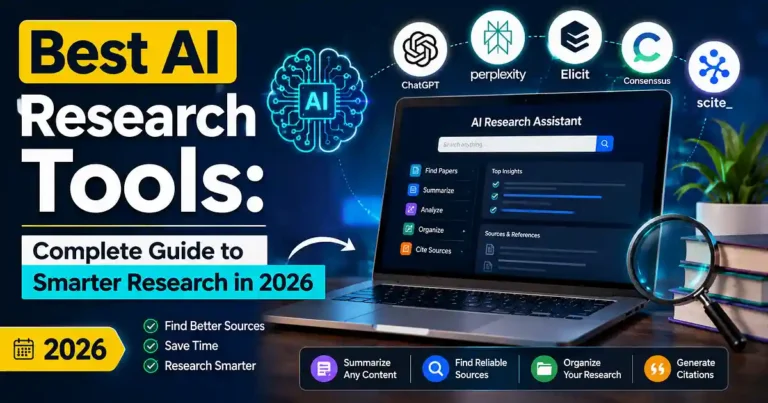
- Best AI Research Tools in 2026
- How to Choose the Right AI Research Tool
- Practical Research Workflow
- Common Mistakes to Avoid
- Frequently Asked Questions
- Conclusion
What Are AI Research Tools?
AI research tools employ artificial intelligence to help users gather, analyze, summarize, sort, and comprehend information much quicker than by employing the old search method.
In addition to simply providing webpages as search engines do, these tools have the ability to:
• summarize lengthy documents
• compare multiple sources
• explain complex ideas
• find academic papers
• generate citations
• sort out research information
• provide insight
• ask follow-up questions based on the sources
Far from eliminating critical thinking, AI is most useful when employed as an assistant.
Why the Best AI Research Tools Are Becoming Essential
Research is becoming more difficult since information increases at a rate that is impossible to catch up with.
Professionals waste endless hours:
• Finding credible sources
• Read long reports
• Compare contradictory information
• Taking notes
• Summarizing findings
AI can significantly reduce all these activities.
While you may read ten research articles from beginning to end, with the help of AI, you can get concise summaries that will help you choose which articles need closer examination.
More time to think and fewer to search.
Best AI Research Tools in 2026
1. ChatGPT
Best for:
- General research
- Brainstorming
- Explaining complex topics
- Creating outlines
Strengths:
- Easy conversational interface
- Excellent for simplifying difficult concepts
- Strong reasoning capabilities
- Helpful for planning research projects
Limitations:
- Always verify factual claims
- Works best when paired with trusted sources
Ideal users:
- Bloggers
- Freelancers
- Business owners
- Students
2. Perplexity AI
Best For:
• Internet searches
• Timely information
• Cited results
Usefulness:
Unlike other AI assistants, Perplexity provides citations for its results, which makes it simple to verify any information.
It is most suitable for researching technologies, financial market trends, and current events.
3. Elicit
Best for:
- Academic research
- Literature reviews
- Scientific papers
Key features:
- Searches research databases
- Summarizes academic studies
- Compares findings across papers
- Extracts important data
Researchers often use Elicit to speed up literature reviews without reading hundreds of abstracts individually.
4. Consensus
Best for:
- Evidence-based research
- Health
- Science
- Education
Consensus searches published scientific literature instead of general websites.
Rather than giving opinions, it focuses on what research evidence actually says.
This makes it particularly useful for:
- Medical research
- Psychology
- Economics
- Education
5. NotebookLM
Best for:
- Organizing personal research
- Understanding uploaded documents
Instead of searching the web, NotebookLM works with documents you provide.
You can upload:
- PDFs
- Reports
- Lecture notes
- Books
- Research papers
Then ask questions based only on those materials.
It’s like having an AI research assistant trained exclusively on your documents.
6. Semantic Scholar
Best for:
- Academic discovery
Researchers appreciate Semantic Scholar because it helps identify:
- Highly cited papers
- Influential authors
- Related studies
- Research trends
Its AI-powered recommendations often uncover papers that traditional searches miss.
7. Scite
Best for:
- Evaluating research quality
One unique feature of Scite is citation context.
Instead of simply showing how many times a paper was cited, it tells you whether later studies:
- Support it
- Contradict it
- Mention it neutrally
That helps researchers judge credibility more effectively.
8. Zotero + AI Integration
Good for:
• Citation management
• References organizing
Although Zotero itself is not an AI application, AI plugins have made it more intelligent.
Advantages:
• Tagging
• Summarization
• Organization
• Literature reviews
Comparing the Best AI Research Tools
| Tool | Best For | Sources | Ideal User |
| ChatGPT | General research | Mixed | Everyone |
| Perplexity | Web research | Yes | Professionals |
| Elicit | Academic studies | Yes | Researchers |
| Consensus | Scientific evidence | Yes | Students |
| NotebookLM | Personal documents | Uploaded files | Teams |
| Semantic Scholar | Academic discovery | Research papers | Scholars |
| Scite | Citation analysis | Scientific literature | Academics |
| Zotero AI | Organization | User library | Researchers |
How to Choose the Best AI Research Tools
Not every user needs the same solution.
Choose ChatGPT if you:
- Need explanations
- Want brainstorming help
- Create content
- Plan research
Choose Perplexity if you:
- Need current information
- Want source citations
- Research industries
Choose Elicit if you:
- Write research papers
- Conduct literature reviews
- Analyze studies
Choose NotebookLM if you:
- Work with large PDFs
- Study textbooks
Organize company documents
Practical Example
If you were writing on:
“Will AI take away jobs in finance at the entry level?”
Here is how you can follow for efficient workflow:
Step 1:
Research news on Perplexity
Step 2:
Research scientific articles on Consensus
Step 3:
Academic research on Elicit
Step 4:
Upload articles on NotebookLM
Step 5:
Interpretations on ChatGPT and create an outline for your article.
Actionable Tips for Better AI Research
Best AI Tools for Researching get even better results if used effectively.
• Begin with a specific research question.
• Cross-check the most important information with several sources.
• Use peer-reviewed sources for research papers.
• Save your bibliography while researching.
• Ask additional questions rather than relying on the first result.
• Compare the information provided by various AI resources.
• Read the original source before citing it.
• Use AI summaries as a basis rather than conclusive evidence.
Common Mistakes to Avoid
Most individuals have exaggerated expectations of artificial intelligence.
Do not commit these errors when using AI:
Believing everything that is said by AI
It might be wrong or even outdated.
Not bothering to check the original source
It is necessary to always read the original document before referencing it.
Depending on a single source of data
There are many tools specialized in various fields.
Omitting publication dates
Outdated research might no longer be relevant.
Copying the generated text by AI
Use AI for assistance, not substitution of your own thoughts.
Frequently Asked Questions
1. What is the best AI research tool altogether?
There is no one winner. ChatGPT performs well when it comes to explanation, whereas Perplexity, Elicit, and Consensus perform better when it comes to source-based research.
2. Can AI replace the conventional research process?
No. AI will just speed up the research process, but human assessment will remain crucial.
3. Are AI research tools free?
Many offer generous free plans, though advanced features often require a paid subscription.
4. Which AI tool is best for academic papers?
Elicit, Consensus, Semantic Scholar, and Scite are among the strongest options for academic and scientific research.
5. How can I verify AI-generated information?
Cross-check important claims using trusted sources, official publications, peer-reviewed journals, and reputable organizations before relying on them.
Conclusion
The Best AI Research Tools have nothing to do with AI replacing researchers; they simply enable them to work smarter and faster. Whether you’re working on an academic article, business report, web content, or any other project that requires you to conduct research, AI will help you find information, process it more efficiently, and reveal some new insights.
The best way to use these tools is to use all of them together. Employ conversational AI to get your ideas straight, source-based search engines to check your facts, and a research management tool to stay organized. The combination of all three with proper evaluation of the information will bring you great results.










Your comment will appear immediately after submission.