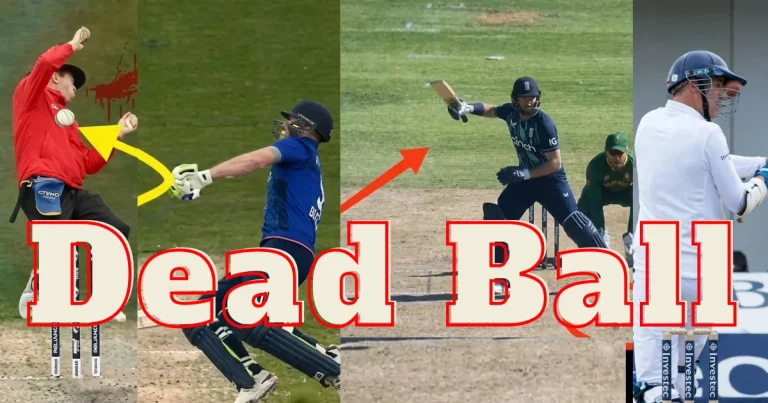
Cricket is governed by the laws established by the world-famous Marylebone Cricket Club (MCC). Among the 42 laws of the MCC, Law 20 specifically deals with the ‘Dead Ball’. However, there are certain situations where we might think the ball should be cancelled or dead, but in reality, the play remains live.
1. Dead Ball in Special Circumstances:
According to MCC rules, an umpire declares the ball ‘Dead’ under several unusual circumstances:
- 1.1 Ball Hitting a Helmet on the Field: If a ball strikes a fielder’s extra helmet placed inside the field, it immediately becomes a dead ball. Due to this error, the bowling team is penalized 5 runs, which are added to the batting team’s total.
- 1.2 Ball Hitting Spidercam or Drone: In modern cricket, if the ball hits an overhead camera or a drone, the umpire will call it a dead ball. No runs or dismissals can occur on that delivery, and the bowler must re-bowl it.
- 1.3 Ball Lodged in Batsman’s Clothing: If the ball gets stuck inside a batsman’s pads, jersey, or helmet in a way that it doesn’t fall to the ground, the umpire declares it a dead ball.
- 1.4 Bowler Dropping the Ball: During the run-up or bowling action, if the ball slips from the bowler’s hand and falls near their feet, it is considered a dead ball.
- 1.5 Deliberate Distraction: If a fielder moves intentionally or distracts the batsman right before the bowler releases the ball, the umpire calls it a dead ball. The bowling team receives a 5-run penalty, which is added to the batting team’s score.
- 1.6 Batsman Not Ready: If a batsman steps away for a valid reason while the bowler is about to release the ball, that delivery will be treated as a dead ball.
2. Cases Where the Ball is NOT Dead (Stays Live):
Some situations might look like the ball is cancelled, but according to the rules, the play remains live:
- 2.1 Ball Hitting the Umpire: If the ball hits the umpire and deflections occur (without getting stuck anywhere), it does not become a dead ball. The play continues, and the batsman can take runs.
- 2.2 On a No-Ball or Wide: The ball does not become dead the moment the umpire signals a No-Ball or Wide. The batsman can still score runs, and fielders have the opportunity to run them out.
- 2.3 Ball Hitting the Wicket without Bails Falling: Sometimes the ball hits the stumps with force, but the bails do not fall. In this case, the ball remains live, and the batsman can choose to run.
Conclusion and Special Caution on Run-Outs
This Law 20 or the ‘Dead Ball’ rule in cricket is very subtle. Often, a batsman assumes the ball has become dead after reaching the bowler or keeper and starts walking out of the crease carelessly. However, according to the law, the ball remains live until it is fully settled with the fielding side and the umpire is satisfied that the play for that moment is over. If the keeper breaks the stumps during this time, the batsman will be sent back to the pavilion as run out or stumped.
The Marylebone Cricket Club (MCC) designed this rule to ensure that no unexpected incident on the field results in an unfair advantage for any team. As a conscious cricket lover or player, knowing these details is essential, as a timely ‘Dead Ball’ or penalty run can change the fate of an entire match. Through this article, we understand when the ball is ‘Live’ and when it is ‘Dead’, which helps maintain transparency and the ‘Spirit of Cricket’.




Your comment will appear immediately after submission.