Introduction
Why do you open the shopping app if you just want one thing? Why do you find yourself putting several things in your cart after only a couple of minutes of searching, including the one product that you did not expect yourself to buy?
Sometimes, all your shopping behavior makes perfect sense at the moment.
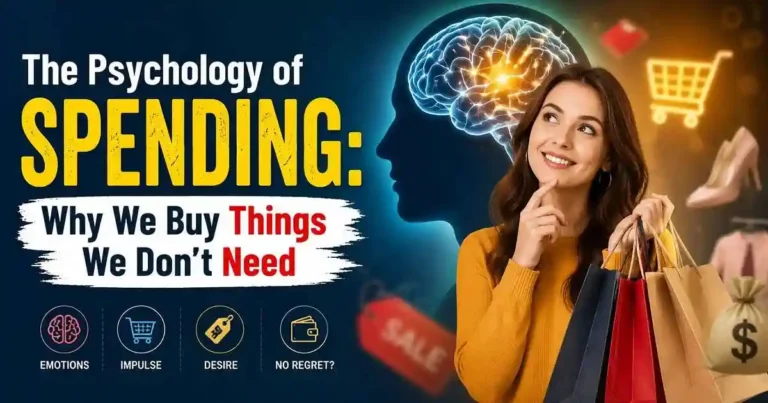
This is why reading the book The Psychology of Spending: Why We Buy Things We Don’t Need is so useful. Not all your spending is logical and rational. Your emotional state, habits, social pressure, advertising, convenience, and instant gratification can all lead you to certain purchases.
Recognizing these factors does not mean you should stop shopping altogether or feel bad about each of your purchases. The main idea is to learn how to control your spending and know the circumstances under which you buy extra things.
Table of Contents
1.Why Do We Buy Things We Don’t Need?
2.The Psychology of Spending: Why We Buy Things We Don’t Need
3.Emotional Spending and Instant Gratification
4.Why Discounts Make Us Spend More
5.The Influence of Social Media and Other People
6.How Convenience Encourages Impulse Buying
7.Practical Examples of Unnecessary Spending
8.How to Control Impulse Buying
9.Common Spending Mistakes to Avoid
10.Frequently Asked Questions
11.Conclusion
Why Do We Buy Things We Don’t Need?
In case people were only purchasing what was strictly necessary for their survival, shopping would be quite another matter.
Shoes worn out would have to be replaced, smartphones would have to be upgraded if not fulfilling requirements anymore, and clothes would be purchased when one really needed them. Instead, shopping is usually associated with emotions and certain expectations.
There are a number of factors behind purchasing things that one does not necessarily need:
• Emotional compensation – shopping helps to change one’s mood temporarily.
• Immediate satisfaction – shopping allows feeling the immediate satisfaction from a purchase.
• Fear of losing an opportunity – there is an urgency when offers are limited.
• Social comparison – purchasing things others possess may motivate one to do so.
• Habitual behavior – looking at shopping apps becomes a routine.
• Saving on the purchase – a discount on something may make the cost of a purchase seem reasonable.
• Convenience – easy checkout procedure facilitates the purchase.
• Identity formation – certain goods help to become the desired self.
What matters is that unnecessary purchasing does not always imply a lack of responsibility with money but rather reacting to the triggers of such behavior unnoticed by consumers.
The Psychology of Spending: Why We Buy Things We Don’t Need
One of the core ideas raised in the article The Psychology of Spending: Why We Buy Things We Don’t Need is that people make purchases based on their emotions.
For example, let us think about the situation of a man who has had a hard day at work. He is sitting with his mobile phone, browsing an online store where he sees some shoes which he has planned to purchase for a while.
The purchase is not needed. His current shoes are quite good.
Nevertheless, the purchase can give him a feeling of something special.
That could provide the man with a short term feeling of happiness. However, problems appear when the shopping is a way of coping with stress, boredom, or dissatisfaction.
Gradually, one may develop a cycle:
Emotions → urge to shop → buy → short-term satisfaction → regret → cycle repeats
The actual purchasing action is not necessarily an issue. The repeated cycle is.
The Question That Will Make a Purchase Differently
Prior to making a needless purchase, one could ask himself:
“What exactly am I hoping to gain through this purchase?”
Perhaps he is looking for convenience; perhaps pleasure; perhaps recognition from others; or maybe just diversion.
After one knows what exactly he wants, then he could determine whether the buying of the particular item would be the answer.
Emotional Spending and Instant Gratification
Emotion is among the most powerful motivators of spending.
One may decide to spend more depending on whether he or she is:
• Stressed
• Bored
• Sad
• Lonely
• Euphoric
• Angry
• Tired
• Celebrating
• Insecure
All the above types of spending are not always negative. Self-medication is sometimes essential to make sure that one enjoys their life using whatever funds they have.
What is negative is dependence on spending to resolve emotions.
A perfect example could be one who always orders gourmet takeout after a stressful day. Another perfect example would be one who purchases new clothes each time they feel insecure about their looks.
Why Instant Gratification Is So Powerful
In most cases, saving involves sacrificing something at the moment for something in the future.
The opposite of this is spending.
With spending, you get the goods, entertainment, or the experience immediately.
It becomes harder to motivate someone to save for something in the future compared to rewarding him/her with an immediate gain.
This explains why spending money on a gadget is much more motivating than saving money for an emergency fund.
Why Discounts Make Us Spend More
A discount changes the entire process of buying.
Now let’s assume there is a product sold for $100, but now its price is $60. All your attention will go on saving $40.
Here is one point to consider:
Would you have purchased this product at $60 without any discount?
If your answer is negative, then the discount didn’t save you any money. You just spent extra.
The “Sale” Trap
Here are some psychological ploys used by retailers to make consumers feel urgent:
• “Offer expires on…”
• “There are only few left”
• Countdown timer
• “Flash Sale!”
• “Buy one, get one free”
• “Free delivery after…”
• Personalized offers
These aren’t tricks; these techniques are meant to inspire action.
The trouble is in believing that every opportunity to save money means an opportunity to buy.
The product you don’t need stays unnecessary regardless of the fact that it is 50% off.
The Influence of Social Media and Other People
Spending also has its social dimension.
When you see your coworker with a brand new mobile phone, suddenly your phone becomes obsolete. Your best friend buys himself a very expensive watch and it occurs to you that it might be time for an upgrade as well. Your friends plan an expensive trip and now it’s difficult for you to stay away from it.
The effect of social networks is even stronger in this case.
People tend to share the best moments of their lives on social media. But behind each photo there is no savings account, no debts, no income and sacrifices.
Asking Yourself One Question
Whenever you buy anything just because everyone else has it, think:
“Do I still want it if I have never seen it before?”
The answer is no; then it can be considered buying under peer pressure.
One’s financial priorities do not have to match another person’s lifestyle choices.
How Convenience Encourages Impulse Buying
Buying has become unbelievably easy.
You can look at an item, click a button, pay instantly, and get it delivered at your doorstep without stepping out of your home.
This is indeed handy, but it also eliminates some of the natural chances to reconsider the purchase.
In the past, making a purchase might have been like:
Identifying the item → Going to the store → Comparing alternatives → Making up your mind to buy → Paying for it
Nowadays, it could be:
Identify the product → Tap → Purchase
Easy transactions could lead to impulsive purchases.
Adding Some Friction to the Process
It is possible to introduce some steps in order to make a needless purchase less likely.
Try:
• Deleting payment details
• Turning off buying alerts
• Unsubscribing from emails
• Snoozing shopping applications
• Awaiting 24 hours before making the purchase
• Adding items to wish list instead of purchasing right away
Practical Examples of Unnecessary Spending
Example 1: The Cheap Purchase
A $10 accessory seems not too expensive.
The purchase does not matter much.
However, if one makes a similar purchase ten times a month, then one could save that money, pay off debt, invest, etc.
Lesson: One should not ignore regular small purchases.
Example 2: The Technology Upgrade
Your phone works fine, but you want the new model because it has an improved camera and processor.
It may not be necessary, but the improvements make you think that your phone became obsolete.
Before making the upgrade, think:
• Which problems will a new device solve?
• How many times per week/month/year will you use the additional features?
• Is the difference worth the money?
• Can I live without it for another year?
The upgrade sometimes is a good idea, and the other time it is just the desire for something new.
Example 3: Shopping after Bad Day
Someone has a bad day, and he/she starts to surf online shops to calm down.
He/She buys some clothes which he/she do not need.
When the mood goes away, one feels regretful.
Lesson: If you go shopping right after a significant emotional event, then one should wait before buying something.
How to Control Impulse Buying
It is not necessary to devise a very strict budget. It is better to have a few systems that are easy and practical in the context of spending.
1.Use a 24-Hour Rule
For unnecessary expenses, wait at least for 24 hours.
For big expenses, wait for one week before making the purchase.
Reassess the purchase when the time is over.
2.Create a Wish List
Don’t buy things immediately; add them to a wish list.
Check the list afterwards.
You will find that some products will lose their charm once the initial excitement fades away.
3. Determine The Real Price
Think beyond just the cost of the item itself.
Consider what you could have used that money for.
For instance, $100 could actually have been used for:
• An emergency fund
• Payment of debt
• Investment
• Education
• Something valuable
• Planning for your finances in the future
This does not imply that you should refrain from spending $100. This implies that you have to know the opportunity cost.
4. Plan For Enjoyment Money
Budgeting without leaving room for any fun expenses might prove challenging.
Reserve some amount for entertainment and other miscellaneous expenses.
Once this amount has been saved up, you can spend it without worrying. Once it is exhausted, move on to the next budget cycle.
5. Monitor Your Purchasing Triggers
Keep track of the following when you find yourself making an impulsive purchase for the next month:
What did I buy?
How much did it cost me?
How was I feeling before buying it?
This will help you see patterns.
It turns out that most of your impulsive purchases occur in the evening, post-work, during sales, or even on social media.
Such knowledge is important since you will be able to tackle the trigger rather than blame yourself.
Common Spending Mistakes to Avoid
Error 1: Believing All Discounts Are Saving Money
Saving $20 on an item you do not need is not the same as making $20.
Look at the benefit of buying, not the discount amount.
Error 2: Overlooking Small Expenses
Small expenses can grow to be big.
An expense that does not seem much can accumulate into hundreds over a year’s time.
Error 3: Using Shopping for Entertainment
If you are shopping for fun, you are consistently being exposed to spending opportunities.
Find entertainment that does not lead to spending.
Mistake 4: Purchase Driven by Need for Approval
A purchase motivated more by a desire to win approval of others may fail to yield satisfaction.
Make purchases based on what your values are, not someone else’s.
Mistake 5: Seeking to Suppress All Wants
Just because you have certain wants does not mean you should get rid of them all.
Money is also supposed to bring fun and joy.
Frequently Asked Questions
1. What is the psychology of spending?
The psychology of spending includes certain aspects of the purchasing process such as emotional, behavioral, social and psychological and it provides an explanation of the reasons why people are ready to spend money even though they should not do so.
2. Why do I spend money on unnecessary things?
There are many reasons for that kind of behavior since people are not able to control their emotions, they get bored and need to satisfy their desires at once; moreover, there are people who are compelled to buy something because of necessity influenced by the social environment, advertising and so on.
3. How can I control my impulsive behavior?
For that purpose, it is necessary to have some time for that and 24 hours will be enough.
4. Is emotional shopping always bad?
Not necessarily. Random shopping just for fun is never bad but only becomes bad when done excessively and out of control, causing you to get into debt.
5. How can I develop good money management practices?
Before actually engaging in the transaction, determine whether the shopping serves any purpose or if it’s reasonable and relevant to your needs. You can also decide to delay the purchase.
Conclusion
Psychology of Spending: The reasons for buying things we don’t need is that our decisions regarding finances are not entirely logical.
We buy things seeking pleasure, excitement, convenience, approval, and compensation. Social pressure and marketing add emotions to this mix, and technology helps us satisfy our needs right away.
What is the solution? Give up on your shopping?
Not at all! Just create a gap between the moment you feel like buying something and the moment of purchasing by asking yourself whether you actually want the thing you wish to buy and whether you appreciate what you want.
Thus, you will make place both for enjoyment and prosperity.










Your comment will appear immediately after submission.