
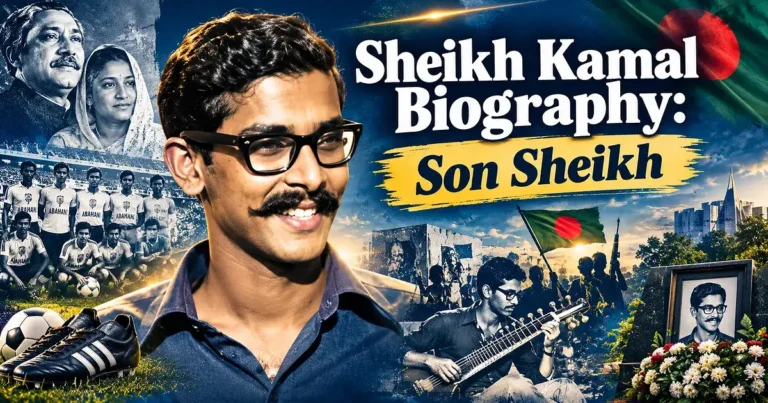
On July 31, 1975, Sheikh Hasina was about to leave for Germany. She asked her younger brother what she should bring back for him. Sheikh Kamal’s answer had nothing to do with himself: he wanted Adidas boots for the players of his football club, Abahani. Two weeks later, he was dead. In 26 years of life, Sheikh Kamal was a freedom fighter, a sports organizer, a student, a sitar learner and a founder of cultural groups, and his imprint on Bangladesh’s sporting and cultural life is still visible today. This biography tells his story from a riverside village to the night of August 15, 1975.
Sheikh Kamal at a Glance
| Detail | Information |
|---|---|
| Born | August 5, 1949, Tungipara, Gopalganj |
| Died | August 15, 1975, Dhaka (aged 26) |
| Parents | Sheikh Mujibur Rahman and Begum Fazilatunnesa |
| Siblings | Sheikh Hasina, Sheikh Rehana, Sheikh Jamal, Sheikh Russel |
| Spouse | Sultana Kamal Khuku (married July 14, 1975) |
| Known for | Freedom fighter, founder of Abahani Krira Chakra, cultural organizer |
| Education | Shaheen School, Dhaka College, University of Dhaka (Sociology, final-year MA student) |
| Buried | Banani Graveyard, Dhaka |
Birth and Childhood
A Boyhood on the Riverbanks
Sheikh Kamal was born on August 5, 1949, in Tungipara in Gopalganj. He was the eldest son of Sheikh Mujibur Rahman and Begum Fazilatunnesa, and the younger brother of Sheikh Hasina. His early years were spent playing with village boys along the Madhumati and Raigha rivers. That open rural childhood nurtured his love of sports.
A Childhood Shadowed by Politics
His childhood was far from carefree. His father was at the forefront of the movement against Pakistani rule and was jailed repeatedly, so the family often lived without him. The experience made Kamal responsible and mature at an early age.
Education
Kamal completed his secondary education at Shaheen School and his higher secondary at Dhaka College before enrolling at the University of Dhaka. After the Liberation War, he retired from the army and returned to his studies. In 1975, he was a final-year master’s student in the Department of Sociology. He was also active in student politics.
Sheikh Kamal in the Liberation War
1971: Answering the Call
When the Liberation War began in 1971, Kamal joined as an organizer. He received military training in India and was commissioned during the war.
ADC to General Osmani
He served as aide-de-camp (ADC) to General M. A. G. Osmani, the Commander-in-Chief of the Mukti Bahini. The role carried both honor and risk.
After Independence
After Bangladesh won independence, Kamal retired from the army and returned to his studies. The discipline of military life remained visible in his organizing ability and leadership.
Pioneer of Sports: Abahani Krira Chakra
The Dream of 1972
After independence, Kamal wanted to rebuild Dhaka’s sporting scene. In 1972, he founded Abahani Krira Chakra, now known as Abahani Limited, and served as its founding president. He is regarded as one of the pioneers of modern football in Bangladesh.
Beyond Football
Kamal cared about more than football. He took an interest in cricket, volleyball, basketball, hockey and athletics as well, and as an organizer he constantly thought about the welfare and facilities of players.
The Story of the Adidas Boots
Sheikh Hasina’s recollection of his request for Adidas boots for the Abahani players tells a lot about him. He asked for nothing for himself. His concern was for his team.
Abahani’s Legacy
Abahani went on to become one of the country’s leading sports institutions and holds a prominent place in Bangladesh football history. The club observes his birthday on August 5 every year.
A Man of Culture
Dhaka Theatre
Kamal was one of the founding members of Dhaka Theatre, and he participated in efforts to advance stage drama in independent Bangladesh.
Spondon Shilpi Gosthi
He founded Spondon Shilpi Gosthi, a folk music group, reflecting his love of Bengali folk culture.
Learning the Sitar at Chhayanaut
He learned to play the sitar at Chhayanaut. Even with a busy life as an organizer and a politically prominent family, he made time for music.
Political Involvement
Kamal was a member of the central committee of the Bangladesh Chhatra League. In 1975, after the formation of BAKSAL, he was a member of the central committee of the Jatiya Chhatra League. Still, most recollections remember him less as a politician than as a sports-loving, cheerful organizer.
Personal Life: A Marriage of Barely a Month
On July 14, 1975, with the consent of both families, Kamal married Sultana Kamal Khuku, who was herself an athlete. Their married life lasted less than a month, and it ended on the night of August 15.
August 15, 1975
In the early hours of August 15, 1975, a group of army personnel attacked the residence at Road 32 in Dhanmondi, Dhaka. Most members of Sheikh Mujibur Rahman’s family were killed. Kamal and his wife, Sultana Kamal Khuku, were among those who died that night. He was 26. Only his sisters, Sheikh Hasina and Sheikh Rehana, survived, because they were abroad at the time. Kamal was buried with other family members at Banani Graveyard.
Remembrance and Recognition
Sheikh Kamal’s Birth Anniversary
August 5 is observed each year as his birth anniversary. In 2020, the cabinet reportedly approved a proposal from the Ministry of Youth and Sports to include the day among nationally observed days. How the day is marked has varied with political circumstances over the years.
Tributes at Abahani
Each year, officials, players and supporters of the Abahani club lay wreaths at his portrait on club premises, and tributes are also paid at his grave in Banani.
The Sheikh Kamal Gold Medal
Abahani gives out the Sheikh Kamal Gold Medal for special achievement, keeping his name alive in sports.
Conclusion
Sheikh Kamal’s life was short but wide-ranging: a Liberation War organizer, the founder of a football club, a founding member of a theatre group, a sitar student, and above all a young man whose dream was to build a confident new generation from the playing field. His life ended at 26, but his name lives on at Abahani’s grounds, on stage and in Bangladesh’s sporting history.
Frequently Asked Questions
Who was Sheikh Kamal?
Sheikh Kamal was the eldest son of Sheikh Mujibur Rahman and the younger brother of Sheikh Hasina. He was a Liberation War organizer, the founder of Abahani Krira Chakra and a notable figure in Bangladesh’s sports and cultural life. He was killed on August 15, 1975, at the age of 26.
When and where was Sheikh Kamal born?
He was born on August 5, 1949, in Tungipara, Gopalganj. His childhood was spent playing with village boys along the Madhumati and Raigha rivers. His birth anniversary is remembered each year on August 5.
Who were Sheikh Kamal's parents and siblings?
His parents were Sheikh Mujibur Rahman and Begum Fazilatunnesa. His siblings were Sheikh Hasina, Sheikh Rehana, Sheikh Jamal and Sheikh Russel. Kamal was the eldest son of the family.
What was Sheikh Kamal's educational background?
He passed his secondary examination from Shaheen School and his higher secondary from Dhaka College, then studied at the University of Dhaka. After the Liberation War, he left the army and returned to his studies.
What did Sheikh Kamal study at the University of Dhaka?
He studied in the Department of Sociology at the University of Dhaka. At the time of his death in 1975, he was a final-year master’s student in that department.
What was Sheikh Kamal's role in the Liberation War?
In 1971 he worked as an organizer of the war, received military training in India and was commissioned during the conflict. He served as aide-de-camp (ADC) to General M. A. G. Osmani, the Commander-in-Chief of the Mukti Bahini.
Was Sheikh Kamal the ADC to General Osmani?
Yes, during the Liberation War he served as aide-de-camp to General Muhammad Ataul Gani Osmani. He took on this role after receiving his wartime commission.
Why is Sheikh Kamal sometimes called Captain?
During the Liberation War he trained, was commissioned into the army and served as an ADC. Because of this military identity, the prefix Shaheed Captain is often used before his name.
What did Sheikh Kamal do after independence?
After Bangladesh won independence, he retired from the army and went back to his studies. He also founded Abahani Krira Chakra in 1972 and took part in efforts to advance theatre and folk music.
What was Sheikh Kamal's contribution to sports?
In 1972 he founded Abahani Krira Chakra and served as its founding president. Beyond football, he took an interest in cricket, volleyball, basketball, hockey and athletics and cared about the welfare and facilities of players. He is regarded as a pioneer of modern football in Bangladesh.
When was Abahani Krira Chakra founded and by whom?
Abahani Krira Chakra was founded in Dhaka in 1972 on the initiative of Sheikh Kamal, who was its founding president. It is now known as Abahani Limited and is one of Bangladesh’s leading sports institutions.
What is the relationship between Sheikh Kamal and Abahani?
Sheikh Kamal is the founder of Abahani. From the beginning, he was concerned about the facilities of the club’s players. Every year on August 5, tributes are paid at his portrait on the club premises, and the club awards a gold medal in his name.
What is the story of the Adidas boots?
On July 31, 1975, before leaving for Germany, Sheikh Hasina asked Kamal what she should bring back. He asked for Adidas boots for the Abahani players, nothing for himself. Hasina has recounted this in a recollection that shows his devotion to his team.
Was Sheikh Kamal involved with Dhaka Theatre?
Yes, he was one of the founding members of Dhaka Theatre. He took part in efforts to advance stage drama in independent Bangladesh.
What is Spondon Shilpi Gosthi?
Spondon Shilpi Gosthi was a folk music group founded by Sheikh Kamal. It performed folk songs and reflected his love of Bengali folk culture.
Did Sheikh Kamal learn music?
Yes, he learned the sitar at Chhayanaut. Even with a busy life as an organizer, he made time for music.
Was Sheikh Kamal involved in politics?
He was active in student politics and was a member of the central committee of the Bangladesh Chhatra League. In 1975, after the formation of BAKSAL, he was a member of the central committee of the Jatiya Chhatra League. Most recollections remember him more as an organizer of sports and culture than as a politician.
Was Sheikh Kamal the founder of the Jubo League?
No reliable source supports this claim, which appears on some websites. He is credited with founding Abahani Krira Chakra and Spondon Shilpi Gosthi and with being a founding member of Dhaka Theatre. His political role was as a member of the central committee of the Chhatra League.
Who was Sheikh Kamal's wife?
His wife was Sultana Kamal Khuku, who was an athlete herself. They married on July 14, 1975, with the consent of both families, and both were killed less than a month later.
When did Sheikh Kamal get married?
He married Sultana Kamal Khuku on July 14, 1975. Their married life lasted less than a month, until the attack of August 15.
How did Sheikh Kamal die?
In the early hours of August 15, 1975, a group of army personnel attacked the residence at Road 32 in Dhanmondi, Dhaka, and he was killed along with most of his family, including his wife. Only his sisters, Sheikh Hasina and Sheikh Rehana, survived because they were abroad.
How old was Sheikh Kamal when he died?
He was 26 years old. He had turned 26 on August 5, 1975, ten days before he was killed.
Where is Sheikh Kamal buried?
He was buried at Banani Graveyard in Dhaka, together with other members of his family who were killed that night. Tributes are paid at the grave on his birth anniversary each year.
How is Sheikh Kamal's birth anniversary observed?
On August 5 every year, tributes are paid at his portrait at the Abahani club and at his grave in Banani. In 2020, the cabinet reportedly approved a proposal from the Ministry of Youth and Sports to include the day among nationally observed days. How the day is marked has varied with political circumstances.
What is the Sheikh Kamal Gold Medal?
It is an award that Abahani gives for special achievement, on the occasion of his birth anniversary. It keeps his name alive in the world of sports.
What was Sheikh Kamal's childhood like?
He spent his early years in Tungipara, playing with village boys along the Madhumati and Raigha rivers. Because his father was jailed repeatedly during the political movement against Pakistani rule, the family often lived without him. This made Kamal responsible and mature at a young age.







Your comment will appear immediately after submission.