Introduction
Think of yourself running a small business where you will have to respond to customer inquiries, post something on social media, manage invoices, keep an eye on inventory, follow up with the leads—before the noon. It is the reality of many entrepreneurs out there, leaving them little time for planning or growing their business.
But here comes the real use of AI Automation for Small Business. Modern AI is not meant to replace people, but helps business owners get rid of routine tasks, minimize the risk of errors, and do the things that bring money to the business.
Moreover, it doesn’t cost a fortune and require a team of software developers to implement it. There are affordable and easy-to-use AI applications that are specially designed for small business owners.
This guide will tell you how AI automation works and when it generates maximum financial benefit for your business.
Table of Contents
- What Is AI Automation for Small Businesses?
- Why More Small Businesses Are Adopting AI
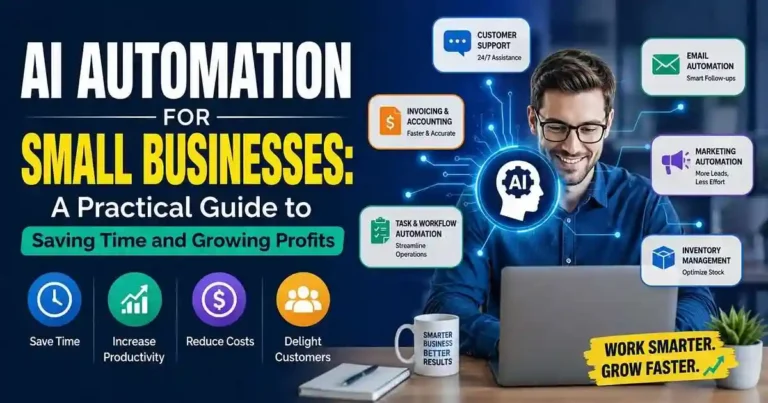
- Areas Where AI Creates the Biggest Impact
- Practical Examples
- Financial Benefits
- Choosing the Right AI Tools
- Common Mistakes to Avoid
- Actionable Tips
- Frequently Asked Questions
- Conclusion
What Is AI Automation for Small Businesses?
AI Automation for Small Businesses is defined as the use of artificial intelligence to execute tasks without much human involvement.
Unlike conventional automation, which is incapable of learning, AI is capable of learning from data, identifying patterns, creating content, answering customers’ queries, and even making business decisions.
In contrast to wasting valuable time on mundane activities, entrepreneurs could automate the following tasks:
• Customer service
• Answering emails
• Scheduling appointments
• Generating invoices
• Conducting marketing campaigns
• Entering data
• Following up with clients
• Managing inventory
Why AI Automation for Small Businesses Is Growing So Quickly
Some of the factors contributing to the increased accessibility of AI include the following:
Cheap cost
There are AI solutions available in the market which provide free services or subscriptions at affordable prices.
Ease of use
The majority of the platforms do not require any technical skills. Moreover, there are some which integrate with the software already available within companies.
Requirements of the customer
There are now customer expectations for quick responses and services. With the help of AI, smaller companies can rival bigger companies.
Productivity
It is simply amazing what a few hours saved a day can do.
Where AI Automation Creates the Biggest Business Value
Customer Service
Customer service is one of the simplest areas to start with.
AI chatbots can:
• Respond to frequently asked questions
• Carry out basic tasks
• Schedule appointments
• Gather customer data
• Route complicated cases to humans
This enables customers to get fast responses while employees deal with scenarios requiring human intervention.
Marketing
Marketing may take up a significant part of the time of a small business owner.
AI software can assist in:
• Blog writing
• Email marketing campaigns
• Social media caption writing
• Product description creation
• Scheduling of content
• Analysis of marketing campaign performance
This ensures that businesses are able to engage in consistent marketing without necessarily employing numerous people.
Sales
Sales automation can enhance lead conversion.
For instance,
• Lead scoring
• Follow-up emails
• Meeting scheduling
• Proposal creation
• CRM updates
In place of keeping track of all opportunities manually, the AI assists in determining the most promising prospects.
Accounting and Finance
Automation can save time in financial management as well.
Some of the tasks that AI software can perform include:
• Expense categorization
• Invoicing
• Cash flow tracking
• Future expense prediction
• Monitoring for unusual transactions
• Creating financial reports
Bookkeeping is done more effectively and accurately.
Inventory Management
Another use of AI technology in inventory management is seen in retailers and eCommerce businesses.
AI technology makes predictions based on:
• Seasonal patterns
• Sales history
• Customer behavior
• Market demand
This ensures that there is neither overstocking nor shortage of inventory.
Practical Examples of AI Automation
Example 1: Local Bakery
A neighborhood bakery receives dozens of customer questions daily.
Instead of answering each message manually, an AI chatbot provides information about:
- Opening hours
- Cake availability
- Delivery options
- Custom orders
Staff spend more time baking and less time answering repetitive questions.
Example 2: Freelance Graphic Designer
For the freelance graphic designer, artificial intelligence can be applied in:
• E-mail writing
• Task scheduling
• Proposal preparation
• Meeting minutes generation
He now has fewer administrative tasks to perform.
Example 3: Online Clothing Store
An online retailer automates:
- Product recommendations
- Customer support
- Inventory updates
- Marketing emails
The result is higher customer engagement with fewer manual tasks.
Financial Benefits of AI Automation
And the most important benefit is not saving time but increased profitability.
Organizations frequently see benefits like:
Reduced expenses
There is less repetitive work through automation which allows the workforce to concentrate on more productive tasks.
Higher efficiency
Employees produce more in a shorter period.
Greater client retention
More efficient service often results in satisfied clients who come back.
Better decisions
AI can analyze business information faster than using a spreadsheet which allows the owners to notice trends sooner.
Greater income potential
Due to automation, organizations can serve more clients without adding more costs to their staff.
How to Choose the Right AI Automation Tool
It cannot be one single solution for each business process which can be applied everywhere.
The following factors should be considered while implementing a solution.
Identify those processes which are repetitive.
List down the processes which take the longest time per week.
Always do things gradually.
All processes don’t have to be automated at once.
Choosing a domain for example:
• Customer Service
• Marketing
• Accounting
In any case, it is necessary to ensure that the solution will work.
Looking for opportunities to implement
Determining what kind of solution that can work with the software that is already present.
Determination of the cost of solution.
Expensive solutions do not necessarily mean efficiency.
See how much time will be saved by implementing the solution.
Considering the issue of security.
Personal information must be kept secure.
Think of security issues before uploading data.
Common Mistakes When Implementing AI Automation for Small Businesses
The main reason for disappointments in most firms is unrealistic expectations and not ineffective technology.
Avoid the following mistakes.
Complete automation all at once
Do it in stages.
Good organizations always do things slowly but only after being sure of their successes.
Failing to include human monitoring
The task of AI is to work alongside human beings.
This doesn’t imply making business decisions without human analysis.
Selection of tools in the absence of objective definition
Do not acquire software just because it is in demand.
Identify the problem in the organization first.
Lack of employee training
Even a basic tool of AI needs some training to employees.
Those who know the software will do a good job.
Measurement of incorrect metrics
Rather than just measuring how much work AI is doing, measure:
• How much time is saved
• Satisfaction of customers
• Growth in revenue
• Lowering of costs
• Increased productivity of employees
Actionable Tips for Small Business Owners
Steps to take if you are new:
1. Find the three tasks that you perform regularly in a daily manner.
2. Figure out how many hours do these tasks take weekly.
3. Pick any AI solution that solves one of the problems.
4. Test the solution for 30 days.
5. Note down all the improvements you have made so far.
6. Scale only when there is something positive coming up.
7. Consistently analyze your performance.
Frequently Asked Questions
1. Is AI automation expensive for small businesses?
Not necessarily. Many AI tools offer affordable monthly subscriptions, and some provide free plans suitable for startups.
2. Will AI replace employees?
In most cases, AI supports employees by handling repetitive tasks, allowing people to focus on creative, strategic, and customer-facing work.
3. Which department should automate first?
Customer support, marketing, and administrative tasks are often the easiest starting points because they deliver quick productivity gains.
4. How long does implementation take?
Many cloud-based AI tools can be set up within a few hours or days, depending on business complexity.
5. Can very small businesses benefit from AI?
Absolutely. Even solo entrepreneurs and freelancers can save significant time by automating scheduling, emails, invoicing, and content creation.
Conclusion
No More AI Automation for Large Corporations Only, as affordable AI solutions make it possible to streamline operations, offer better customer support and make informed financial decisions without a drastic rise in expenses.
The best solution is to start solving one problem at a time, see how effective this was, and then continue. Companies that have managed to integrate AI into their work along with human skills can be in a better position to develop, deliver excellent customer experience, and stay competitive in a digital environment.
Instead of discussing whether your company needs AI or not, you should ask yourself about what repetitive job you need to automate first.










Your comment will appear immediately after submission.