Introduction
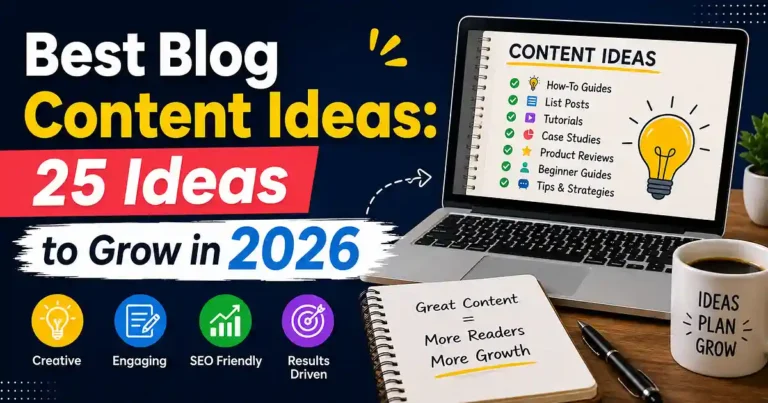
You have got a blog, several blog posts have been written, and here is the age-old dilemma again: What topic shall I write next?
While posting randomly everything that comes into mind will surely help keep your website alive, it might not be enough to attract the right kind of visitors. The idea is to post topics depending upon what your readers want to know, what issues they want to solve, and how your blog can provide more insights than other blogs.
It is here that the good blog content ideas really start making sense. While good content ideas may include topics which are interesting, they have one thing in common – they always have a purpose to serve; be it attracting organic traffic, answering a query, gaining authority, generating leads or promoting a product or service.
Here are some practical blog content ideas which could fit any niche you want to write for.
Table of Contents
- What Makes a Good Blog Content Idea?
- Best Blog Content Ideas for 2026
- How to Choose the Right Topic
- How to Turn One Idea Into Multiple Posts
- Common Blog Content Mistakes
- Frequently Asked Questions
- Conclusion
What Makes a Good Blog Content Idea?
Before analyzing some specific topics, it will be important to find out how to differentiate between a good topic and a bad one.
The following factors should be considered while choosing a good topic:
• It can solve some particular problems of the reader.
• It answers some frequently asked questions.
• It gives some instructions.
• It compares various options.
• It helps the reader to make his/her decision.
• It explains some complex issues in simple terms.
• The topic should stay relevant during months and even years.
• It fits into the general goal of the website.
Theme “Fitness Tips” is not concrete enough to be considered a good topic. Unlike this, “How to Build a 20-Minute Home Workout Routine for Beginners” motivates the reader.
The main point is quite clear – the more concrete is the topic, the more useful it is.
Best Blog Content Ideas for 2026
Here are 25 ideas you can adapt to different industries and audiences.
1. How-To Guides
Another kind of blog that is very effective is how-to blogs since it presents a solution to a problem.
How-to guides include:
• How to Start Your Very Own Blog From Scratch
• How to Live on What You Earn Monthly
• How to Create Portfolio for Freelancer
• How to Optimize Your Website Through SEO
In order to be successful, the how-to blog must help its readers reach somewhere.
2. Beginner’s Guides
In every niche there are beginners who need to learn about a certain thing in simple terms.
This kind of guide may be written regarding anything starting from concepts and ending with an instrument, skills and processes.
For example, in case you have a financial blog, then your beginner’s guide may be something like “Beginner’s Guide to Index Funds” while in case of a technology blog it should be “Beginner’s Guide to Cloud Computing”.
The main idea is to avoid any kind of jargon and see things for the very first time.
3. List Articles
When your readers need some choices to consider, you can create list articles.
Examples of list articles are:
• 15 Freelancing Jobs For Beginners
• 10 Tricks To Save Money Every Month
• 12 Useful AI Tools for Small Businesses
• 20 Ideas For Social Media Content
Lists can be effective, yet make sure that you don’t add any points just for the sake of making the article longer. Every item must have informative content.
4. Comparison Articles
When people are near decision-making, comparison articles can be very useful.
Examples of comparison articles are:
• Freelancing vs. Working On a Regular Job
• WordPress vs. Website Builders
• Active Income vs. Passive Income
• Email Marketing vs. Social Media Marketing
Effective comparison must involve pros and cons, cost, and who will benefit from which option.
5. Product/Tool Review
If your target audience frequently uses software, applications, financial instruments, and business tools, reviews might prove to be extremely valuable evergreen content.
While stating that the tool in question is “great” will not make much sense, it is much more appropriate to describe:
• what it does;
• who it is for;
• its main features;
• paying attention to pricing, limitations, alternatives, and overall usefulness.
Candid critique is very important when writing reviews.
6. Case Study
Case study allows transforming a general lesson into a real-life example.
It can involve studying the success story of the company, improvements of the website traffic, or any other particular approach.
If you lack a case study of your own, find one available publicly and cite the source accordingly. Do not fabricate results and experiences.
7. Typical Mistakes You Can Avoid
People always search for tips on how not to make expensive mistakes.
Such as:
• Top 10 Common Mistakes Made by Blogging Beginners That You Should Avoid
• Common Freelancing Mistakes that Will Cost You a Fortune
• Most Common Budgeting Mistakes That Stop You from Saving Money
• Common SEO Mistakes That Will Ruin Your Website
These kinds of articles will be very effective if you will explain why people need to do something different instead.
8. FAQs
The questions that you have listed in your FAQ section can also become good ideas for an article.
You can find them through:
• Suggested searches
• Comments
• Communications with your clients
• From online forums
• Your statistics
• Questions from your readers
And then answer those questions without providing additional info.
9. Easy Tutorials
While tutorials may be comparable to how-to articles, they are more often dedicated to a particular task or tool.
Examples include:
“Create Your First Google Analytics Report”
This is a lot more actionable compared to a general analytics article.
Screenshots, examples, checklists, and step-by-step instructions will definitely increase the utility of your tutorial.
10. Industry Trends
Industry trend articles can inform readers about changes in your field.
The topics may include:
• Trends in digital marketing AI
• Blogging trends for small businesses
• Personal finance trends
• Freelancing trends
• E-commerce trends
Keep in mind that trends content is risky since facts get outdated very quickly. Always date your information and describe the meaning behind this change.
11. Articles about Statistics and Data
Numbers always attract people if they have meaning behind them.
The topics to consider:
• Industry statistics
• Consumer behavior
• Blogging statistics
• Freelancing statistics
• Personal finances statistics
Use only reliable sources and always provide the meaning behind the figures rather than a mere set of percentages.
12. Checklists
Checklists are always useful for people.
For example:
• New blog launch checklist
• SEO checklist for beginners
• Checklist for client onboarding of freelance writers
• Monthly financial review checklist
It can also be used as a downloadable resource for your content.
13. Templates
People always like the templates that can save their time.
Depending on the topic you cover, you can share the following:
• Budget templates
• Content calendar
• Email templates
• Proposal templates
• Business planning templates
• Social media calendar
Sometimes, one template can be more helpful than an entire article.
14. “Best Tools” Posts
People like to know which tools they should use.
Some examples are:
• “Best SEO Tools”
• “Best Budgeting Software”
• “Best AI Tools for Freelancers”
• “Best Productivity Apps”
The main thing about such posts is to show criteria for choosing a tool. In contrast to making a universal list, you can explain how every particular tool should be used in this or that situation.
15. Problem-solving Posts
Try to think of some problems that your target audience may have.
Here are some examples:
• “Why Isn’t My Blog Getting Traffic?”
• “Why Can’t I Save Money?”
• “Why Are My Freelance Proposals Being Rejected?”
• “Why Is My Website Loading Slow?”
These kinds of posts are likely to draw people’s attention.
16. Is It Worth It? Articles
It is especially useful to use for decision-making regarding time or money.
Examples:
• Is Blogging Worth It in 2026?
• Is Freelancing Worth It for Beginners?
• Is an Online Course Worth the Money?
• Is Paid SEO Software Worth It?
Provide an unbiased answer instead of trying to make everything sound positive.
17. Personal Finance Education
When writing for a finance-based blog, educational articles may include information on:
• Emegency funds
• Budgeting
• Finance basics
• Compounding
• Managing debt
• Saving for retirement
• Generating multiple sources of income
Be especially cautious when providing financial information. Don’t confuse general education with personal financial advice.
18. Beginner Business Ideas
Readers interested in entrepreneurship often want realistic ideas they can evaluate.
Examples:
- Digital business ideas
- Low-cost business ideas
- Online service businesses
- Creator economy opportunities
- AI-related business ideas
Focus on startup requirements, skills, potential challenges, and realistic expectations rather than promising guaranteed income.
19. Content Marketing Guides
If your audience includes business owners, marketers, or bloggers, content marketing provides a large number of potential topics.
You could cover:
- Content strategy
- Keyword research
- Content calendars
- Content promotion
- Internal linking
- Updating old articles
- Measuring content performance
These subjects can also create natural connections between multiple articles on your website.
20. Resource Roundups
A resource roundup is an article that groups some useful resources.
Examples include:
“25 Free Resources to Learn Digital Marketing”
This could feature everything ranging from courses, tools, books, community, to reference.
Group resources according to their functions so that people can easily access what they need.
21. Expert Interview
Expert interviews can provide unique information that other types of posts fail to give.
Avoid asking general questions. People will only benefit from your interview if it discusses real decisions, problems, strategy, and lessons.
22. Myth Busting Posts
Each industry has its myths.
Some examples include:
– Blogging myths that beginners should stop believing.
– Common investing myths explained.
– SEO myths that can waste your time.
– Freelancing myths about making money online.
A good myth busting post explains the source of the myth and the truth behind it.
23. Hypothetical Examples about “What I Would Do” Educational Topic
It is possible to develop a realistic hypothesis example without turning it into an example that reflects one’s own personal life experiences.
For example,
“What I Would Do If I Were to Start My Online Business with $500”
Here, the author would be able to give reasons for each step without bringing personal life experiences into the topic.”
24. Content Update and Refreshing
Not all content strategies require creation of new content. Sometimes, updating an existing piece might prove better than creating a similar article.
Here are some aspects that should be looked out for:
• Outdated information
• Link breakages
• Outdated stats
• Missing information
• Poor examples
• Poor introduction
• New search intent
and updating the piece thoroughly rather than just changing the date of publication.
25. Ultimate Guides
A guide basically means an integration of various questions into one large content piece.
An example is:
“Ultimate Guide to Starting Your Own Blog”
which could cover such topics as topic identification, site creation, blogging, SEO, marketing, and earning from your blog.
How to Choose the Right Blog Topic
Having 25 ideas is good, but randomly publishing them is not a tactic.
First, raise three questions.
1. Is this topic relevant to my target audience?
The topic may have very high search demand but still be irrelevant to your website.
If your target audience is made up of beginner freelancers, an article on advanced corporate finance might not be appropriate even if the keyword is promising.
2. Am I able to give real value?
When choosing the topic to pursue, think whether you will be able to describe it in practical terms.
When there are already dozens of great guides available on the same topic, think about your value added.
3. Does the topic fit into a broader content strategy?
Cluster your content instead of creating posts on their own.
For instance, a personal finance blog may create a cluster based on budgeting:
• How to Create a Monthly Budget
• Top Budgeting Applications
• Budgeting Blunders
• How to Create an Emergency Fund
• How to Cut Back on Monthly Spending
Such pieces can be easily linked to each other.
How to Turn One Idea Into Multiple Posts
When you have chosen your topic, there will definitely be lots of subtopics to explore.
Let us take a look at some possible sub-topics connected with freelancing for beginners.
The following is the list:
1. Become a Freelancer
2. Skills of Good Freelancer
3. How to Create a Freelancer’s Profile
4. Getting Your First Client Tips
5. Mistakes That You Should Not Make When Freelancing
6. Freelancing Fees Calculation
7. Create a Freelancer’s Portfolio
This approach will save you much time for doing the research and developing an effective content marketing plan.
Moreover, each single article can easily become a video, post, e-mail or even a book.
Common Blog Content Mistakes
Even a great topic can perform poorly if the article itself is weak.
Publishing Without Understanding Search Intent
A keyword tells you what people type, but search results can reveal what they expect to find.
Study the intent before deciding on your format.
Writing Only for Search Engines
Keywords matter, but readers matter more.
Do not force the primary keyword into every paragraph. Use related terms naturally and focus on answering the reader’s actual question.
Topic Selection Just because a Keyword Has High Search Volume
High search volume keywords tend to be fiercely competitive.
A more specific topic will bring in lower traffic, but higher conversions.
Ignores the Existence of Other Content
Duplicate content creation will lead to competition between your own pages.
Check on your current content before making new ones.
Fails to Refresh Important Articles
Knowledge becomes outdated. Tools become outdated. Prices change.
A content marketing plan should include refresh of old articles that matter.
Frequently Asked Questions
1. What are the best blog content topics for beginners?
Topics that are beginner-friendly include “how-to” guides, list posts, FAQ, tutorials, avoid-the-pitfalls guides, and basic education guides. This type of format will be much simpler to create based on problems your readers have.
2. How do I choose blog topics people will want to read?
You can investigate questions that your target audience asks, search suggestions, competitive content analysis, community discussions, and website analytics. Using several sources will be more effective than using one source.
3. What is the frequency of blog post releases?
It depends on you. It is better to be consistent rather than frequently publishing low-quality posts. There are cases where one good blog post is much better than five low-quality ones.
4. Should every blog post have keywords?
If the blog operates on searches, then yes, it would be great to think about the search intention. But it does not mean that every article needs to be based on some highly-sought keywords. The content might serve for information purposes only.
5. What will make blog content more interesting?
Giving examples, making short paragraphs, writing descriptive headers, using images, comparing things, conducting an analysis, and giving practical steps. Most importantly, answering readers’ questions.
Conclusion
No, good blog topics do not necessarily mean those, which are complicated or trendy ones. They mean topics, which connect an actual need with pieces of information you can provide.
The entire process starts with identifying actual needs. Having done that, you can create how-to articles, comparisons, tutorials, FAQs and many other sources of information. All you have to do then is link appropriate articles depending on your content marketing strategy.
Instead of thinking about what topic you can blog about today, you should think about what will make your perfect reader’s life easier?
It will help you turn a bunch of random blog posts into an interesting site.








Your comment will appear immediately after submission.