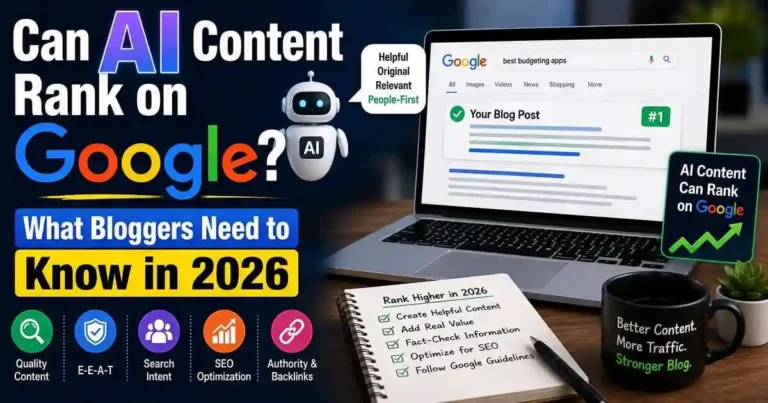
By now, after spending some time working on your blog post thanks to your AI writing software, you have managed to create an absolutely perfect article with proper grammar and good formatting. Yet, just as soon as you are about to publish it, the following question emerges in your mind:
Does Google rank AI content?
Sure enough, this is a perfectly valid question because using AI writing software to produce content is rather common nowadays, yet there are certain issues with recognition of such content by search engines.
Of course, it does. Google does rank AI content. And it is irrelevant to whether this content was created by people or by AI. What really matters is the quality, originality, and value of this content.
In this article, we will provide an answer to the question Does Google Rank AI Content, tell you about Google’s policy towards AI content, and give you several recommendations on using AI properly for ranking your searches.
Google’s Position on AI Content
Misconception number one is that Google will punish content due to the use of artificial intelligence in producing it.
This is not the case.
Google has stated quite clearly that it will evaluate the quality of content rather than how it was produced.
Therefore, any AI-assisted article which is valuable for its audience and answers the readers’ questions should be ranked highly on Google.
Low quality content written solely to manipulate is never going to work.
Why Some AI Articles Rank and Others Don’t
AI is just a tool. What you get depends on how it is applied.
High-ranking articles generally:
- Solve a particular problem.
- Conform to user intent.
- Offer original findings.
- Are verified.
- Possess good structure.
- Have practical illustrations.
- Have value added to that found online.
Poor-performing articles usually:
- Retell obvious information.
- Have incorrect data.
- Lack substance.
- Ignore user intent.
- Use too many keywords.
- Have no new material.
The distinction is not really in the tool—it’s in the editorial process.
How Google Evaluates Content
Google assesses certain signals which will enable them to decide whether the content is relevant and reliable.
The signals are listed below:
1. User Intent
Is it going to give the right answer to the user’s query?
2. Originality
Is it giving any new insight or useful suggestions instead of reproducing the same-old data?
3. Expertise & Experience
The target audience likes the contents provided by the real expert in that field.
Of course, it does not mean that you have to play the role of the expert; your content should at least be professionally written and backed up with facts and analysis.
4. Accuracy
Errors are possible with AI.
All facts, quotes, suggestions, and technical data should be double-checked for accuracy before publishing.
5. User Experience
Organized writing with heading tags, short paragraphs, links, and quick loading will create a good user experience.
Google Content Evaluation Criteria Summary
| Criteria | Description | Importance |
|---|---|---|
| User Intent | Answers the user’s question correctly | Very High |
| Originality | Provides new insights or perspectives | Very High |
| Expertise | Shows professional knowledge and analysis | High |
| Accuracy | All facts, quotes, and data are correct | Very High |
| User Experience | Well-organized, easy to read, fast loading | High |
Best Practices for Using AI in Blogging
Use AI as a Writing Assistant
AI works best for:
- Brainstorming ideas
- Creating outlines
- Improving grammar
- Rewriting sections
- Generating FAQs
- Summarizing research
Human judgment should guide the final article.
Add Original Insights
Readers and search engines value content that goes beyond generic explanations.
Include:
- Comparisons
- Practical scenarios
- Industry observations
- Updated information
- Balanced analysis
Fact-Check Everything
Never assume AI-generated information is correct.
Verify:
- Statistics
- Dates
- Product information
- Pricing
- Legal or financial advice
Accuracy builds trust.
Edit Before Publishing
A first draft—whether written by AI or a human—benefits from editing.
Review:
- Clarity
- Readability
- Tone
- Structure
- Keyword placement
- Internal links
Focus on Helping Readers
The purpose of every article should be solving a reader’s problem.
When usefulness comes first, SEO often follows naturally.
Practical Example
Think of two bloggers who write about budgeting software.
Blog A takes an AI-generated draft and posts it on their blog without changing anything.
It contains outdated facts, common sense advice, and repetition.
Blogger B generates an outline using AI, gathers information on current budgeting apps, verifies their features, makes comparisons, analyzes, improves readability, and gives practical advice.
Although both bloggers have used AI in writing, Blogger B is more likely to be trusted by readers because they have written useful content.
Actionable Tips
To use AI effectively:
- Start with AI-generated outlines.
- Expand each section with original insights.
- Verify every factual claim.
- Add examples and comparisons.
- Improve readability with short paragraphs.
- Optimize titles and headings.
- Include internal links.
- Update articles regularly.
- Avoid publishing AI drafts without review.
- Focus on solving readers’ problems.
Common Mistakes
Publication Without Editing
Not all original AI products are unique and sophisticated.
Overloading With Keywords
Overuse of keywords makes the content incomprehensible and may influence SEO ranking.
Losing Focus on User Intention
Great content always begins with understanding the intent of the users.
Applying AI to Sensitive Content without Verification
Some topics such as finance, law, and medicine need to be approached carefully.
Ignoring Human Insight
It is the human insight that turns the arranged information into valuable content.
Frequently Asked Questions (FAQ)
Does Google rank AI written content?
Quality and relevance of the written content will be examined irrespective of its source, AI or any other individual or company.
Can AI written content be penalized by Google?
This is impossible since Google will never give ranking to such low-quality written content.
Is AI content enough for SEO?
While AI can help us in creating written content very quickly, SEO requires something more from us.
Should bloggers make people aware that they are using AI?
It is not necessary to reveal the use of AI in normal blogging cases. But it does become essential when the use of AI affects the readers’ or editors’ expectations.
How can I use AI safely in my blogs?
Use AI while ideating, outlining, writing, and editing your content. But keep in mind that humans will still be required to go through your content.
Does Google have a specific AI content policy?
Google’s policy focuses on content quality, not how it was created. They reward helpful, accurate, and original content regardless of whether AI was used in its creation.
Can I publish AI-generated content without editing?
It’s not recommended. Raw AI content often contains inaccuracies, lacks originality, and may not fully address user intent. Always review and edit before publishing.
Conclusion
Can AI Written Content Rank in Google Search Results? The simple answer to this is yes, although only in cases where AI written content matches all the criteria set by Google for any other type of good content. Google prioritizes content that is correct, useful, original, and geared towards assisting the user.
AI can be used as a productivity aid, but not to replace human expertise in any way. Use AI to make things easier and faster for you while writing, but use human common sense to ensure the accuracy and originality of the information included in your piece.








Your comment will appear immediately after submission.