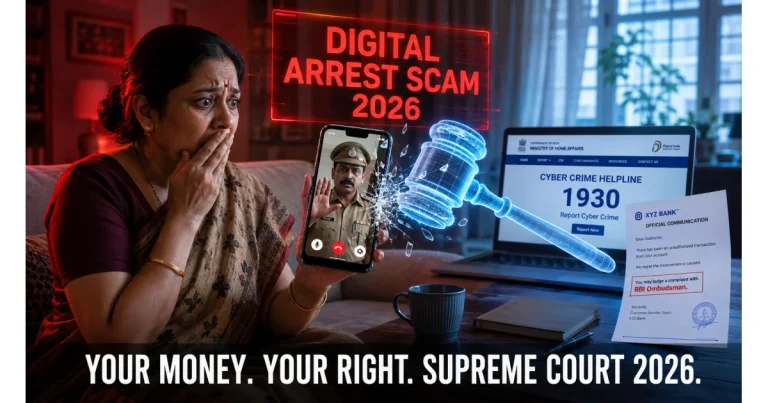
February 28, 2026 — The Supreme Court of India delivered a landmark judgment that fundamentally changed how digital arrest scam victims can recover their lost money. Banks are now legally bound to refund fraudulent transactions within 10 days of receiving a complaint. In the first four months of 2026 alone, over 45,000 digital arrest complaints were registered across India, with victims losing an average of ₹4.2 lakh each. Senior citizens (aged 60+) remain the most vulnerable and most affected group.
| Topic | Quick Answer |
|---|---|
| What is the scam? | Fake police/CBI officers threaten “digital arrest” to extort money |
| What did Supreme Court say? | Banks must refund within 10 days; no internal investigation delay allowed |
| First step to take? | Call 1930 within 30 minutes of sending money |
| Bank refuses to refund? | File free complaint with RBI Ombudsman |
| How long for refund? | 16 to 45 days (case dependent) |
What Exactly Is Digital Arrest Scam and How Does It Work?
Digital arrest scam is a phone call fraud where criminals pretend to be police officers, CBI, ED, or Income Tax officials and claim that a “digital arrest” has been issued against you.
Three-Step Scam Process
Step 1: Phone Call — “Illegal transactions detected in your account”
The criminal calls your phone number and says: “Your bank account has been used in money laundering, drug trading, or child pornography. An FIR has been filed against you.” They create pressure to make you panic.
Step 2: Video Call — Fake officer in uniform
You are connected to a video call (WhatsApp, Skype, or Telegram). The criminal wears a police uniform with a backdrop designed to look like a police station. They show a “court order” and ask for your bank balance information, then declare: “You are being placed under digital arrest. This call is being recorded.”
Step 3: Pressure to Transfer Money
The scammer says: “To avoid arrest, break your FD, sell your shares, borrow from friends.” They instruct you to transfer money to a “legal account” or “voluntary deposit account” with a promise: “The money will be returned after investigation.” The money never returns.
Real 2026 Case Study
Case: Retired doctor from Mumbai (67 years old)
- Lost: ₹1.2 crore (March 2026)
- What happened: Fake CBI officer kept him on video call for 6 hours, threatening “digital arrest”
- Current status: Following the Supreme Court judgment, the bank has partially refunded ₹78 lakh; the remaining amount is pending in court
Supreme Court February 2026 Judgment — What Obligations Does It Create for Banks?
Case Number: W.P. (C) No. 458/2025 Ramesh (pseudonym) v. Union of India
Judgment Date: February 28, 2026
Bench: Justice B.R. Gavai and Justice P.K. Mishra (Division Bench)
Four Key Holdings of the Judgment
| Holding | Details |
|---|---|
| Holding 1 | Banks ignored red flags during transactions — sudden FD breaking, large amount transfers |
| Holding 2 | Banks failed to verify whether customers were sending money voluntarily or under coercion |
| Holding 3 | Banks must refund within 10 days of receiving complaint — “no-fault liability” |
| Holding 4 | Banks must freeze transactions within 24 hours of receiving FIR from cyber cell |
Step-by-Step Process to Get Your Money Back
Step 1: Call 1930 — The Golden First 30 Minutes
National Cyber Crime Helpline Number: 1930
- Call within 30 minutes of sending money: 95% chance of freezing the transaction
- Call after 1 hour: Chance drops to 50%
- Call after 24 hours: Chance drops below 10%
Information to provide during the call:
- Your full name
- Bank name and branch from which money was sent
- Transaction reference number (UTR number)
- Amount sent
- Account number where money was sent
- Scammer’s phone number
After the call: You will receive a complaint number. Save this number immediately.
Step 2: File an FIR at the Police Station
Online Method (Easy & Fast):
- Website:
cybercrime.gov.in - Select “Report Other Cyber Crime”
- Category: “Digital Arrest / Fake Police Call”
- Upload required documents
Offline Method:
- Visit your nearest cyber crime police station
- Submit a written complaint
What to include in the FIR:
- Scammer’s phone number
- Bank statement (proof of transaction)
- Video call screenshots (if available)
- WhatsApp chat screenshots (if available)
- Copy of 1930 complaint
Step 3: Submit Written Complaint to the Bank
Send to: Bank’s Branch Manager
Carbon Copy (CC):
- Zonal Office
- Regional Manager
What to include in the letter:
- Reference to Supreme Court judgment (W.P.(C) No. 458/2025)
- Attached copy of FIR
- Attached bank statement
- Mention the 10-day deadline set by Supreme Court
Bank’s response deadline: 30 days as per RBI Guidelines 2026
Step 4: File Complaint with RBI Ombudsman
When to file:
- Bank does not respond within 30 days
- Bank’s response is unsatisfactory
- Bank directly refuses to refund
Website: cms.rbi.org.in
Complaint fee: Completely free
Documents required:
- Copy of letter submitted to bank
- Bank’s response (if available)
- Copy of FIR
- Bank statement
RBI Ombudsman decision deadline: 30 days
Step 5: Approach Consumer Forum or High Court
Consumer Forum:
- If claim amount is less than ₹1 crore
- Under Section 35 of Consumer Protection Act 2019 (District Commission)
- Timeline: 3-6 months
High Court:
- For direct enforcement of Supreme Court order
- Under Article 226 of the Indian Constitution (Writ Petition)
- Timeline: 1-3 months
- Lawyer mandatory
What to Do If the Bank Refuses to Refund?
Three Common Bank Excuses and Their Remedies
Excuse 1: “You sent the money yourself, so the bank is not liable”
Remedy: Show them Supreme Court Paragraph 47 directly. The court clearly stated — the victim was coerced into sending money; this was not a voluntary transaction.
Excuse 2: “The criminal has not been caught yet. Please wait.”
Remedy: Explain to the bank — the Supreme Court order requires banks to refund first and recover from the criminal later.
Excuse 3: “Our bank’s policy does not have such a provision.”
Remedy: The Supreme Court order overrides any bank policy.
If the bank still refuses: Go directly to RBI Ombudsman. RBI can fine the bank ₹5,000 per day until the money is refunded.
RBI’s New SOP 2026 — Timeline for Banks
April 14, 2026 — RBI issued new SOP under the SARFAESI Act.
| Timeline | What Bank Must Do |
|---|---|
| 24 hours | Freeze transaction upon receiving notice from cyber cell |
| 7 days | Complete preliminary investigation and update victim |
| 10 days | Refund money if fraud is confirmed |
| 30 days | Report to RBI if any exception exists (e.g., money moved outside India) |
RBI’s Powers If Bank Fails to Comply
- Recommend cancellation of bank’s license
- Fine of ₹5,000 per day of delay
- Show cause notice to bank management
Real 2026 Cases — Who Has Received Their Money Back?
Case 1: Senior Citizen from Kolkata (68 years)
| Detail | Information |
|---|---|
| Lost | ₹45 lakh (March 2, 2026) |
| What happened | Fake CBI officer kept on video call for 4 hours, forced FD breaking |
| Refund received | ₹45 lakh (March 18, 2026) |
| Time taken | Only 16 days |
| What they did | Called 1930 within 20 minutes + FIR + bank letter |
Case 2: Startup Founder from Delhi (34 years)
| Detail | Information |
|---|---|
| Lost | ₹28 lakh (February 15, 2026) |
| What happened | Edited video call with fake police station background |
| Initial status | Bank refused refund (before the Supreme Court judgment) |
| Refund received | ₹28 lakh + 6% interest (April 2026) |
| Time taken | 45 days |
Case 3: Homemaker from Chennai (52 years) — Ongoing
| Detail | Information |
|---|---|
| Lost | ₹12 lakh (April 10, 2026) |
| What happened | Shown fake “Digital Arrest Warrant” |
| Current status | Bank has frozen transaction but no refund yet |
| Next step | Complaint pending with RBI Ombudsman |
Free Legal Template — Letter to Bank Manager
Date: [Date]
To,
The Branch Manager
[Bank Name], [Branch Name] Branch
[Address]
Subject: Claim for refund of money lost in Digital Arrest scam under Supreme Court order (W.P.(C) No. 458/2025)
Dear Sir/Madam,
I am [Your Name], holder of account number [Account Number].
- On [Date], I received a phone call and video call from a person identifying themselves as [Police/CBI/ED] officer named [Name given by scammer]. This person threatened me with “Digital Arrest.”
- Under their coercion, I transferred ₹[Amount] from my bank account to the following account:
- Recipient account number: [Account Number]
- IFSC Code: [IFSC Code]
- Transaction reference number: [UTR Number]
- I have already taken the following actions:
- Complaint filed on 1930: Complaint number [Number]
- FIR filed at cyber police station: FIR number [Number]
- Under Supreme Court judgment W.P.(C) No. 458/2025 (dated February 28, 2026), Paragraphs 47 and 52, banks are required to refund fraudulent transaction money within 10 days.
Therefore, I request you to refund my lost amount of ₹[Amount] within 10 days.
Attachments:
- Copy of FIR
- Copy of bank statement
- Copy of 1930 complaint
Yours sincerely,
[Your Signature]
[Your Full Name]
[Your Phone Number]
Carbon Copy (CC):
RBI Ombudsman (if no action taken within 10 days)
Zonal Manager, [Bank Name] Zonal Office
Regional Manager, [Bank Name] Regional Office
Frequently Asked Questions (FAQ)
How long after sending money can I claim a refund under the digital arrest scam?
You can claim a refund within 90 days under the Supreme Court judgment. However, the earlier you act, the higher the chance of recovery. Calling 1930 within 30 minutes is most effective.
What if my money was transferred to a foreign bank?
The process becomes complex but not impossible. RBI can issue suspended account notices and attempt recovery through international banking channels. Timeline: 3-6 months.
The bank says ‘complain to another branch’ — what should I do?
The Supreme Court has clearly stated: the branch from which money was sent is responsible. The bank cannot redirect you. Show the bank manager a copy of the Supreme Court judgment.
Can I do this process without a lawyer?
Yes. The first four steps (1930 → FIR → bank letter → RBI Ombudsman) can be done without a lawyer. Only Step 5 (High Court writ petition) requires a registered lawyer.
The scammers asked for Bitcoin or cryptocurrency. Can I get my money back?
The process is difficult but not impossible. From January 2026, all crypto exchanges in India are required to maintain KYC and transaction tracking. Timeline: 6-12 months. Anonymous wallets are nearly impossible to recover.
My 65-year-old mother fell victim to this scam. How can I help her?
First, call 1930. Then file an FIR at the nearest cyber police station (you can file as her guardian). Submit a letter to the bank on her behalf. The Supreme Court judgment provides for expedited process for senior citizens.
The bank says ‘refund will take 6 months’ — is this valid?
No, this is completely illegal. The Supreme Court has clearly stated 10 days. File a complaint with RBI Ombudsman immediately.
The scammers took photos of my Aadhaar and PAN cards. What should I do?
This is serious. Scammers may take loans or issue credit cards in your name. Take the following actions:
1.Activate free credit freeze on all four credit bureaus (CIBIL, Experian, Equifax, CRIF)
2.Inform your bank about identity theft
3.Place a fraud alert to block suspicious loan or credit card applications
Your Action Plan — What to Do Today
If you have fallen victim to digital arrest scam:
- Print this article and keep it with you
- Go to your bank tomorrow morning and submit the letter template above
- If you don’t receive your money within 10 days, go directly to RBI Ombudsman
If someone you know has fallen victim:
- Send them this complete guide
- Help them call 1930
- Accompany them to the bank
To stay protected in the future:
- Follow the cyber cell’s WhatsApp channel (number: 90404 40140)
- Save 1930 number in your mobile phone
- Never send money to anyone threatening “digital arrest” over phone. No one is ever arrested over a phone call.
Share this guide: Share this guide with your parents, neighbors, and relatives. The biggest weapon against digital arrest scams is awareness.
Disclaimer
This article is for educational and informational purposes only and does not constitute legal advice. Laws, rules, and judicial interpretations may change after the publication date (May 2026). The process and templates described herein are accurate as per the Supreme Court judgment W.P.(C) No. 458/2025 and RBI guidelines. For legal advice specific to your situation, please consult a qualified advocate registered with the Bar Council of India or file an application before the appropriate consumer forum or court. The author and publisher assume no liability for any action taken based on this content.




Your comment will appear immediately after submission.