
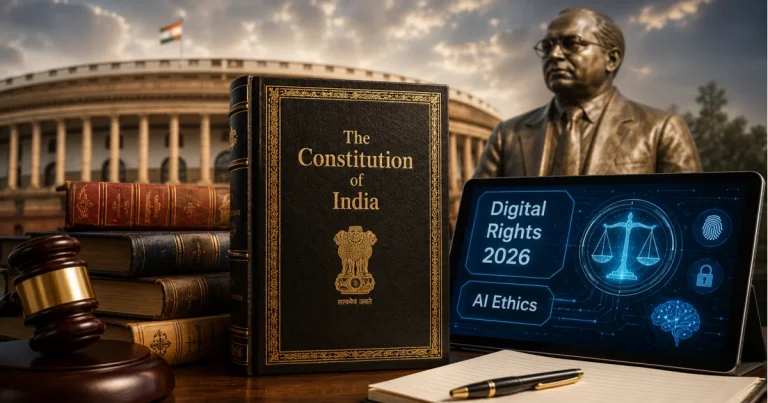
Fundamental Rights are the conscience of the Indian Constitution – they shield citizens from arbitrary state action and uphold human dignity. Enshrined in Part III of the Constitution under Articles 12 to 35, these rights are justiciable, meaning they can be enforced in a court of law. This comprehensive guide walks you through all six fundamental rights, landmark Supreme Court judgments, the right to constitutional remedies, and how these rights interact with the Directive Principles of State Policy.
Why Fundamental Rights Are the Bedrock of Indian Democracy
Without enforceable fundamental rights, democracy is reduced to a mere formality. These rights serve as a constitutional check on government power, ensuring that the state cannot trample individual liberties. A citizen whose fundamental right is violated does not need to navigate a complex bureaucracy—under Article 32, he or she can directly knock on the doors of the Supreme Court for swift justice. For example, a person illegally detained can file a habeas corpus petition and be produced before the court within 24 hours. This direct access transforms the Constitution from a political document into a living shield for every Indian.
Complete List of Six Fundamental Rights (Article 14 to 32)
Part III originally contained seven fundamental rights, but today six remain. The Right to Property (Article 31) was removed by the 44th Constitutional Amendment Act, 1978 and is now a legal right under Article 300A.
- Right to Equality (Articles 14-18): Guarantees equality before law, prohibits discrimination, and abolishes untouchability and titles.
- Right to Freedom (Articles 19-22): Protects six fundamental freedoms, safeguards in criminal proceedings, and ensures protection of life and personal liberty.
- Right against Exploitation (Articles 23-24): Prohibits human trafficking, forced labour, and child labour in hazardous jobs.
- Right to Freedom of Religion (Articles 25-28): Secures freedom of conscience and the right to profess, practice, and propagate religion.
- Cultural and Educational Rights (Articles 29-30): Protects the language, script, and culture of minorities and their right to establish educational institutions.
- Right to Constitutional Remedies (Article 32): Empowers citizens to approach the Supreme Court directly for enforcement of fundamental rights.
Right to Equality (Articles 14-18)
The Right to Equality forms the very foundation of a just society. It ensures that every individual is treated equally before the law and receives equal protection.
Article 14 – Equality Before Law and Equal Protection of Laws
Article 14 embodies the English principle of “Rule of Law” and the American concept of “equal protection.” It forbids class legislation but permits reasonable classification if it is based on an intelligible differentia and has a rational nexus with the object sought to be achieved. The landmark case State of West Bengal vs Anwar Ali Sarkar (1952) established that arbitrary classification violates Article 14.
Article 15 – Prohibition of Discrimination
Article 15 prohibits the State from discriminating against any citizen on grounds only of religion, race, caste, sex, place of birth, or any of them. However, special provisions can be made for women, children, and socially and educationally backward classes. In 2019, the 103rd Constitutional Amendment introduced 10% reservation for Economically Weaker Sections.
Article 16 – Equality of Opportunity in Public Employment
Article 16 guarantees equal opportunity for all citizens in matters of public employment. The State may make reservations for backward classes not adequately represented. The Mandal Commission implementation and the subsequent Indra Sawhney vs Union of India (1992) judgment clarified the limits of reservation, capping it at 50% and introducing the concept of “creamy layer.”
Article 17 – Abolition of Untouchability
Article 17 abolishes “untouchability” in all its forms. Practising it is a criminal offence under the Protection of Civil Rights Act, 1955. This provision is a powerful social reform tool that strikes at caste-based discrimination.
Article 18 – Abolition of Titles
Article 18 prohibits the State from conferring any title (except military or academic distinctions). Citizens are barred from accepting titles from any foreign State. This provision reinforces the republican character of the nation.
Right to Freedom (Articles 19-22)
This cluster of rights breathes life into individual autonomy and personal liberty.
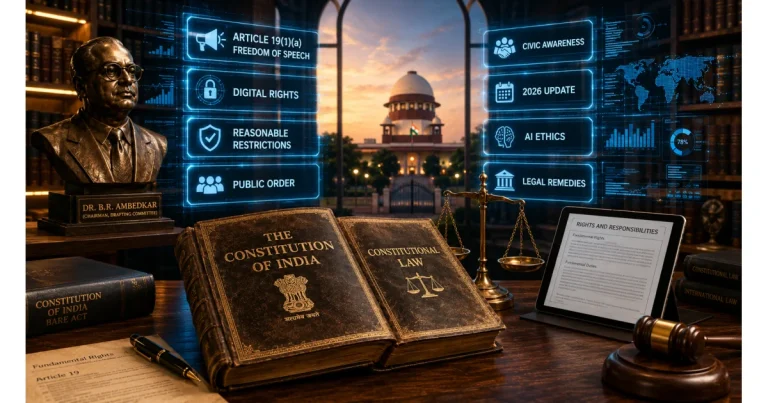
Article 19 – Six Fundamental Freedoms
Article 19 originally guaranteed seven freedoms; the seventh (right to property) was deleted. The six freedoms are:
- Freedom of speech and expression
- Freedom to assemble peaceably and without arms
- Freedom to form associations or unions
- Freedom to move freely throughout the territory of India
- Freedom to reside and settle in any part of India
- Freedom to practise any profession, or to carry on any occupation, trade or business
Each of these freedoms is subject to “reasonable restrictions” on grounds such as security of the State, public order, decency, morality, contempt of court, defamation, and incitement to an offence.
Article 20 – Protection in Respect of Conviction for Offences
Article 20 provides three vital protections:
- No ex-post facto law (no punishment for an act that was not an offence when committed)
- No double jeopardy (no person shall be prosecuted and punished for the same offence more than once)
- No self-incrimination (no accused shall be compelled to be a witness against himself)
Article 21 – Protection of Life and Personal Liberty
Article 21 states: “No person shall be deprived of his life or personal liberty except according to procedure established by law.” The phrase “procedure established by law” was initially interpreted narrowly in A.K. Gopalan vs State of Madras (1950) . However, the landmark Maneka Gandhi vs Union of India (1978) transformed Article 21 by reading into it the American “due process” requirement—any law depriving life or liberty must be fair, just, and reasonable, and not merely enacted. This single judgment gave birth to numerous derivative rights, including the right to privacy, right to clean environment, right to livelihood, right to speedy trial, and right to legal aid.
Article 22 – Protection Against Arrest and Detention
Article 22 safeguards individuals against arbitrary arrest. Key protections include:
- Right to be informed of the grounds of arrest
- Right to consult and be defended by a legal practitioner of choice
- Right to be produced before a magistrate within 24 hours of arrest
Preventive detention laws are an exception, but they too must comply with constitutional limitations.
Right against Exploitation (Articles 23-24)
Article 23 – Prohibition of Traffic in Human Beings and Forced Labour
Article 23 bans human trafficking, beggar (forced labour without payment), and all forms of forced labour. The only exception is compulsory service for public purposes imposed by the State without any discrimination.
Article 24 – Prohibition of Child Labour
Article 24 forbids the employment of children below 14 years in factories, mines, or any other hazardous occupation. This is reinforced by the Child and Adolescent Labour (Prohibition and Regulation) Act, 1986.
Right to Freedom of Religion (Articles 25-28)
India is a secular state, and these articles guarantee religious freedom to all.
Article 25 – Freedom of Conscience and Religion
Article 25 gives every person the right to freedom of conscience and the right to freely profess, practise, and propagate religion—subject to public order, morality, and health. The State can also regulate economic, political, or other secular activities associated with religious practice.
Article 26 – Freedom to Manage Religious Affairs
Article 26 grants every religious denomination the right to establish and maintain institutions, manage its own affairs in matters of religion, own and acquire property, and administer such property.
Article 27 – Freedom from Taxation for Promotion of Religion
Article 27 prohibits the State from compelling any person to pay taxes that are specifically meant for the promotion or maintenance of a particular religion.
Article 28 – Freedom from Religious Instruction in State Educational Institutions
Article 28 bans religious instruction in educational institutions wholly maintained out of State funds. In recognized or aided institutions, attendance in religious instruction is voluntary.
Cultural and Educational Rights (Articles 29-30)
Article 29 – Protection of Interests of Minorities
Article 29 protects the right of any section of citizens to conserve its distinct language, script, or culture. No citizen shall be denied admission to any State-maintained or State-aided educational institution on grounds only of religion, race, caste, or language.
Article 30 – Right of Minorities to Establish and Administer Educational Institutions
Article 30 empowers religious and linguistic minorities to establish and administer educational institutions of their choice. In the seminal T.M.A. Pai Foundation vs State of Karnataka (2002) , the Supreme Court held that while the State can regulate such institutions, it cannot destroy their minority character.
Right to Constitutional Remedies (Article 32)
Article 32 is the “heart and soul” of the Constitution, as described by Dr. B.R. Ambedkar. It guarantees the right to move the Supreme Court directly for enforcement of fundamental rights. The Supreme Court is duty-bound to protect these rights.
Five Writs Under Article 32 and Article 226
To enforce fundamental rights, the Supreme Court (Article 32) and High Courts (Article 226) can issue five types of writs:
- Habeas Corpus: “You may have the body.” Produces a detained person before the court to examine the legality of detention.
- Mandamus: “We command.” Directs a public authority to perform its statutory duty.
- Prohibition: Issued by a higher court to a lower court to prevent it from exceeding its jurisdiction.
- Certiorari: Quashes an order already passed by an inferior court or quasi-judicial authority.
- Quo Warranto: “By what authority?” Restrains a person from holding a public office to which he is not entitled.
Relationship Between Fundamental Rights and Directive Principles (DPSP)
Fundamental Rights (Part III) are justiciable, while Directive Principles of State Policy (Part IV) are non-justiciable. Initially, courts gave primacy to Fundamental Rights when conflicts arose. However, a harmonious construction evolved over time.
- In Kesavananda Bharati vs State of Kerala (1973) , the Court held that both Fundamental Rights and Directive Principles form the basic structure of the Constitution and must be balanced.
- In Minerva Mills Ltd. vs Union of India (1980) , the Supreme Court struck down the attempt to give absolute primacy to Directive Principles over Fundamental Rights, re-affirming the need for balance.
Article 31C, introduced by the 25th Amendment and amended by the 42nd Amendment, attempted to give supremacy to certain Directive Principles. The Minerva Mills judgment limited its scope, restoring the harmony between Part III and Part IV.
Suspension of Fundamental Rights During Emergency (Article 359)
During a proclamation of national emergency under Article 352, the President may under Article 359 suspend the right to move any court for the enforcement of Fundamental Rights (except Articles 20 and 21). The notorious 1975-77 Emergency witnessed such suspension, prompting the 44th Amendment, 1978 to make Articles 20 and 21 non-suspendable even during an emergency. Today, the right to life and liberty stands as an inviolable bulwark against executive overreach.
Landmark Judgments on Fundamental Rights
- A.K. Gopalan vs State of Madras (1950) — Narrow interpretation of Article 21; “procedure established by law” not subject to judicial review on fairness.
- Maneka Gandhi vs Union of India (1978) — Expanded Article 21; introduced American “due process” and interlinked Articles 14, 19, and 21.
- Kesavananda Bharati vs State of Kerala (1973) — Established the Basic Structure Doctrine; Parliament cannot destroy the Constitution’s core.
- Vishakha vs State of Rajasthan (1997) — Laid down guidelines against sexual harassment at the workplace; precursor to the POSH Act, 2013.
- Naz Foundation vs Govt. of NCT of Delhi (2009) — Decriminalised homosexuality (overturned in 2013, but later upheld in Navtej Singh Johar vs Union of India (2018) ).
- Justice K.S. Puttaswamy (Retd.) vs Union of India (2017) — Right to privacy declared a fundamental right under Article 21.
- Joseph Shine vs Union of India (2018) — Struck down Section 497 IPC (adultery) as unconstitutional, affirming gender equality.
Frequently Asked Questions
How many Fundamental Rights are originally in the Indian Constitution?
Originally there were seven Fundamental Rights. The Right to Property (Article 31) was removed by the 44th Amendment (1978) and made a legal right under Article 300A. Today, six Fundamental Rights exist.
Which Article is called the heart and soul of the Constitution?
Article 32 (Right to Constitutional Remedies) is called the heart and soul of the Constitution by Dr. B.R. Ambedkar, because it allows citizens to directly approach the Supreme Court for enforcement of fundamental rights.
Can Fundamental Rights be suspended?
During a national emergency declared under Article 352, the President can suspend the enforcement of fundamental rights (except Articles 20 and 21). The 44th Amendment ensured that the right to life and personal liberty can never be suspended.
What is the difference between Fundamental Rights and Directive Principles?
Fundamental Rights are justiciable and individual-centric, enforceable by courts. Directive Principles are non-justiciable and state-centric, guiding the government to create a welfare state. Courts strive to harmonise both.
Can a citizen file a writ petition for violation of Fundamental Rights?
Yes. Under Article 32, a citizen can directly approach the Supreme Court by filing a writ petition (Habeas Corpus, Mandamus, Prohibition, Certiorari, Quo Warranto). High Courts have similar power under Article 226.
Conclusion
Fundamental Rights empower citizens and limit state power. They are not absolute—reasonable restrictions apply to balance individual liberty with societal good. Yet, the core of these rights remains inviolable. As Dr. Ambedkar rightly observed, the right to constitutional remedies is the greatest of all rights. Know your rights – they are your shield against injustice.
Summary of Key Takeaways
- Six fundamental rights under Articles 12-35 provide a comprehensive charter of liberty.
- Article 32 is the heart of the Constitution, offering five powerful writs.
- Rights can be suspended during an emergency, but Articles 20 and 21 remain eternally protected.
- Landmark cases like Maneka Gandhi and Puttaswamy expanded the scope of the right to life and privacy.
- Harmony between Fundamental Rights and Directive Principles is essential for a just society.
Recommended Resources for Further Study
- Constitutional Law of India – H.M. Seervai
- Indian Polity – M. Laxmikanth (Chapter on Fundamental Rights)
- Introduction to the Constitution of India – D.D. Basu
- Supreme Court of India – Official Website for latest judgments
- India Code – Digital Constitution


Your comment will appear immediately after submission.