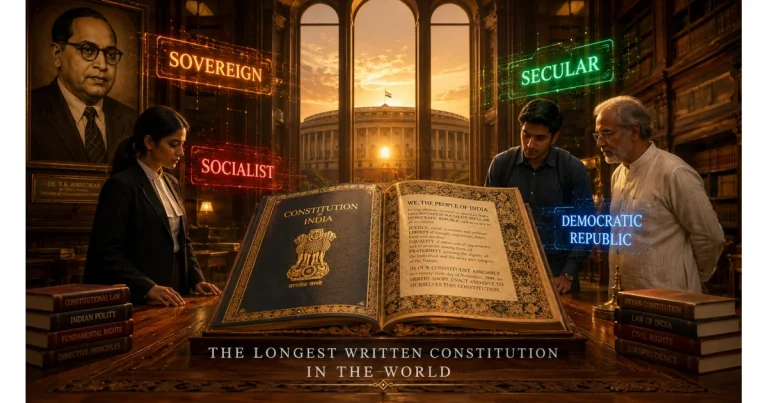
The Constitution of India is not merely a legal document—it is the supreme covenant that transforms a diverse civilization into a sovereign, democratic republic. As the longest written constitution in the world, it stands as an unparalleled monument of legal craftsmanship, governing over 1.4 billion lives with remarkable resilience. For legal professionals, scholars, students, and informed citizens alike, deconstructing this supreme law is not an academic luxury but an absolute necessity for understanding the mechanics of the world’s largest democracy. This comprehensive guide navigates the intricate history, robust structure, and enduring features that make the Indian Constitution a living, breathing masterpiece.
Why the Indian Constitution Matters Today: A Living Document
The Indian Constitution is not a static relic of 1950—it is a dynamic, evolving instrument that shapes daily life for every citizen. From the moment you step out onto the street, the Constitution walks with you: the right to open a business, the freedom to express your opinion without fear, or the liberty to practice your faith—all of these fundamental freedoms are constitutionally guaranteed shields against state overreach. Simultaneously, when the government formulates welfare policies, guarantees food security for the underprivileged, or protects a citizen from unlawful detention, the ultimate source of legitimacy flows directly from this supreme law.
Consider the landmark 2017 judgment on the Right to Privacy. In a unanimous verdict, the Supreme Court declared that privacy is an intrinsic part of the fundamental right to life and personal liberty under Article 21. This single ruling has had a seismic impact on data protection, digital surveillance boundaries, and personal autonomy in the digital age. This real-world example demonstrates precisely how the Constitution functions as a living document—its text, creatively interpreted by an independent judiciary, adapts to confront emerging challenges while preserving its essential character. Thus, for safeguarding democracy, individual liberty, and governmental accountability, the Indian Constitution remains profoundly relevant today.
Historical Background and the Making of the Indian Constitution
The seeds of the Indian Constitution were sown during the long arc of British colonial rule through a series of legislative enactments. The journey from the Regulating Act of 1773 to the Government of India Act 1935 represents a gradual, though incomplete, devolution of power. The 1935 Act was particularly significant as it introduced provincial autonomy and a federal framework, yet it remained fundamentally flawed—the ultimate authority was vested not in the Indian people but in the British Parliament and the Governor-General. It was a tool of imperial control, not a charter of self-governance.
The political landscape shifted decisively after the Second World War. In 1946, the British government dispatched the Cabinet Mission, whose recommendations paved the way for Indians to draft their own constitution. Consequently, the Constituent Assembly of India was formed in December 1946. Its members were indirectly elected by the provincial legislative assemblies. Initially comprising 389 members, this number was reduced to 299 following the Partition of India. This august body became the principal architect of India’s post-independence destiny, dedicating 2 years, 11 months, and 18 days to meticulous debate, deliberation, and consensus-building to craft the world’s most comprehensive written constitution.
Constituent Assembly and the Role of Dr. B.R. Ambedkar
The Constituent Assembly convened its first session on 9 December 1946, embarking on an historic journey through 11 sessions to scrutinize every clause of India’s future constitution. To streamline the monumental task, the Assembly established multiple key committees. Among these, the most crucial were: the Union Powers Committee (chaired by Jawaharlal Nehru), the Fundamental Rights and Minorities Committee (chaired by Vallabhbhai Patel), and, most importantly, the Drafting Committee, established on 29 August 1947.
The chairmanship of the Drafting Committee was entrusted to Dr. Bhimrao Ramji Ambedkar. Possessing extraordinary legal erudition, profound knowledge of constitutional history, and an unwavering commitment to marginalized communities, Ambedkar elevated the Constitution to unprecedented heights. He did not merely draft clauses; he infused each provision with deep legal philosophy and practical applicability. His speeches in the Constituent Assembly are studied today as philosophical treatises in their own right. His unyielding stance on minority rights, the abolition of untouchability, and equal status for women rendered the fundamental rights chapter truly transformative. Without question, Dr. Ambedkar’s visionary legal foresight laid the cornerstone for the Indian Constitution’s durability, adaptability, and justice-oriented character.
Timeline of Adoption and Enforcement
The journey of India’s constitutional enactment is marked by two dates of monumental significance.
- 26 November, 1949 – Constitution Adopted:
- The Constituent Assembly, after 2 years, 11 months, and 18 days of rigorous debate, formally adopted the final text of the Constitution.
- This day is celebrated annually as Constitution Day (Samvidhan Diwas).
- 26 January, 1950 – Constitution Enforced:
- The Constitution officially came into force across the entire nation, transforming India into a sovereign democratic republic.
- On this day, Dr. Rajendra Prasad took oath as the first President of India, and the colonial legal framework was definitively replaced. This day is celebrated as Republic Day.
Why was 26 January chosen?
This date carries profound historical resonance. In December 1929, at the Lahore session of the Indian National Congress, Jawaharlal Nehru moved the historic “Purna Swaraj” (Complete Independence) declaration. The Congress resolved that 26 January, 1930 would be observed as the first Independence Day. To honor that revolutionary spirit and anchor the new republic in the legacy of the freedom struggle, the Constituent Assembly deliberately chose 26 January as the date for the Constitution’s enforcement. In this single decision, India’s colonial past and its sovereign future were bound together by an unbreakable constitutional thread.
The Preamble: The Soul of the Constitution
In jurisprudence, the Preamble to any constitution is its heart—a succinct mirror reflecting the entire document’s core philosophy, moral foundations, and the collective aspirations of the nation. The Preamble is not treated as a mere ceremonial introduction; rather, it is the lens through which the true soul of the Constitution becomes visible.
The Preamble opens with the resounding words, “We, the People of India…”—in these few words lies the ultimate source of sovereign authority in the Indian Republic. It unequivocally declares that power does not emanate from a monarch, the British Parliament, or any external force; it is vested solely in the collective will of every Indian citizen.
This single-paragraph document crystallizes the nation’s contemporary dreams and future direction through a few carefully chosen words. The Preamble declares India a Sovereign, Socialist, Secular, Democratic, Republic and solemnly pledges to secure for all its citizens Justice, Liberty, Equality, and Fraternity. The Supreme Court has repeatedly held that the Preamble is an integral part of the Constitution and serves as the master key for interpreting complex legal questions. Undoubtedly, the Preamble is the life-breath of the Indian Constitution and the purest expression of its inner spirit.
Analysis of Key Terms: Sovereign, Socialist, Secular, Democratic, Republic
The five key terms enshrined in the Preamble define the fundamental character and direction of the Indian state.
- Sovereign: India is an independent state with the absolute authority to make its own decisions in both internal and external affairs. No foreign power or external authority can impose control over India.
- Socialist: The state is committed to eliminating social and economic inequalities and ensuring equal opportunity and fair distribution for all citizens. While private property is recognized, the state pursues a welfare-oriented economic path.
- Secular: The state has no official religion. It maintains equal respect and neutrality towards all faiths. Citizens possess full freedom to profess, practice, and propagate their chosen religion.
- Democratic: The governing power of the country rests in the hands of the people. Citizens form and change governments through their elected representatives. Regular elections and universal adult suffrage form its bedrock.
- Republic: The Head of State (the President) is not hereditary or nominated but is indirectly elected by the people. There is no monarchy or dynastic rule—it is the rule of the people.
Important Note: The original draft of the Preamble did not contain the words “Socialist” and “Secular” . These two historic terms were strategically inserted into the Preamble through the 42nd Constitutional Amendment Act of 1976, enacted during the Indira Gandhi government.
Justice, Liberty, Equality, and Fraternity Explained
The four noble ideals enshrined in the Preamble are not merely philosophical abstractions—they constitute the moral pillars upon which the entire edifice of the Indian Constitution and state machinery rests.
Justice
The Constitution pledges to secure justice across three distinct yet interconnected dimensions—
- Social Justice: Elimination of caste-based discrimination, untouchability, and all hereditary social inequalities to establish a society of equal dignity.
- Economic Justice: Reduction of the gulf between rich and poor, equal pay for equal work, and fair distribution of resources to ensure financial security.
- Political Justice: Universal adult franchise, equal participation in the electoral process, and equal access to public office to decentralize political power.
Liberty
The Constitution grants citizens freedom of thought, expression, belief, faith, and worship. However, this liberty is neither absolute nor unregulated; it operates within the reasonable bounds of state security, public order, morality, and the rights of others. The core objective is the fullest development of the individual’s personality and creative potential.
Equality
Equality means all are equal before the law—no individual or class shall face discrimination or enjoy special privileges. The Constitution mandates equal rights, equal opportunity, and the abolition of untouchability and hereditary titles. Simultaneously, it permits temporary special protective measures (reservation) for historically disadvantaged groups to achieve substantive equality in practice.
Fraternity
Fraternity embodies the spirit of mutual respect, empathy, and national unity among all citizens. This ideal works to bind India’s vastly diverse society into a single thread by ensuring individual dignity and national integration. The constitutional vision is that every Indian, transcending divisions of caste, religion, language, or region, should first identify as an ‘Indian’.
These four ideals are mutually reinforcing. Justice without liberty is hollow, liberty without equality is incomplete, and without fraternity, the entire structure remains fragile. Together, they serve as the ethical foundation and the protective shield of the Indian Republic.
Structural Overview of the Indian Constitution
The Indian Constitution is not only the longest but also an extraordinarily methodical and logically organized legal document. Its framers divided it into clearly defined tiers—Parts, Articles, and Schedules—so that readers, lawyers, and judges can navigate its depths with ease. Presently, the Constitution comprises 25 Parts, 448 Articles, and 12 Schedules.
Below is a sequential outline of the principal Parts:
- Part I (Articles 1-4): The Union and its Territory
- Part II (Articles 5-11): Citizenship
- Part III (Articles 12-35): Fundamental Rights
- Part IV (Articles 36-51): Directive Principles of State Policy
- Part IVA (Article 51A): Fundamental Duties
- Part V (Articles 52-151): The Union Government
- Part VI (Articles 152-237): The State Governments
- Part VIII (Articles 239-242): The Union Territories
- Part IX (Articles 243-243O): The Panchayats
- Part IXA (Articles 243P-243ZG): The Municipalities
- Part X (Articles 244-244A): Scheduled and Tribal Areas
- Part XI (Articles 245-263): Relations between the Union and the States
- Part XII (Articles 264-300A): Finance, Property, Contracts and Suits
- Part XIII (Articles 301-307): Trade, Commerce and Intercourse within India
- Part XIV (Articles 308-323): Services under the Union and the States
- Part XIVA (Articles 323A-323B): Tribunals
- Part XV (Articles 324-329A): Elections
- Part XVI (Articles 330-342): Special Provisions relating to Certain Classes
- Part XVII (Articles 343-351): Official Language
- Part XVIII (Articles 352-360): Emergency Provisions
- Part XIX (Articles 361-367): Miscellaneous
- Part XX (Article 368): Amendment of the Constitution
- Part XXI (Articles 369-392): Temporary, Transitional and Special Provisions
- Part XXII (Articles 393-395): Short Title, Commencement, etc.
Note: Part VII (pertaining to Part B states in the original Constitution) was repealed by the 7th Amendment Act of 1956. The current count of 25 Parts has been reached through subsequent amendments adding Part IVA, IXA, XIVA, etc.
Understanding Articles, Parts, and Schedules
The Indian Constitution is a vast document, organized into distinct layers for ease of study and application.
- Article: Each specific legal clause or provision within the Constitution. Every Article provides clear directives regarding a particular right, duty, power, or procedure. Articles form the very flesh and blood of the constitutional text.
- Part: A logical chapter that groups together related Articles dealing with a common subject matter. A Part serves as a thematic map for the reader.
- Schedule: Supplementary lists or appendices attached at the end of the main constitutional text, providing detailed tables, lists, or formal formats that complement specific Articles.
Simple Memory Aid: Think of a Part as a broad chapter, an Article as each sentence within that chapter, and a Schedule as the appendix or glossary at the end of the book.
Why It Is the Longest Written Constitution in the World
The Indian Constitution’s status as the longest written constitution of any sovereign state is not an accident—it is the product of historical necessity, legal foresight, and a unique philosophical foundation.
- Extremely Detailed Administrative Provisions: The Indian Constitution does not merely outline basic laws and rights; it governs in meticulous detail almost every administrative and legal subject—from centre-state relations and the nuances of citizenship to the jurisdiction of the Supreme Court and even the service conditions of government employees.
- Amalgamation of the Best Features from Global Constitutions: The Constituent Assembly studied the proven best elements of various successful constitutions worldwide and adapted them to the Indian context. The parliamentary system from the UK, fundamental rights and judicial review from the USA, and directive principles from Ireland—all find refined placement within this single document.
- Solutions for India’s Immense Geographical, Religious, and Cultural Diversity: To unite a vast population with multiple languages, religions, and distinct regional customs under a single constitutional framework, specific legal and administrative arrangements were imperative. Special reservations for Scheduled Castes and Tribes, provisions for linguistically-based state reorganization, and protections for religious and linguistic minorities naturally expanded the document’s scope.
- Comprehensive Emergency and Special Provisions: The Constitution contains elaborate provisions for three types of emergencies (national, state, and financial). Additionally, temporary special provisions for certain states and unique agreements with princely states have all contributed to the document’s bulk.
Core Features of the Indian Constitution
The Indian Constitution possesses several distinctive features that set it apart from other constitutions and elevate it to a unique stature.
- World’s Longest Written Constitution: Presently organized into 25 Parts containing 448 Articles and 12 Schedules.
- Clear Ideological Declaration in the Preamble: The Preamble succinctly declares the state’s core character—Sovereign, Socialist, Secular, Democratic, Republic—and pledges Justice, Liberty, Equality, and Fraternity.
- Fundamental Rights (Part III): Six fundamental rights serve as the protective shield for individual dignity and liberty.
- Directive Principles of State Policy (Part IV): These non-justiciable principles provide the state with a guiding roadmap for building a welfare society.
- Fundamental Duties (Part IVA): Added through the 42nd Amendment in 1976, these 11 duties impose an obligation on citizens to foster patriotism, unity, and environmental consciousness.
- Federal Structure with Unitary Bias: India is a federal state yet possesses a strong centralizing tendency, giving it a unique quasi-federal character.
- Parliamentary Form of Government: The President is the nominal head, real executive power rests with the Prime Minister and the Council of Ministers, who are collectively responsible to the Lok Sabha.
- Independent and Integrated Judiciary: A single, unified judicial system headed by the Supreme Court, with the power of Judicial Review.
- Blend of Rigidity and Flexibility in Amendment: Constitutional amendment ranges from simple to rigid, allowing adaptation while protecting the core structure.
- Universal Adult Suffrage: Every adult citizen has the right to vote irrespective of caste, religion, sex, or creed.
- Secularism: The state maintains neutrality and equal respect towards all faiths.
- Emergency Provisions: Special provisions to maintain stability during war, external aggression, armed rebellion, constitutional breakdown in a state, or financial crisis.
Blend of Rigidity and Flexibility
One of the Indian Constitution’s most unique features is its amendment mechanism under Article 368, which maintains a remarkable balance between rigidity and flexibility.
Amendment by Simple Majority (Flexibility)
Certain provisions can be amended by a simple majority of Parliament (more than half of the members present and voting). This enables swift administrative adaptation.
Amendment by Special Majority (Moderate Rigidity)
The vast majority of constitutional provisions require a special majority—a majority of the total membership of each House and a two-thirds majority of members present and voting. This prevents any single party from making sweeping changes easily.
Amendment by Special Majority plus State Ratification (Highest Rigidity)
For sensitive provisions affecting the federal structure, the above special majority must be supplemented by ratification by at least half of the state legislatures. This tier acts as a protective shield for federalism.
Through this three-tiered system, the Indian Constitution achieves the capacity to evolve with changing times while preserving its core structure and federal character. The Supreme Court, in the landmark 1973 Kesavananda Bharati case, further established the Basic Structure Doctrine, making it clear that Parliament cannot destroy the fundamental structure of the Constitution through any amendment.
Federal System with Unitary Bias
The Indian Constitution adopts a distinctive federal framework, often described as ‘quasi-federal’ or ‘federal in form, unitary in spirit.’
Federal Features
- Dual Polity: Clear division of powers between the Centre and the States through the Union List, State List, and Concurrent List.
- Written and Rigid Constitution: A written constitution is essential for defining the distribution of powers.
- Independent Judiciary: The integrated judicial system acts as the ultimate arbiter in Centre-State disputes.
- Bicameral Legislature: The Rajya Sabha represents the interests of the states.
Unitary Bias
- Single Citizenship: Unlike the dual citizenship of the USA, India provides a single Indian citizenship.
- Strong Centre: The Union List contains the most crucial subjects, and central law prevails over state law in case of conflict.
- Alteration of State Boundaries: Parliament can create new states or alter boundaries by simple majority without the consent of the concerned state.
- Single Constitution: One Constitution for both Centre and States.
- Integrated Judiciary: A single unified judicial hierarchy under the Supreme Court.
- Emergency Provisions: During an Emergency, the federal structure can temporarily become suspended.
- All India Services: Officers of the IAS, IPS, etc., serve in states but are ultimately controlled by the Centre.
This extraordinary synthesis of federal and unitary elements grants India the ability to preserve unity amidst diversity while enabling swift decision-making during crises.
Parliamentary Form of Government
The Indian Constitution adopted the parliamentary form of government at both the Centre and State levels, primarily modelled on the British Westminster system.
Nominal and Real Executive: The Dual Role
- The President (Head of State): The President is the nominal (De Jure) executive head. According to Article 53, the executive power of the Union is vested in the President, but he acts on the aid and advice of the Prime Minister and the Council of Ministers.
- The Prime Minister and Council of Ministers (Real Executive): The Prime Minister is the real (De Facto) executive head. He leads the Council of Ministers and takes all executive decisions in the name of the President. Under Article 75(3), the Council of Ministers is collectively responsible to the Lok Sabha.
Collective Responsibility: The Cornerstone
The lifeblood of India’s parliamentary system is the collective responsibility of the Council of Ministers to the Lok Sabha. If defeated on a confidence vote, the entire Council must resign together. The Prime Minister’s resignation signifies the fall of the entire Ministry.
Key Elements of Parliamentary Governance
- Parliament’s powers are bound within the limits of the Constitution; the judiciary can strike down parliamentary laws.
- The President retains some discretion in exceptional circumstances, such as when no party has a clear majority.
- The directly elected Lok Sabha holds primacy; the Rajya Sabha cannot block a Money Bill.
- Party discipline is enforced through the whip system under the Anti-Defection Law, 1985.
Sources of the Indian Constitution (Borrowed Features)
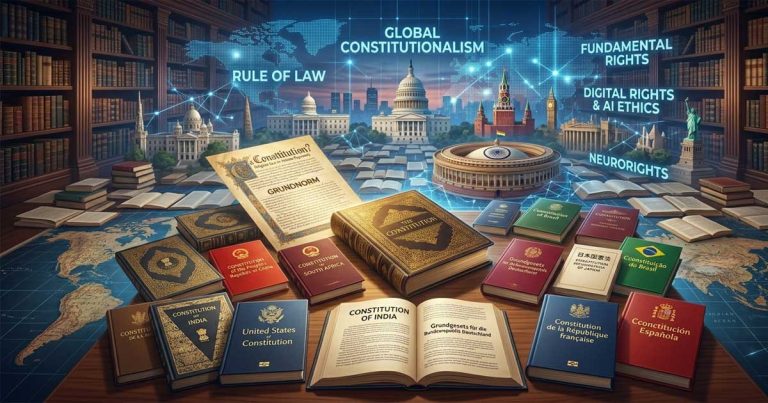
The framers of the Indian Constitution drew inspiration from the successful constitutional traditions of various mature democracies worldwide and creatively adapted the best elements to suit India’s unique context.
- United Kingdom (Britain): Parliamentary system of government (Westminster Model), Rule of Law, Single citizenship, Collective responsibility of the Council of Ministers, Legislative procedure, Office and powers of the Speaker, Parliamentary privileges.
- United States of America: Fundamental Rights (inspired by the Bill of Rights), Judicial Review, Indirect election of the President (Electoral College), Impeachment procedure for the President, Removal procedure for Supreme Court and High Court judges, Language of the Preamble (“We, the People”), Basic concept of federalism.
- Ireland: Directive Principles of State Policy, Proportional representation in the election of the President, Nomination of members to the Rajya Sabha.
- Canada: Federal structure with a strong centre, Vesting of residuary powers with the Centre, Appointment of Governors in states by the Centre.
- Australia: Concept of the Concurrent List, Freedom of trade, commerce, and intercourse (Article 301), Provision for joint sittings of Parliament.
- Germany (Weimar Constitution): Suspension of fundamental rights during an Emergency.
- France: Ideals of Justice, Liberty, Equality, and Fraternity (Liberté, égalité, fraternité), Concept of Republic.
- Japan: Certain elements of the procedure and structure of the Supreme Court.
- South Africa: Certain provisions of the amendment procedure.
- Soviet Union (Former USSR): Concept of Fundamental Duties (later added via the 42nd Amendment), The tripartite concept of Justice—Social, Economic, and Political—in the Preamble.
What India Adopted from the UK, USA, Ireland, and Germany
United Kingdom (Britain)
- Parliamentary System of Government: India adopted the Westminster Model with a nominal Head of State and a real executive head.
- Rule of Law: The concept of ‘equality before law’ reflected in Article 14.
- Single Citizenship: Instead of dual citizenship, India opted for single citizenship to strengthen national unity.
- Legislative Procedure: The process of introducing bills, reading, discussion, and passage in Parliament follows British conventions.
United States of America
- Fundamental Rights: Inspired by America’s Bill of Rights, India created a catalogue of Fundamental Rights.
- Judicial Review: Courts can declare laws unconstitutional, a power adopted from the US Supreme Court.
- Indirect Election of the President: Modelled on the US Electoral College.
- Impeachment and Removal of Judges: Procedures follow the US constitutional pattern.
- Language of the Preamble: “We, the People of India” is directly adopted from the US Constitution.
Ireland
- Directive Principles of State Policy: Modelled on Ireland’s Directive Principles of Social Policy, placed in Part IV of the Indian Constitution.
- Proportional Representation: The Single Transferable Vote system for Presidential election was adopted from Ireland.
- Nomination of Members to Rajya Sabha: The President’s power to nominate experts is inspired by a similar Irish provision.
Germany (Weimar Constitution)
- Suspension of Fundamental Rights during Emergency: India adopted the concept but placed it under parliamentary approval and judicial review to prevent misuse, learning from the failure of the Weimar Constitution.
Important Articles and Landmark Amendments
First Amendment (1951) and Basic Structure Doctrine
The First Amendment Act of 1951 was the first major test of independent India’s Constitution.
- Reasonable Restrictions on Free Speech: Article 19(2) was amended to allow restrictions on eight grounds.
- Validation of Zamindari Abolition: Articles 31A, 31B and the Ninth Schedule were created to protect land reform laws.
- Reservation for Backward Classes: Article 15(4) was added, empowering the state to make special provisions for SCs, STs, and OBCs.
The Basic Structure Doctrine (1973): In the Kesavananda Bharati v. State of Kerala case, a 13-judge bench ruled by a 7:6 majority that while Parliament can amend any part of the Constitution, it cannot destroy or alter its Basic Structure. Features like democracy, secularism, federalism, judicial independence, and fundamental rights are beyond the reach of amendment.
42nd Amendment (1976) – Mini Constitution
Enacted during the Emergency, the 42nd Amendment is the most extensive and controversial amendment.
- Addition of New Words to the Preamble: “Sovereign Democratic Republic” became “Sovereign, Socialist, Secular Democratic Republic,” and “Unity of the Nation” became “Unity and Integrity of the Nation.”
- Addition of Fundamental Duties: For the first time, 10 Fundamental Duties were added under Part IVA.
- Primacy of Directive Principles: An attempt was made to give supremacy to Directive Principles over Fundamental Rights.
- Curtailment of Judicial Review: The power of courts was significantly curtailed.
- Binding the President to Cabinet Advice: Article 74 was amended to state the President shall be bound by the advice of the Council of Ministers.
- Extended Tenure of Legislatures: The normal tenure was extended from 5 to 6 years (later restored by the 44th Amendment).
- Strengthening of Centre vis-à-vis States: Central law was given primacy, and certain state subjects were brought under central control.
- Administrative Tribunals: Provision for tribunals to resolve service disputes of government employees.
Many controversial provisions of the 42nd Amendment were later repealed or modified by the 44th Amendment Act of 1978, but the words “Socialist,” “Secular,” and “Integrity” in the Preamble, along with Fundamental Duties, remain permanent features.
Frequently Asked Questions
What is the significance of 26th January in Indian Constitutional history?
26th January is celebrated as Republic Day because on this day in 1950, the Constitution of India came into full legal effect, officially replacing the colonial Government of India Act (1935) as the supreme governing framework of the sovereign nation.
Who is officially recognized as the Father of the Indian Constitution?
Dr. B.R. Ambedkar is universally recognized as the Father of the Indian Constitution due to his brilliant legal scholarship and monumental contributions as the Chairman of the Drafting Committee.
How many articles, parts, and schedules were originally in the Indian Constitution?
At the time of its official enactment in 1950, the original Constitution contained exactly 395 articles, 22 distinct parts, and 8 foundational schedules.
What is the core definition of the Basic Structure Doctrine?
Established by the Supreme Court in the 1973 Kesavananda Bharati case, the Basic Structure Doctrine mandates that the essential, defining features of the Constitution—such as democracy, secularism, judicial independence, and the rule of law—cannot be destroyed, altered, or repealed by any legislative amendment.
Is the Indian Constitution classified as rigid or flexible?
It is a unique combination of both. Common administrative provisions can be easily updated via a simple parliamentary majority, but vital federal and structural provisions require a special majority coupled with formal ratification by at least half of the state legislatures.
What is the Preamble of the Indian Constitution?
The Preamble is the introductory statement to the Constitution, embodying its core philosophy and ideals. It declares India to be a Sovereign, Socialist, Secular, Democratic Republic and pledges Justice, Liberty, Equality, and Fraternity. The Supreme Court has held it to be an integral part of the Constitution.
What are Fundamental Rights?
Fundamental Rights are the rights enshrined in Part III (Articles 12-35) of the Constitution, essential for the all-round development and dignity of every citizen. Six fundamental rights currently exist: Right to Equality, Right to Freedom, Right against Exploitation, Right to Freedom of Religion, Cultural and Educational Rights, and Right to Constitutional Remedies.
How can the Indian Constitution be amended?
Article 368 provides for three methods of amendment: simple majority of Parliament, special majority, and special majority plus ratification by at least half of the state legislatures for federal provisions.
What are Directive Principles of State Policy?
Part IV (Articles 36-51) contains the Directive Principles, which are guidelines for the state to establish a welfare society. They are non-justiciable but are fundamental in the governance of the country.
What is the Emergency provision under the Indian Constitution?
The Constitution provides for three types of emergencies: National Emergency (Article 352) on grounds of war, external aggression, or armed rebellion; State Emergency or President’s Rule (Article 356) on failure of constitutional machinery in a state; and Financial Emergency (Article 360).
Conclusion
The Indian Constitution is not merely a legal document—it is the living embodiment of a civilization’s collective dreams, struggles, and commitments. From 26 January 1950 to the present day, this Constitution has served as the protective shield of India’s democracy, the guardian of citizens’ fundamental rights, and the definitive blueprint of state power. The enduring significance of the Indian Constitution rests not only in its articles but in our collective constitutional morality.
Summary of Key Takeaways
- Historical Milestones: Legacy of the Government of India Act 1935; formation of the Constituent Assembly in 1946; Dr. B.R. Ambedkar’s leadership; adoption on 26 November 1949; enforcement on 26 January 1950.
- Preamble Ideals: India declared a Sovereign, Socialist, Secular, Democratic, Republic; pledges Justice, Liberty, Equality, and Fraternity; “Socialist” and “Secular” added via the 42nd Amendment in 1976.
- Structural Organization: 25 Parts, 448 Articles, 12 Schedules; Articles as specific provisions, Parts as thematic chapters, Schedules as supplementary appendices.
- Core Features: Blend of rigidity and flexibility in amendment; federal system with unitary bias; parliamentary form of government; Fundamental Rights, Directive Principles, and Fundamental Duties; independent judiciary; Basic Structure Doctrine established in 1973.
- International Sources: UK (parliamentary system, rule of law); USA (fundamental rights, judicial review); Ireland (directive principles); Germany (suspension of rights during emergency); creative adaptation from Canada, Australia, France, Japan, South Africa, and former USSR.
Recommended Resources for Advanced Learning
Authoritative Books and Commentaries
- Granville Austin – The Indian Constitution: Cornerstone of a Nation
- Dr. Subhash C. Kashyap – Our Constitution and Constitutional Law of India
- Dr. Durga Das Basu – Introduction to the Constitution of India
- J.N. Pandey – Constitutional Law of India
- M.P. Jain – Indian Constitutional Law
Official Government and Online Resources
- India Code (www.indiacode.nic.in) – Updated digital version of the Constitution.
- Supreme Court of India (supremecourtofindia.nic.in) – Landmark judgments.
- Lok Sabha and Rajya Sabha websites – Parliamentary debates and committee reports.
Legal Research Databases
- SCC Online
- Manupatra
- National Law University (NLU) Journals



Your comment will appear immediately after submission.