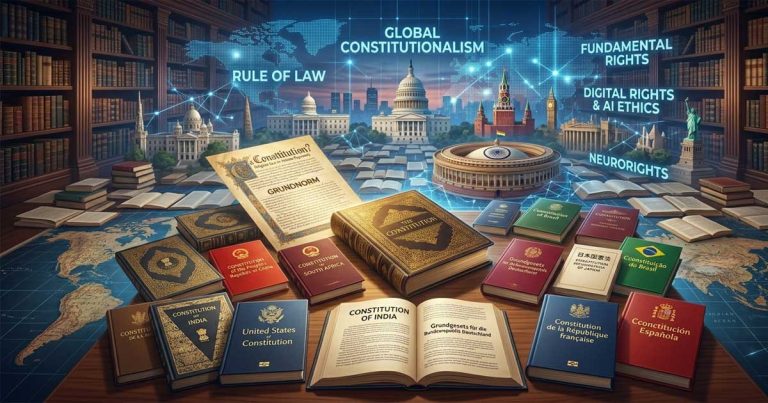
The Psychology of Power vs. The Constitution: Why Do We Need a ‘Supreme Law’?
Humanity, by nature, is susceptible to the blinding allure of power. History bears witness that whenever absolute power is concentrated in the hands of an individual or a group, the inevitable consequences have been ruthless tyranny, systemic discrimination, and structural injustice. As political scientists and psychologists famously observe: “Power tends to corrupt, and absolute power corrupts absolutely.”
It is at this precise juncture that the necessity arises for an impenetrable system—one that governs a nation not based on the whims of an individual or a government, but on the foundation of definitive principles. That system is known as the Constitution.
It is far more than a lifeless legal document; it is a mathematical guarantee of the balance of power and an invisible, yet invincible, shield protecting the fundamental rights of every citizen. In this expansive and profound analysis, we shall explore everything from the deep philosophy of constitutionalism to its complex relationship with religious mandates and the emerging challenges of the digital frontier.
The Philosophy of the Constitution: ‘Grundnorm’—The Ultimate Foundation of the Modern State
The renowned Austrian legal philosopher Hans Kelsen, in his seminal work ‘Pure Theory of Law’, introduced a timeless concept—the ‘Grundnorm’ or the Basic Norm. In simple terms, the thousands of laws within a state derive their validity only when they draw power from a single, centralized source. The Constitution serves as that gravitational center.
Kelsen’s Theory and the Supremacy of the Constitution
The ‘Grundnorm’ is the invisible and primordial assumption upon which the entire legal edifice stands, much like a grand monument. It is not an ordinary law in itself; rather, it is a nation’s collective recognition that—“This Constitution is supreme, and it must be obeyed.” The philosophical pillars of the Constitution are:
- The Fountainhead of Sovereignty: It unequivocally declares that the source of all power is not a monarch, a cleric, or a specific elite group—but the People.
- The Basis of Legitimacy: It provides the state with both moral and legal justification to exercise authority.
- The Matrix of Law (The Mother of Laws): The Constitution dictates the protocol for how all other laws are to be enacted. Should any statutory law conflict with this ‘Basic Norm’ of the Constitution, it is rendered void ab initio (invalid from the beginning).
The Separation of Powers: Harmonizing the Executive, Legislative, and Judiciary
The essence of an ideal democratic state lies not in the centralization of authority, but in its strategic distribution. Perhaps the greatest contribution of a Constitution is the doctrine of the Separation of Powers. This principle bifurcates the state into three distinct pillars, ensuring that no single entity ascends to a position of absolute or autocratic dominance.
The Tripartite Pillars of the State
- The Legislature: The Voice of Popular Will Tasked with the solemn duty of law-making, this branch articulates the changing needs of society into statutory law. It serves as the direct manifestation of the people’s representation and mandate.
- The Executive: Implementation and Governance The Executive is responsible for the practical application and enforcement of laws. However, its operational reach is strictly confined within the perimeter established by the Constitution.
- The Judiciary: The Vigilant Sentinel of the Constitution Functioning as the ultimate arbiter, the Judiciary interprets the law. Through the power of Judicial Review, it ensures that the other two branches do not infringe upon constitutional mandates. It is the true guardian of the constitutional spirit.
Operational Philosophy: Checks and Balances
This system creates a symbiotic oversight where if any branch attempts to overreach its constitutional boundaries, the other two can legally intervene and restrain it. This mutual accountability—or Checks and Balances—safeguards the modern state from the specter of tyranny and upholds the Rule of Law.
The Historical and Philosophical Conflict: Theocratic Law vs. Constitutional Supremacy
The relationship between law and religion is both ancient and intricate in the history of human civilization. Historically, the state and religion were often inseparable, where religious mandates functioned as the supreme law of the land—a system known as Theocracy. However, the dawn of the modern era was heralded by the concept of ‘Constitutional Supremacy’, where the ultimate source of power is not a spiritual entity or a religious institution, but the People.
Personal Belief vs. The Law of the State
While religious laws primarily influence a person’s spiritual life, personal morality, and the conduct of specific communities, the fundamental characteristics of a modern democratic state are:
- Universal Application: Religious laws may be confined to a specific community, but the Constitution applies equally to every citizen of the nation, irrespective of caste, creed, or religion.
- The Standard of Supremacy (Conflict of Laws): In instances where religious customs or Personal Laws conflict with fundamental rights granted by the Constitution (such as gender equality or freedom of speech), the Constitution is recognized as the Final Authority within the modern legal framework.
- The Modern Form of Secularism: It does not negate religion; rather, it ensures that the state maintains neutrality and does not show partiality toward any particular faith. This is the bedrock of a secular democracy, protecting both the individual’s freedom of belief and the collective Rule of Law.
Legal Philosophy: Constitutional Morality
When ‘Faith’ and ‘Law’ stand at a crossroads, the modern state chooses the path that safeguards fundamental human dignity and equality. This principle is defined as Constitutional Morality.
Comparative Analysis: Theocratic Law vs. Modern Constitutional Law
There are fundamental differences between religious mandates and modern constitutional frameworks. Below is a comparative breakdown of these two legal paradigms:
1. The Origin
- Theocratic Law: Its primary source lies in sacred scriptures and spiritual beliefs passed down through centuries.
- Constitutional Law: Its foundation is built upon popular sovereignty, human reason, and the “Social Contract” established among the citizens of a nation.
2. Scope of Application
- Theocratic Law: Typically governs the personal, spiritual, and communal conduct of a specific religious group.
- Constitutional Law: Applies uniformly to every citizen residing within the state’s borders, regardless of race, religion, or gender.
3. Flexibility and Evolution
- Theocratic Law: Often considered immutable or unchangeable, as it is rooted in fixed faith-based doctrines.
- Constitutional Law: Recognized as a “Living Document.” It evolves through Amendments to stay relevant to the needs of changing generations.
4. Sovereignty and Supremacy
- Theocratic Law: Sovereignty is perceived to rest with a divine entity or religious leadership.
- Constitutional Law: The People are the ultimate sovereign. No religious or political authority is above the Constitution.
5. Standard of Civil Rights
- Theocratic Law: Rights and obligations may vary based on religious status or belief systems.
- Constitutional Law: Based on the principle that all humans are born equal. Discrimination based on gender, religion, or caste is strictly prohibited.
6. Real-world Examples
- Theocratic Law: Historical applications of the Manusmriti, Medieval Canon Law, or specific personal applications of Sharia.
- Constitutional Law: The modern democratic constitutions of nations like India, the United States, Germany, or Japan.
A Global Wonder: The Constitution of India—The Untold History and Calligraphy of the World’s Largest Democracy
In the history of the democratic world, the Constitution of India stands as a unparalleled marvel. It is not merely the longest written constitution on Earth, but the culmination of centuries of struggle by a remarkably diverse nation. As of 2026, its sheer scale and depth have elevated it to a unique status on the global stage.
Current Status and Statistics (2026 Update)
The Indian Constitution is an ever-evolving document. Over time, its scope has expanded to address modern complexities:
- Articles: Currently contains approximately 448 Articles (up from the original 395).
- Parts: The document is now divided into 25 Parts.
- Schedules: It comprises 12 Schedules.
- Amendments: With 106 successful amendments as of 2026, it remains a resilient framework adapted to contemporary needs.
Untold Historical Insights: Beyond the Text
The original Constitution of India was not printed by a press; it was a masterpiece of art and calligraphy.
- Exquisite Calligraphy: The original English version was handwritten in flowing italic style by Prem Behari Narain Raizada. He notably refused any payment for his labor, requesting only that his name be inscribed on every page.
- The Art of Shantiniketan: Each page was meticulously decorated by the legendary artist Nandalal Bose and his team from Shantiniketan. The illustrations depict scenes from Indian history, ranging from ancient epics to the freedom struggle.
- Ambedkar’s Visionary Leadership: As the Chairman of the Drafting Committee, Dr. B.R. Ambedkar crafted a framework that seamlessly unified India’s extreme diversity and immense social complexities.
- A Marathon of Dedication: It took the Constituent Assembly exactly 2 years, 11 months, and 18 days to finalize this monumental document.
Reflection of Philosophy
The Constitution of India is more than a governance manual; it is a living reflection of the dreams, diversity, and communal harmony of over a billion people.
Modern Evolution: Why the Constitution is a ‘Living Document’
A Constitution is truly successful only when it ceases to be a static legal text and begins to pulsate with the rhythm of time. It is hailed as a ‘Living Document’ because it is not a rigid stone monument; rather, it is an evolving entity that constantly reinvents itself to keep pace with social evolution, technological revolutions, and the aspirations of new generations.
Flexibility and the Safeguard of the ‘Basic Structure’
Two distinct mechanisms work in tandem to sustain the vitality of this living entity:
- Adaptability through Amendments: As society progresses, many archaic laws become obsolete. The Amendment process allows the state to integrate new laws to tackle modern challenges. This inherent flexibility ensures the Constitution remains relevant across eras.
- Protection of the Basic Structure: Established through the landmark Kesavananda Bharati case by the Supreme Court of India, this doctrine dictates that while the Constitution can evolve, its ‘Soul’ or Basic Structure (such as Democracy, Judicial Independence, and Secularism) can never be destroyed or altered.
The Essence: A Biological Metaphor
The Constitution is akin to a tree. Its leaves and branches (laws and regulations) may wither and regrow with the seasons of time, but its roots (The Basic Structure) remain unshakable. This delicate balance provides the state with stability while protecting it from chaos.
The Digital Future: The Struggle for New Constitutional Rights in the Age of AI
We are living in an era where data is the new oil. In this age of Artificial Intelligence (AI), Big Data, and pervasive surveillance, the traditional definitions of constitutional rights are facing unprecedented challenges. Modern states are now looking beyond physical security to safeguard the digital existence of their citizens.
Emerging Digital Challenges of 2026
- Data Privacy and Personal Autonomy: Data is no longer just information; it is an extension of the human persona. High courts across the globe are increasingly ruling that the ‘Right to Privacy’ is an inviolable fundamental right, protecting citizens from unauthorized digital surveillance.
- Algorithmic Bias and AI Ethics: If an AI or algorithm makes discriminatory decisions based on race, gender, or ethnicity, who holds the liability? Within modern constitutional frameworks, the demand for ‘Algorithmic Justice’—ensuring technological neutrality—is rapidly gaining momentum.
- Combating Deepfakes and Misinformation: The manipulation of truth through Deepfake technology poses a direct threat to public opinion and democracy. Constitutions must now evolve to maintain a delicate equilibrium between the protection of truth and the freedom of speech.
- Neurorights: The Final Frontier: This is perhaps the most significant battle of the future. To ensure that human thoughts or neural data cannot be hacked or manipulated by technology, countries like Chile have already begun incorporating ‘Neurorights’ (Mental Integrity) into their national constitutions.
The Future Outlook
Technology moves at a velocity far greater than the speed of law. Therefore, future constitutions must become more ‘Adaptive.’ The core of tomorrow’s constitutional struggle will be ensuring that machines never attain dominance over human dignity and agency.
Conclusion: The Power of an Informed Citizenry and the Path Ahead
A Constitution is not merely a lifeless book meant to gather dust on a library shelf. It truly comes alive only when the conscious citizens of a nation embrace and embody its inherent values in their daily lives. The first step toward ensuring the protection of the rights granted to you by the Constitution is to be fully aware of those very rights.
Remember, the democracy of a nation is only as strong as the awareness of its citizens. When you know and understand your Constitution, you gain the power to ask the state constructive and meaningful questions. Therefore, know your rights, respect the rights of others, and safeguard this supreme and sacred document—for, at the end of the day, it is the greatest strength and identity for you and the generations to come.
Frequently Asked Questions on Constitutional Law
What is the ‘Grundnorm’ and how does it relate to the Constitution?
According to legal philosopher Hans Kelsen, the Grundnorm is the primordial and fundamental basis of a legal system from which all other laws derive their authority. The Constitution functions as the ‘Grundnorm’ of a state, providing legal validity to every statutory law and governmental decision.
Which is the largest and longest Constitution in the world?
The Constitution of India is the longest written constitution in the world. As of 2026, it contains approximately 448 to 480+ Articles (including sub-clauses), divided into 25 Parts and 12 Schedules.
Can religious law supersede a modern Constitution?
No. In modern democratic and secular states, Constitutional Supremacy prevails. If personal or religious laws conflict with the fundamental rights granted by the Constitution, the constitutional law always takes precedence.
Which is the oldest Constitution in the world?
The historical statutes of San Marino (1600) are considered the oldest active constitutional documents. However, the United States Constitution (1789) is recognized as the world’s first fully codified and written national constitution.
What new constitutional rights are emerging in the digital age?
In this technology-driven era of 2026, three major potential rights are:
Data Privacy: The right to protect personal information.
Algorithmic Justice: Protection against bias or discrimination by AI.
Digital Access: The fundamental right to uninterrupted internet and digital services.
Legal Disclaimer
Notice: This article is for informational, educational, and awareness purposes only, based on high-level research. It does not constitute professional legal advice. For specific legal issues or actions, always seek the assistance of a registered and experienced legal professional.





Your comment will appear immediately after submission.